









Comments for the Record
November 3, 2025
Employee Noncompete Agreements
Comments of Frederick C. Ashton, Jr.[1]
I. Introduction and Summary
The Federal Trade Commission (FTC) issued a request for information regarding employee noncompete agreements on September 4, 2025.[2]
While these comments are not an exhaustive analysis of noncompete agreements, I will focus my attention on the current noncompete agreements landscape and the legal authority of the FTC to pursue cases against anticompetitive noncompete agreements.
II. Background
Noncompete agreements contractually prohibit employees from actions including working for a competitor, starting a competing business, developing a competing product or service, and hiring former colleagues for a specified number of years in a certain geography upon separation from an employer.[3]
On January 5, 2023, the FTC proposed a rule to ban noncompete clauses in employment contracts, asserting that “noncompetes constitute an unfair method of competition and therefore violate Section 5 of the Federal Trade Commission Act.”[4] More than a year later, on April 23, 2024, the FTC finalized its noncompete rule.[5] The rule prospectively and retrospectively eliminated 30 million existing private contracts, according to the FTC’s estimate. Moreover, the rule preempted the laws of each individual state.
On August 20, 2024, a district court issued an order stopping the agency from enforcing the rule. That ruling was appealed by the FTC on October 18, 2024, but the agency dismissed its appeal on September 5, 2025, effectively abandoning the noncompete rule.
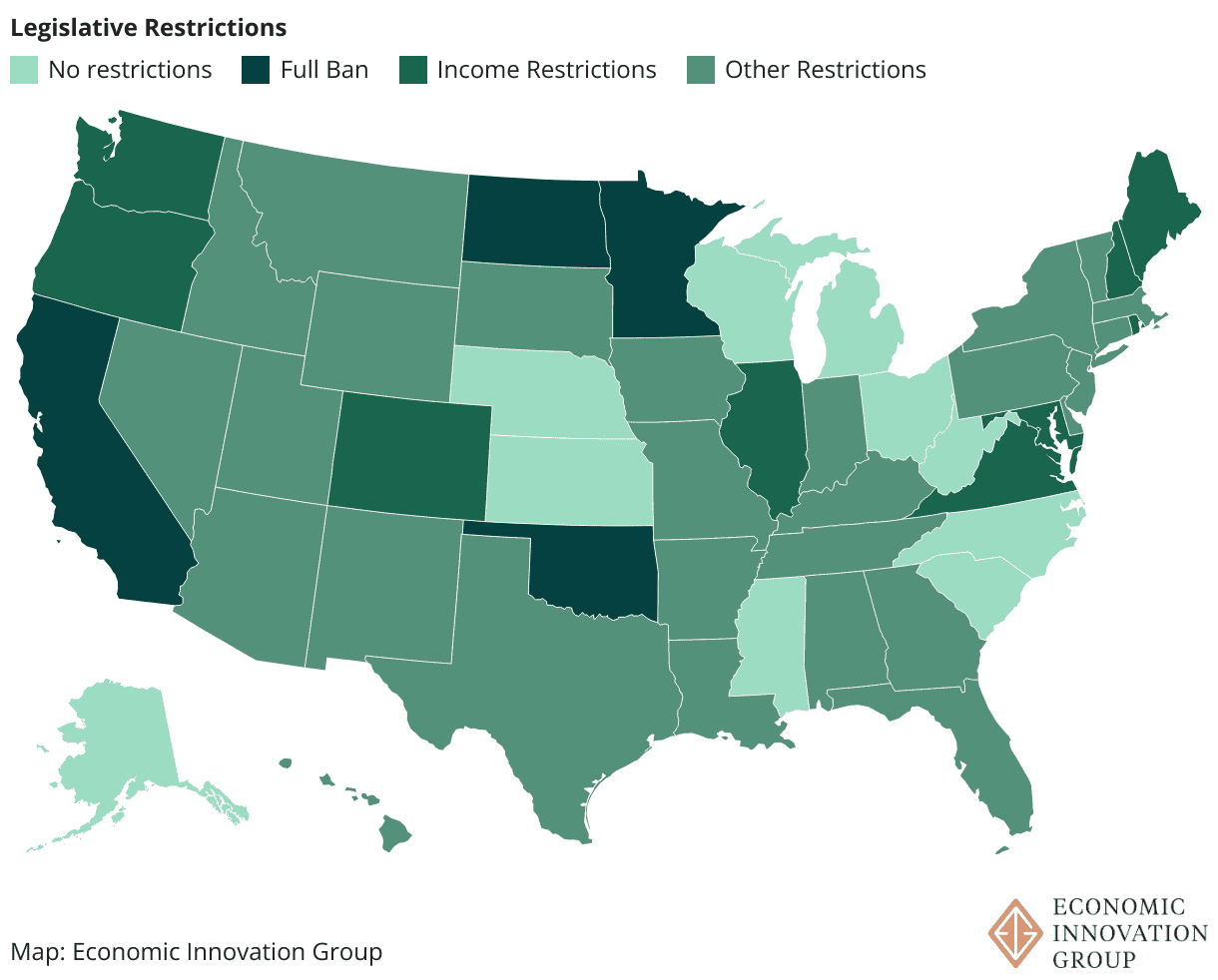
Historically, noncompete agreements have been regulated at the state level. Data from the Economic Innovation Group show that four states – California, Minnesota, North Dakota, and Oklahoma – have a full ban on noncompete agreements, while 36 states and the District of Columbia have either income restrictions or other limits to noncompete agreements. Ten states, meanwhile, have no restrictions.[6]
III. Benefits and Drawbacks of Noncompete Agreements
An employment contract between an employer and an employee that includes a noncompete clause is often agreed upon in exchange for higher wages and better benefits for the employee. In return, the trade secrets and other investments made by the employer are protected.
There is, however, evidence that employers are abusing these agreements beyond their original intent of highly compensated C-suite executives. Studies show that noncompete agreements can stifle wages and limit job mobility. In addition, these agreements can harm employers by limiting the talent pool available for hire.[7],[8]
IV. Future Federal Enforcement: Limited to Antitrust Concerns
The use of noncompete agreements can help promote competition. They can, when used for legitimate business purposes, encourage investment in employees, lower turnover, increase returns to research and development, and can be used as negotiating leverage for the employee to earn a higher salary and better benefits.
If, however, contracts go beyond this scope and result in anticompetitive harm, the FTC should take enforcement action. The agency should maintain its case-by-case approach by applying the rule of reason analysis.
This method was applied in an enforcement action and simultaneous proposed consent order against Gateway Pet Memorial Services. The FTC alleged that almost all the company’s employees were subject to noncompete agreements that prohibited them from working in the pet cremation service industry anywhere in the United States for one year after the termination of their employment. The agency claimed that these noncompete agreements were applied “without any individualized consideration” of the employees work and covered highly compensated executives and hourly workers, including facility-level laborers, and customer service representatives. The consent agreement limited future noncompete agreements to specific employees with whom noncompete agreements were necessary to protect legitimate business interests.[9]
FTC Chair Andrew Ferguson and Commissioner Melissa Holyoak in a statement on the matter of Gateway Pet Memorial Services explained that “enforcement actions, including consent agreements, have a much wider effect than just on the direct subjects of those actions. They set forth, one reasoned decision at a time, the Commission’s view of what circumstances make a particular practice lawful or unlawful under Section 5 of the FTC Act.” They added that “a steady stream of enforcement actions against an unlawful practice provides the markets with transparency about what the agency believes the law requires.”[10]
V. Conclusion
The FTC has the authority – and mandate – under Section 5 of the FTC Act to take enforcement actions against anticompetitive noncompete agreements. The agency should, however, limit its role to only issues of competition and continue its case-by-case approach to enforcement.
[1] Fred Ashton is the Director of Competition Policy at the American Action Forum. These comments represent the views of Fred Ashton and not the views of the American Action Forum, which takes no formal positions as an organization.
[2] “Federal Trade Commission Issues Request for Information on Employee Noncompete Agreements (September 4, 2025),” https://www.ftc.gov/news-events/news/press-releases/2025/09/federal-trade-commission-issues-request-information-employee-noncompete-agreements
[3] “Noncompete Agreements: Have Employers Gone Too Far? (October 20, 2022),” https://www.americanactionforum.org/insight/noncompete-agreements-have-employers-gone-too-far/
[4] “FTC Proposes Rule to Ban Noncompete Clauses, Which Hurt Workers and Harm Competition (January 5, 2023),” https://www.ftc.gov/news-events/news/press-releases/2023/01/ftc-proposes-rule-ban-noncompete-clauses-which-hurt-workers-harm-competition?utm_campaign=ftc_proposes_rule_to_ban_&utm_content=1672930998&utm_medium=social&utm_source=twitter
[5] “FTC Announces Rule Banning Noncompetes (April 23, 2024),” https://www.ftc.gov/system/files/ftc_gov/pdf/noncompete-rule.pdf
[6] “State Noncompete Law Tracker (September 9, 2025),” https://eig.org/state-noncompete-map/
[7]“Non-compete contracts sideline low-wage workers (October 15, 2021),” https://www.minneapolisfed.org/article/2021/non-compete-contracts-sideline-low-wage-workers;
[8] “Noncompete Agreements in the US Labor Force,” https://www.journals.uchicago.edu/doi/abs/10.1086/712206?journalCode=jle#:~:text=Noncompete%20agreements%20(often%20referred%20to,OE3%20in%20the%20Online%20Appendix).
[9] “FTC Takes Action to Protect Workers from Noncompete Agreements (September 4, 2025),” https://www.ftc.gov/news-events/news/press-releases/2025/09/ftc-takes-action-protect-workers-noncompete-agreements
[10] “Statement of Chairman Andrew N. Ferguson Joined by Commissioner Melissa Holyoak In the Matter of Gateway Pet Memorial Services Matter Number 2210170 (September 4, 2025),” https://www.ftc.gov/system/files/ftc_gov/pdf/gateway-ferguson-holyoak-statement-2025.09.04.pdf

October 16, 2025
Comments for the Record
Comments for the Record: Draft FTC Strategic Plan FY 2026-2030
Fred Ashton
Comments of Frederick C. Ashton, Jr.[1] I. Introduction and Summary The Federal Trade Commission (FTC) issued a request for comment on the agency’s…