The Daily Dish
June 12, 2026
Deregulation and the SEC
Deregulation is a signature initiative of the Trump Administration (best followed by subscribing to the Week in Regulation.) The public relations line associated with this effort is the president’s “one in, ten out” pledge to eliminate 10 regulations for every new one. At a mechanical level, the approach is to give each agency a regulatory budget – the dollars of new regulatory burden the agency is permitted to impose on the private sector – and to have those budgets be zero or negative numbers.
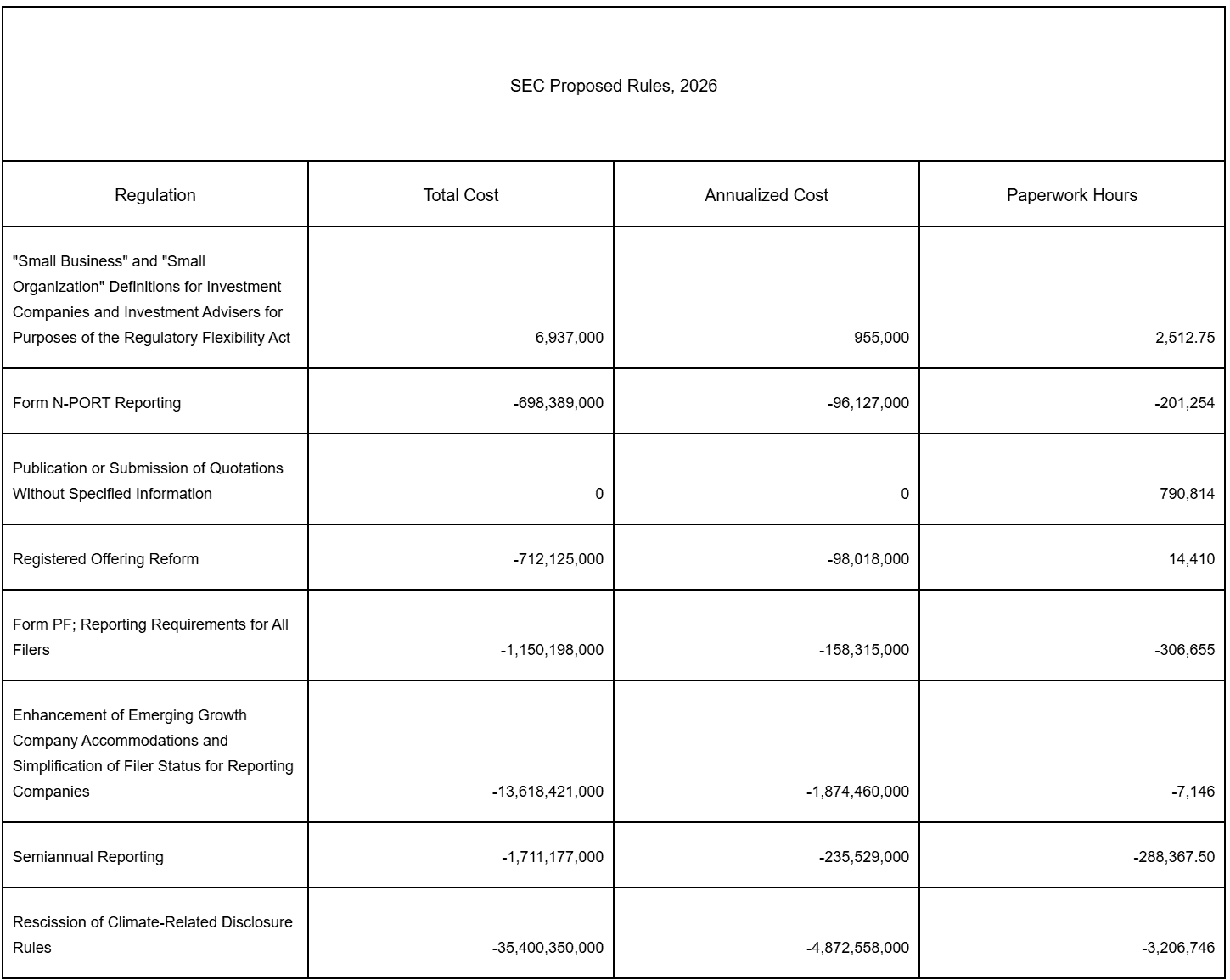
While the overall effort has been a mixed success thus far, there have been some notable deregulatory actions. The Securities and Exchange Commission (SEC) recently received a lot of attention for its proposed rescission of climate-related disclosure requirements. This is shown in the last row of the table (below) that documents all of the SEC proposed rules in 2026. (These are taken from AAF’s Regulation Rodeo.)
As one can see, the SEC did propose a costly rule, but the bulk of its activity thus far this year has been deregulatory. Indeed, the remainder are broadly focused on reducing the regulatory burden on smaller firms by extending the time that newly listed firms receive preferential treatment, raising the limit on capitalization for preferential treatment, lower reporting requirements (semi-annual versus quarterly) and so forth. These are not deregulation for the sake of deregulation. They are a focused effort at increasing the number of firms that are publicly traded.
The number of publicly traded firms peaked at roughly 8,000 in 1996 and now hovers at or below one-half of that number. Is that a problem? For firms, going public permits them to tap into extremely large amounts of capital to finance investments and operations. Making it too costly to be a public firm, then, may inefficiently limit the amount of capital at their disposal. For shareholders, information about public companies is easily available and verified. Small-dollar investors are able to make investments in large, profitable enterprises and market valuations are readily available. If the regulatory apparatus can be made less costly, overall economic efficiency is enhanced.
In sum, it is nice to make the government smaller and less burdensome. It is even better if this is in pursuit of better economic policy as well.
Fact of the Day
Since the start of 2026, the federal government has published $989.6 billion in total regulatory net cost savings and 106.9 million hours of net annual paperwork increases.