The Daily Dish
July 8, 2026
Expected Inflation Drifts Up
Yesterday the Federal Reserve Bank of New York released its latest monthly Survey of Consumer Expectations, including inflation expectations — a crucial part of inflation and disinflation dynamics. For example, if people confuse a one-time increase in the cost of an item (e.g., a tariff) with ongoing price increases (i.e., inflation), they will behave as if facing inflation. They will ask for wage increases that compensate for future increases of the same size, even though they are not actually forthcoming. What happens? The upward pressure on wages turns into more upward pressure on prices. Voila! The consumer was right — prices continued to rise and are now expected to rise further. Expectations transform a one-time event into sustained inflation.
Because recent economic events — tariffs and the war in Iran, in particular — have a heavy one-time component, inflation expectations are especially important at the moment. Hence, it was disappointing for the New York Fed to conclude:
Median inflation expectations at the one-year-ahead horizon increased by 0.2 percentage point to 3.7% in June, the highest level since September 2023. They also increased by 0.2 percentage point to 3.3% at the three-year horizon, the highest level since June 2022.
Not good. First of all, the Fed’s target is 2.0 percent, and the public is expecting 50 percent more than that. Not good. Second, it turns out that June 2022 was the high point of the recent inflation, with year-over-year inflation peaking at 9.1 percent. Anything reminiscent of 2022 is not good.
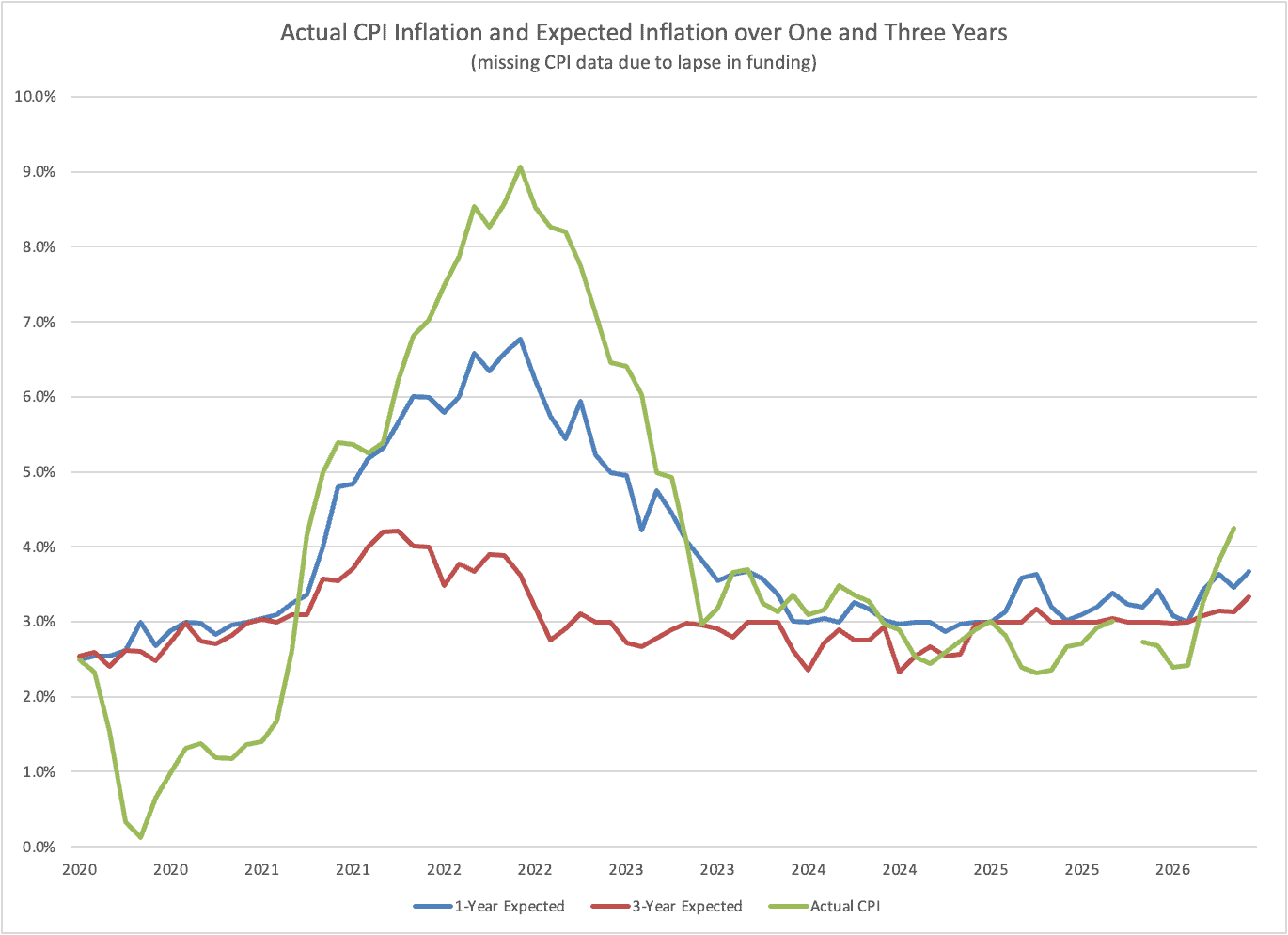
As one can see in the graph, below, inflation expectations at both the one- and three-year horizons chased actual inflation north over the 2021—2022 period. While these expectations ultimately settled, they did so at roughly 3 percent — not 2 percent — and are now headed north again.
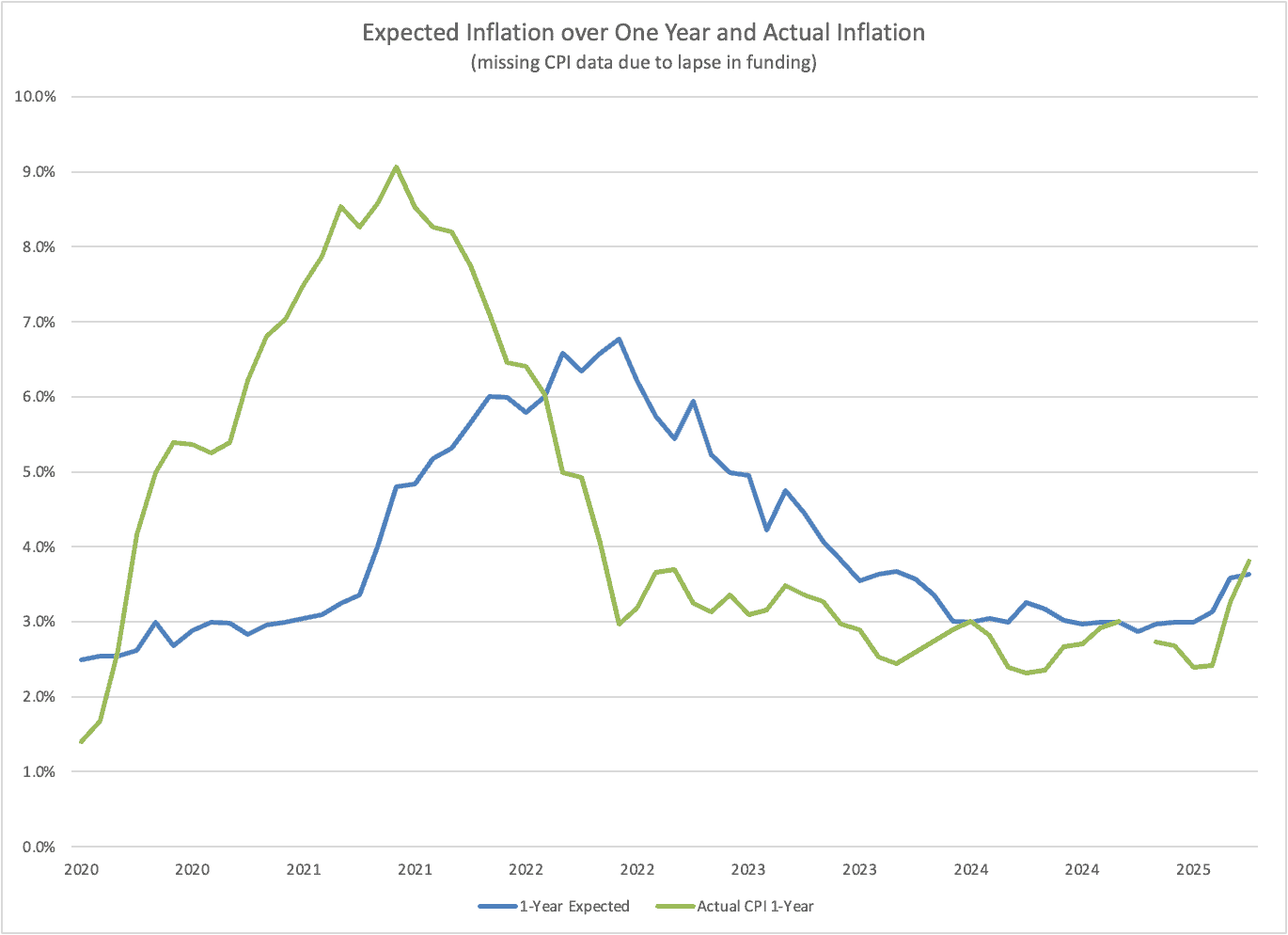
Does that mean we are doomed to higher inflation a year from now? In the graph, below, the blue line is one-year expected inflation. The green line is the actual inflation that occurred over that year. As is clear, inflation initially came in much higher than expected. This quickly reversed and inflation has come in at or below expectations — until the past year, when it picked up and matched expected inflation. You decide what happens next.
If inflation is ever to return to the two-percent target, this is a crucial period. And inflation expectations will have a lot to do with how it plays out.