The Daily Dish
April 24, 2026
Is This a Manufacturing Renaissance?
Yesterday’s addition to the White House website (hat tip to Dan Goldbeck) was: Trump Effect: American Manufacturing Is Roaring Back as Factory Activity Hits Four-Year High. Ok. But Eakinomics could not shake the famous ode to presidential exaggeration:
There once was a president with bright hair
Who sold success with hot air
But this was just version beta
Because the actual data
Showed there was no there there
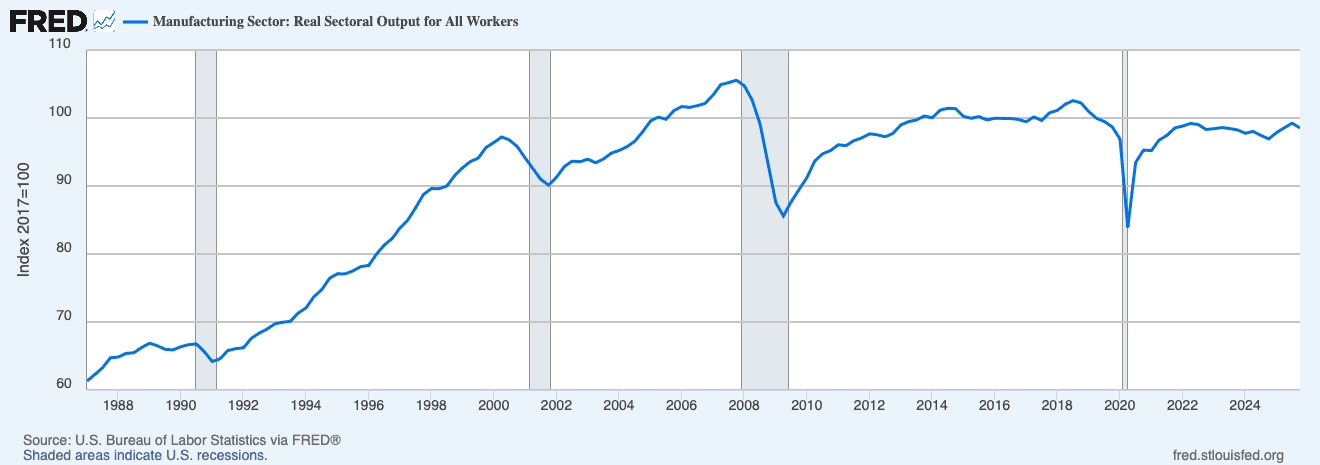
So off Eakonomics (virtually) went for a visit to FRED and a review of the facts. The first is total production (“real sectoral output”) of manufacturers, which remains below the 2017 level and was headed south at the end of 2025.
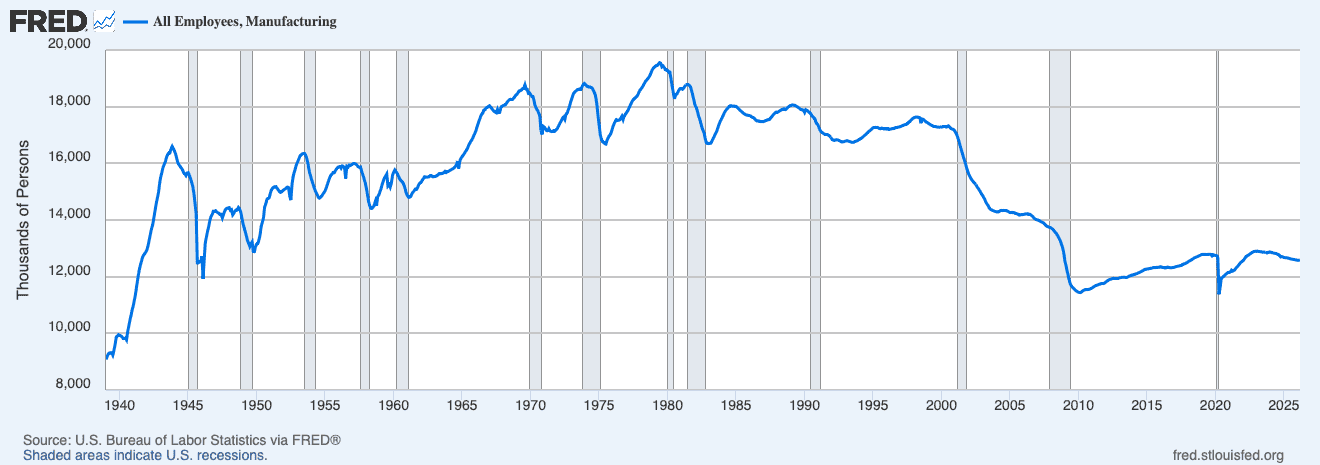
The second is employment in manufacturing. As is well known, manufacturing sector employment is a bit above one-half of its peak, has been in the vicinity of 12 million since the Great Recession, and was also shrinking at the end of 2025.
How can the president’s facts say that factory activity has hit a four-year high? Specifically, it cites:
The Institute for Supply Management’s key manufacturing index — which tracks factory activity across the country — registered the sector’s third straight month of expansion for its highest reading since 2022.
Notice that the “third straight month” is the first quarter of 2026, while the output and employment data are only through the end of 2025. But the data in the Institute for Supply Management report are a diffusion index. A diffusion index summarizes information on the percent of respondents expanding, contracting, or staying unchanged. It does not have any information on how much it is expanding or contracting. To learn that, one must wait for the quarterly data in 2026, which will be released next week.
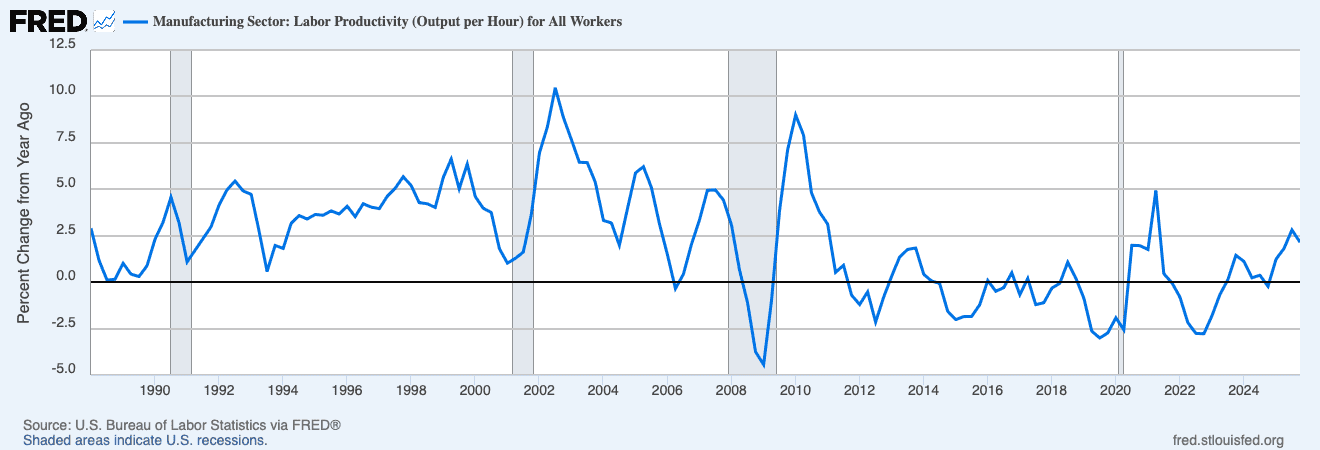
This is a classic example of premature overreach in an effort to demonstrate success. The manufacturing productivity data have shown some promising growth in the past year (year-over-year labor productivity growth is shown below) and any expansion of domestic manufacturing facilities will take years. So there is a chance one will look back and see this as the start of a manufacturing boom. But that is hardly guaranteed.
Fact of the Day
Since the start of 2026, the federal government has published $931.8 billion in total regulatory net cost savings and 37.6 million hours of net annual paperwork increases.