The Daily Dish
March 24, 2026
Lessons From the Laboratories of Democracy
The notion that states are laboratories of democracy is a concept proposed by Supreme Court Justice Louis Brandeis. The freedom to choose spending, tax, regulatory, and other policies is central to the U.S. system. Yet not all experiments are created equal; some just blow up. With that in mind, the table below shows population growth (ranked by percentage growth) over the 2020–2025 period. The left panel shows the five states with the most rapid growth, while the right panel shows the five with the slowest growth. In those cases, slow means that people are fleeing to the exits.
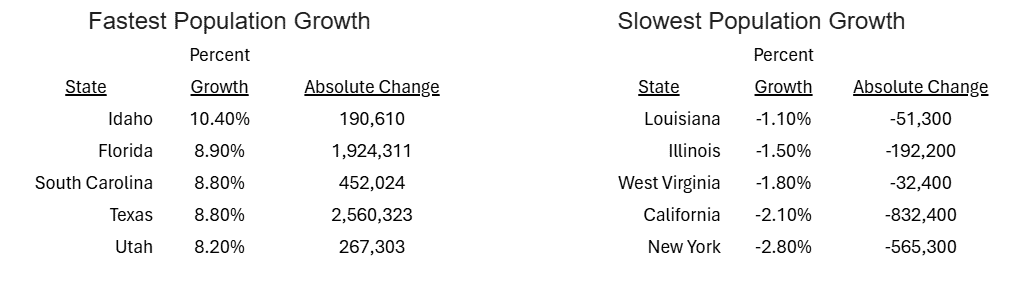
Conspicuous among the losers are Illinois, California, and New York – a trifecta of big government, big government spending, and high taxes. Illinois has a notoriously generous – and underfunded – state pension system that is the promise of higher taxes in the future. In 2026, California has the Billionaire Tax Act – a ballot initiative that, if adopted, would impose a one-time (“honest, really”) 5-percent tax on the net worth of residents with assets exceeding $1 billion. New York City Mayor Zohran Mamdani has proposed a dramatic increase in the state estate tax, along with other tax-and-spend gems.
All of this has driven New York Governor Kathy Hochul to despair. As reported by Yahoo News:
During remarks at Politico’s “New York Agenda: Albany Summit” event last week, the Democratic governor explained that she needs individuals with a “high net worth to support the generous social programs that we wanna have in our state.”
She highlighted the issue by suggesting that wealthy individuals should visit Palm Beach, Florida, to “see who you can bring back home, because our tax base has been eroded.”
Who benefits from these aggressive tax schemes? Certainly not the states, and especially not the average Jane in those states. As you can see, the left panel of the table contains the real beneficiaries – especially Texas and Florida. Indeed, Eakinomics used to joke that all California public policy was designed to build a better Utah. It now looks too close to reality to be funny!
The notion of the states as economic competitors is as old as the United States itself. And Eakinomics feels that if Illinois, California, and New York want to empty themselves of commerce, jobs, and workers, they have that right. But there has been a recent undeserving victim of this phenomenon: U.S. trade policies.
When those jobs go away, politicians have been unwilling to look in the mirror. Instead, they have pointed the finger overseas and asserted that trade is bad for Americans and at fault for job loss. Trade gets blamed for fewer manufacturing workers, but the reality is that the Rust Belt simply relocated to the right-to-work, cheaper energy, U.S. southern states.
Maybe it is time for some policymakers to learn the lessons of previous experiments before launching a dangerous new set of initiatives.
Fact of the Day
Across all rulemakings last week, federal agencies published roughly $402 million in total cost savings but added 735,809 paperwork burden hours.