The Daily Dish
March 26, 2025
Reindustrialize the Midwest?
The Trump Administration touts its economic programs, especially the tariff walls it is planning to erect, as a means to bring manufacturing and factories back to the United States – and in particular the Midwest. The Associated Press recounts of Vice President Vance’s visit to Bay City, Michigan:
Speaking at Vantage Plastics, [Vance] vowed, “We started a great American comeback,” and said the Trump administration will “make it easier and more affordable to make things again in the United States.”
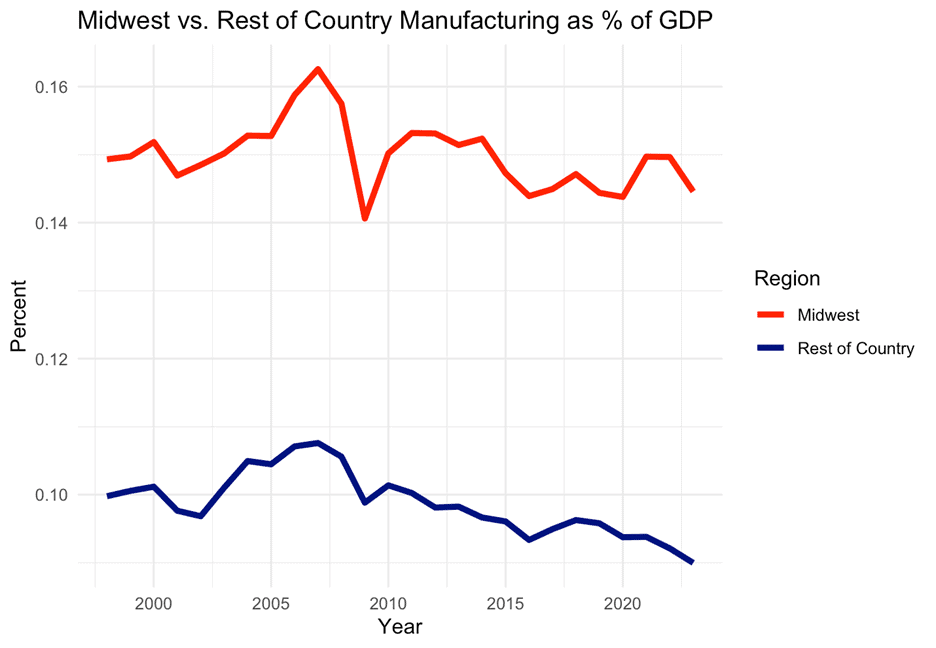
Has the Midwest de-industrialized? To get a feel for the issue, consider the graph below. It shows the fraction of gross state product (GSP) originating in manufacturing in the Midwest states versus the remainder of the country. (The Midwest Census region consists of Illinois, Indiana, Michigan, Ohio, Wisconsin, Iowa, Kansas, Minnesota, Missouri, Nebraska, North Dakota, and South Dakota.)
As the two lines indicate, the Midwest is more manufacturing intensive than the rest of the country. But there is precious little evidence of de-industrialization since 1978. If anything, the manufacturing intensity of the rest of the country has declined even more.
Of course, no politician worth her salt talks about shares of GSP. Jobs are the name of the game. But looking at manufacturing employment as a share of total state employment yields a very similar picture (below).
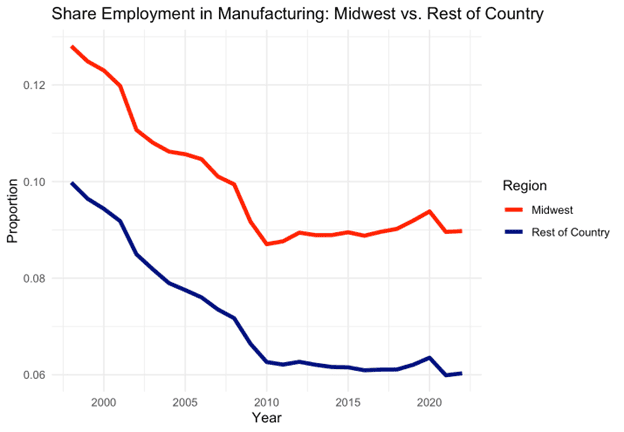
In short, there does not seem to be anything special about the Midwest region and patterns of manufacturing employment and output that the administration could possibly reverse.
There remains, of course, the conspicuous slide in the output and employment shares from 1998 to, roughly, 2010. Perhaps this is the target of the administration’s effort to usher in its Golden Age for the U.S. economy.
Maybe, but count Eakinomics skeptical.
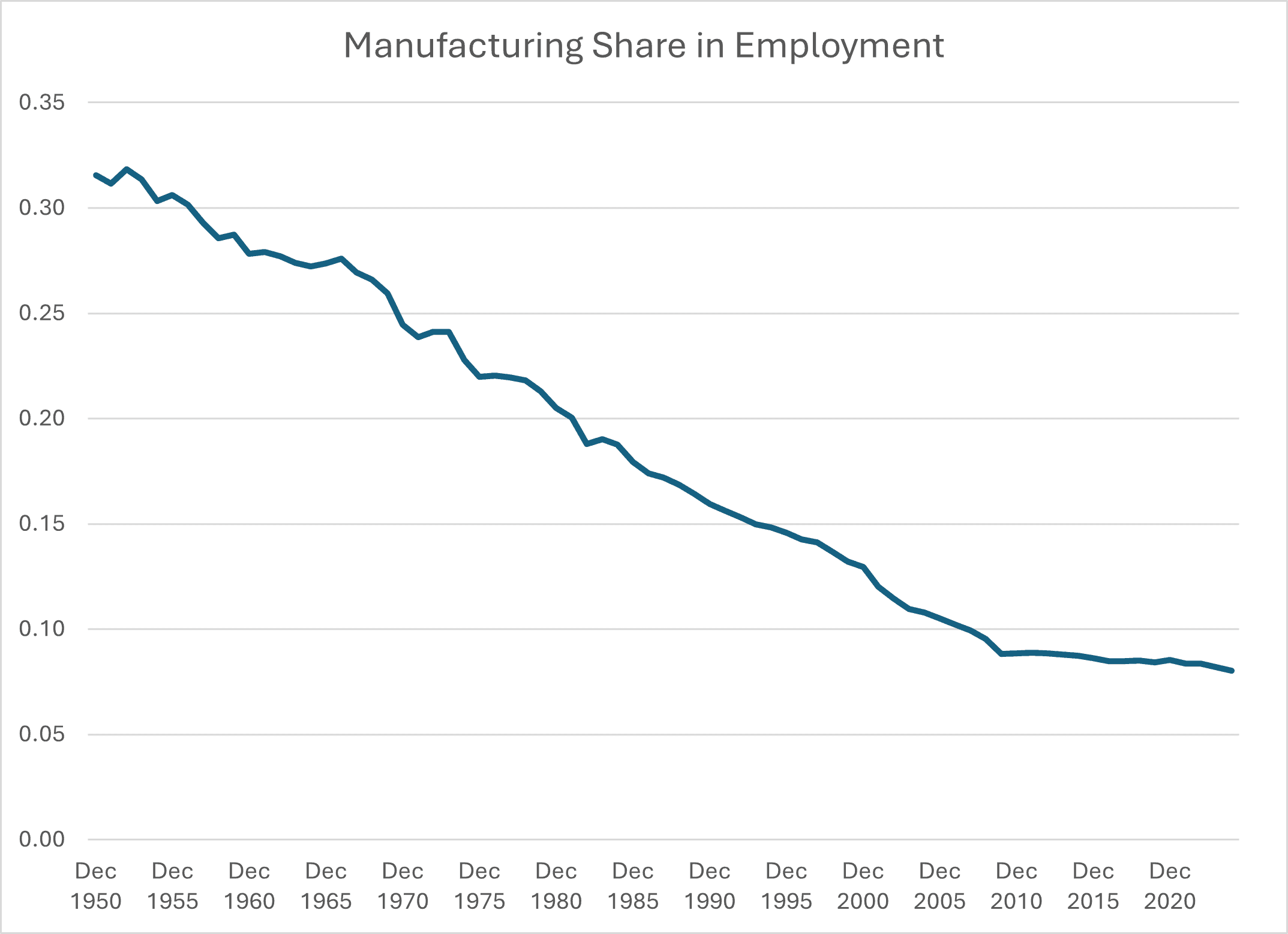
Looking at a longer time period beginning in 1950 and focusing on the economy as a whole, it is clear that manufacturing’s employment share has been experiencing a long, slow decline. (See below.) This has nothing to do with international trade, nothing to do with China, certainly nothing to do with Canada and Mexico, and nothing that will be reversed by the misdirected tariff policies of the administration.
It is time for the president to stop looking backward, inwardly, and fearfully. The U.S. should be equipping itself for the future, engaging with the global economy, and confident in its success. It needs a policy approach to match that task.
Fact of the Day
Kamala Harris' Medicare for All plan would increase federal spending by 43.9 trillion over the decade 2026–2035.