The Daily Dish
May 4, 2026
The Affordability Issue – An Employer View
Among the slew of data released last week was a Bureau of Labor Statistics update on the employment cost index. The data showed that for all civilian workers overall compensation costs rose 3.4 percent between the first quarter of 2025 and the first quarter of 2026. Similarly, wages and salaries rose at the same 3.4-percent rate, but benefit costs rose at a faster 3.6-percent pace.
Notice that all of these numbers were roughly equal to, or below, the prevailing rate of inflation (3.5 percent for the personal consumption expenditures price index). From the employer perspective, then, price increases are sufficient to cover compensation cost increases. But if you flip the perspective, the numbers suggest declining overall real compensation for workers, which makes it harder to afford their usual purchases.
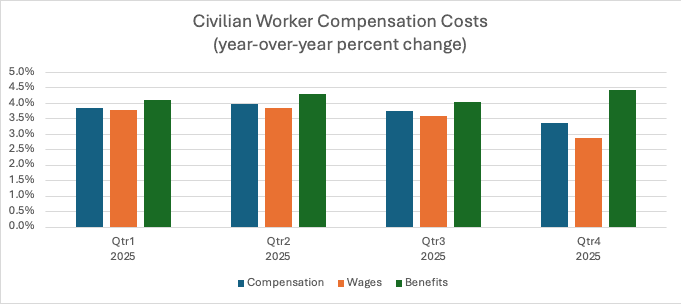
This continues a trend from 2025. Shown below are the year-over-year growth rates of compensation, wages, and benefits for each quarter in 2025. As one can see, for the first three quarters compensation and its components rose faster than inflation – good news for workers. In the fourth quarter, however, the pattern reversed, except for benefits. The growth of wages and salaries were noticeably slower and contributed to the perceived distress of households.
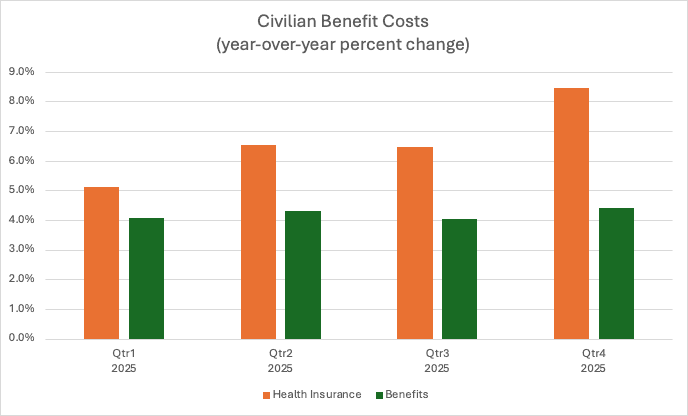
Why are benefits behaving so different? The answer is health insurance. Health insurance costs have skyrocketed for employers. Although the data for the first quarter of this year are not yet available, the chart below shows benefit costs overall as compared to health insurance costs. By the fourth quarter, the year-over-year growth in these costs was over 8 percent.
In the most recent data, the rising cost of gasoline is layered on top of these pressures. In the absence of some dramatic shift in these trends, get ready for an election season chock full of ads about gas and health care costs.
Fact of the Day
When complete, the IEEPA tariff refunds should include 330,000 importers, 53 million import entries, and more than $166 billion.