The Daily Dish
April 1, 2026
The FCC Turns to Sports
The days of three over-the-air broadcast channels are long gone, and with them the days of local, regional, and national sports being funneled to consumers as organized programs. Instead, sports viewers are faced with a welter of broadcast channels, cable TV, and streaming services. “What channel is the game on?” has turned into an essay question!
In this environment, the Federal Communications Commission (FCC) opened a request for comment: “The Media Bureau requests comments to evaluate the sports media marketplace and how changes have impacted broadcasters and consumers.” The issues raised include:
Request for Comment. Given the nexus between sports programming and the local media marketplace—as well as the FCC’s ongoing work to support local news and reporting—we believe it is important for us to evaluate the sports media landscape and understand how changes have impacted consumers and broadcasters. Accordingly, we seek comment on the following questions.
With respect to the sports media marketplace, how have recent developments in the marketplace affected the ability of broadcasters to obtain media rights to sports programming? How have changes in the marketplace affected viewers’ ability to watch nationally televised live sports, as well as their local team(s), on broadcast TV? What type of rights (e.g. exclusive, simulcast, replay) are included in agreements between leagues or conferences and national video programming distributors? How prevalent are sports media rights deals between local TV broadcasters and local sports teams and what are their terms and conditions? How have changes in the marketplace impacted costs to consumers?
That’s the flavor of the request. The actual list of topics for inquiry is quite lengthy. It closes with:
In addition to these specific questions, we invite comment on any other matters that parties believe would help the Commission understand the current sports media marketplace, its legal authority, and what actions the FCC could take to ensure continued access by viewers to live sports through free over-the-air broadcast TV.
Those are difficult issues and Eakinomics doesn’t really know anything about sports (evidence: my NCAA bracket) or broadcast or cable or streaming. The only thing to note at the outset is that the FCC runs the risk of committing a major analytic error if it focuses on broadcasters. Of course, that is its turf. But the focus should always be on consumers and not any one of the competitor suppliers.
Beyond that, Eakinomics doesn’t have to do any real thinking. Instead, AAF’s Angela Luna has provided a nice tour of the issues in her latest insight, Sports Broadcasting: Market Shifts and Policy Questions. The lay of the viewership land is summarized in this graphic.
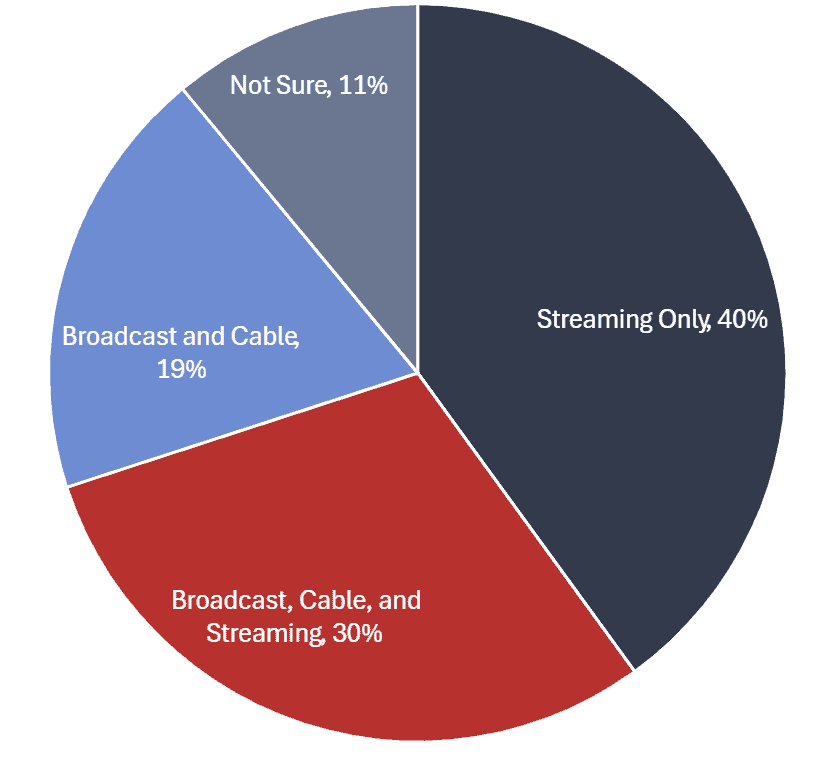
She then notes that in this environment, the rights to sports are increasingly valuable, and increasingly fragmented.
The National Football League (NFL) exemplifies how leagues are selling their rights. As shown in Figure 2, in 2025, the NFL sold its media rights across seven deals, with pure streaming services such as Amazon, YouTube TV, and Netflix accounting for 25 percent of the NFL’s broadcast revenue. Also, the NFL divided its games across platforms by time slot and exclusivity, for example, Sunday night on NBC, Monday night on ESPN, Thursday night on Amazon, and select games exclusively on streaming services such as two Christmas games on Netflix.
Congress could step in to reduce the fragmentation, or it could leave it to the FCC to undertake a rulemaking. Luna’s suggeston: neither. She concludes: “A review of the market suggests that the shift is not inherently harmful or beneficial, but rather a response to consumer preferences and technological change.”
Exactly.
Fact of the Day
As of March 25, the Fed’s assets stood at $6.7 trillion.