The Daily Dish
May 29, 2026
The Fed’s Problem
The Fed – technically the Federal Reserve Board’s Open Market Committee – has a problem: inflation. Yes, it is true that the Fed has a dual mandate for full employment and price stability. But the reality is that the combination of AI-related infrastructure spending and defense spending to replace depleted munitions will keep the economic growth rate above zero. And will happen even if interest rates rise. So if the Fed chooses to focus on the inflation mandate, it does not have to worry (much) about the employment side of the mandate.
And it should focus on inflation. Yesterday the Bureau of Economic Analysis released the April data on the personal consumption expenditures (PCE) price indices. These are the Fed’s preferred measures of inflation because they are constructed using the actual pattern of purchases currently in the economy. The Consumer Price Index, in contrast, measures the inflation in a fixed basket of goods and services.
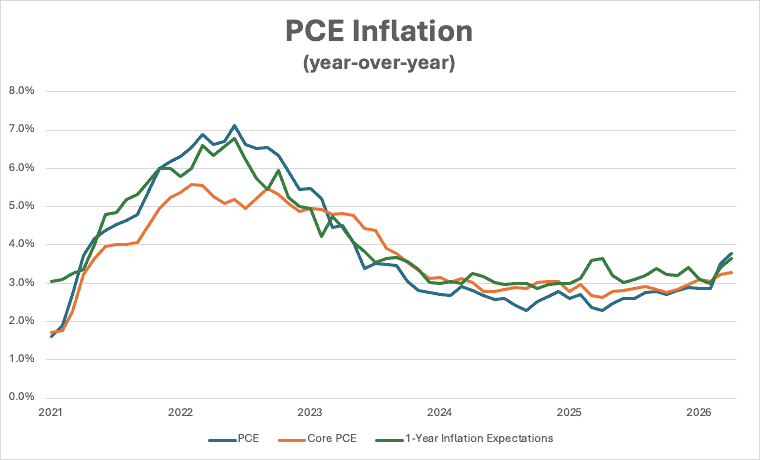
Inflation was expected to be hot and it did not disappoint. At an annual rate, PCE inflation in April was 4.9 percent. Over the past year it was 3.8 percent, while core (non-food, non-energy) PCE inflation was 3.3 percent. The latter is a hint that the inflation problem is not just the war with Iran and global oil prices.
Indeed, the chart (below) traces PCE (blue) and core PCE (orange) inflation from 2021 to the present. After peaking in 2022, both measures of inflation have declined. But they have never even flirted with the 2-percent target, especially the core PCE inflation rate. This measure is the best predictor of future inflation and until the recent resurgence, had seemingly settled at about 3 percent.
The final (green) series depicted is the expected inflation 1 year ahead, as measured by the survey of the New York Fed. It, also, has never flirted with 2 percent. At best, consumers expected a 3-percent inflation rate and recently that has gone up as well.
So, to be precise, the Fed has an inflation credibility problem. Unless and until it reaches the 2-percent target, nobody believes that it will.
Fact of the Day
Since the start of 2026, the federal government has published $972.2 billion in total regulatory net cost savings and 56.4 million hours of net annual paperwork increases.