The Daily Dish
February 3, 2025
Trump Deregulation, Take Two
Yes, there is a little issue of tariffs. Okay, it would be nice to figure out exactly what Elon Musk and the Department of Government Efficiency are actually up to. But the big story got buried on Friday night when the White House announced: “PRESIDENT DONALD J. TRUMP LAUNCHES MASSIVE 10-TO-1 DEREGULATION INITIATIVE.” Among the scant details are:
- The Order requires that whenever an agency promulgates a new rule, regulation, or guidance, it must identify at least 10 existing rules, regulations, or guidance documents to be repealed.
- The Director of the Office of Management and Budget will ensure standardized measurement and estimation of regulatory costs.
- It requires that for fiscal year 2025, the total incremental cost of all new regulations, including repealed regulations, be significantly less than zero.
Putting the Office of Management and Budget (OMB) in charge of standards for regulatory costs is nothing new. Getting rid of 10 regulations for each new rulemaking is a significant increase in the target used in Trump’s first presidency, where the standard was “one in and two out.” But the real meat of the order is that the regulatory burden in fiscal 2025 “be significantly less than zero.” This is a challenge.
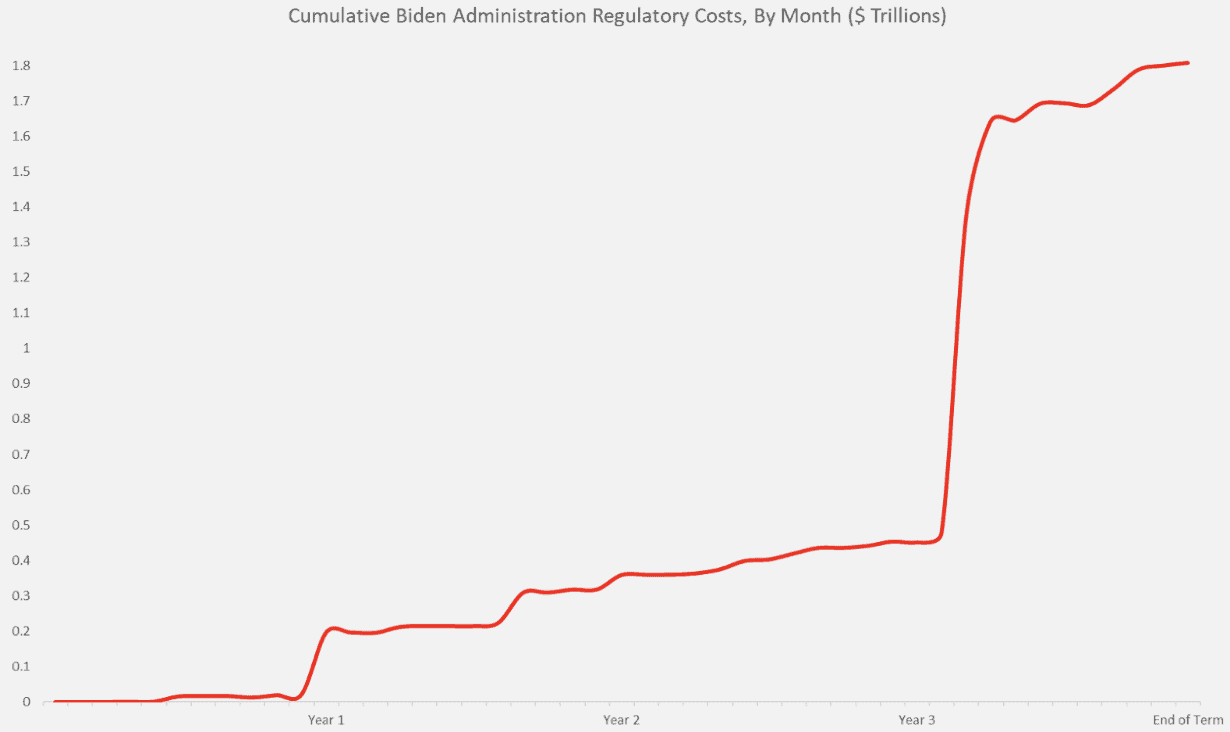
In his recent review of the Biden regulatory record, Dan Goldbeck included this chart (below) on the cumulative regulatory cost. Notice that it is still rising toward the end of his term, which happens to include months after the October 1 start of fiscal 2025. The Trump Administration will have to reverse those costs in addition to any rulemakings of its own to come in below zero for the year.
Hopefully additional details will be forthcoming regarding the mechanics of how the regulatory restraint will be imposed on the agencies. The previous Trump term used regulatory budgets imposed by OMB; one suspects another such effort over the next four years.
These details matter as regulatory restraint is a centerpiece of the administration’s economic policy. It is counting on this strategy to encourage the entry of new businesses, enhance competition, reduce costs, and lower upward pressure on prices.
Fact of the Day
Mexico, Canada, and China represent the United States’ top three trade partners, accounting for roughly 43 percent of all U.S. imports.