









Insight
April 10, 2025
Trump’s Coal Executive Orders: Overview and Implications
Executive Summary
- President Trump signed several executive orders (EOs) on April 8, 2025, intended to significantly boost U.S. production of “beautiful, clean” coal to align with the administration’s energy independence agenda.
- The EOs include numerous provisions to lift environmental regulations and provide targeted support for domestic coal production.
- The EOs are unlikely to reverse the declining trajectory of U.S. coal production due to escalating mining costs, competition from other energy sources, and potentially substantial legal challenges to the administration’s attempt to repeal the regulations.
Introduction
President Trump signed several executive orders (EOs) on April 8, 2025, intended to significantly boost U.S. coal production to “secure America’s economic prosperity and national security, lower the cost of living, and provide for increases in electrical demand from emerging technologies.”
The EOs include numerous provisions to lift environmental regulations including removing barriers to coal mining on federal lands. The orders also provide targeted support for domestic coal production including directing the Department of Energy to utilize all possible funding mechanisms to boost the industry.
The EOs are unlikely to reverse the declining trajectory of U.S. coal production due to escalating mining costs, competition from other energy sources, and likely legal challenges to administration’s repeal of the regulations.
Overview of the Executive Orders on Coal
President Trump signed three executive orders on April 8, 2025, to support U.S. coal production.
“Reinvigorating America’s Beautiful Clean Coal Industry and Amending Executive Order 14241”
This EO states that “We must encourage and support our Nation’s coal industry” to “secure America’s economic prosperity and national security, lower the cost of living, and provide for increases in electrical demand from emerging technologies.”
It includes the following categories of action items:
Deregulation
- Coal designated as a “mineral”: Directs the chair of the National Energy Dominance Council (a new entity created under the Trump Administration) to designate coal as a “mineral” under the EO released in March, “Immediate Measures to Increase Measures to Increase American Mineral Production,” to expedite permitting and production of coal.
- Easing environmental regulations: Directs several agencies to identify, revise, or rescind “any policies or regulations seeking to or that actually discourage investment in coal production and coal-fired electricity generation,” and applies the National Environmental Policy Act’s categorical exclusions (CEs) to coal to expedite the permitting process. CEs are defined as actions that a federal agency deems to “not significantly affect the quality of the human environment.”
- Production on federal lands: Directs several agencies to assess coal resources and accessibility and lift barriers to coal mining on federal lands.
Favorable treatment
The EO also includes several provisions that direct agencies, including the Department of Energy, to utilize “all available funding mechanisms” to support coal technology development, identify regions where coal plants can support AI data centers, and requests that the secretary of energy determine whether coal should be considered a “critical material” for steel production.
“Regulatory Relief for Certain Stationary Sources to Promote American Energy”
This EO is intended to provide relief for coal production from “severe burdens” posed by an Environmental Protection Agency rule. It would exempt coal-fired power plants for two years from a final rule, published under the Biden Administration in 2024, titled “National Emissions Standards for Hazardous Air Pollutants: Coal-and Oil-Fired Electric Utility Steam Generating Units Review of the Residual Risk and Technology Review,” which made the preexisting “Mercury and Air Toxics Standards” rule more stringent.
Specifically, the EO mandates that coal-fired plants would be exempt from compliance with the 2024 final rule from July 2027 to July 2029.
“Protecting American Energy from State Overreach”
This EO directs the U.S. attorney general to identify all state and local laws that are intended to “address ‘climate change’ or involving ‘environmental, social, and governance’ initiatives, ‘environmental justice,’ carbon or ‘greenhouse gas’ emissions, and funds to collect carbon penalties or carbon taxes” and “expeditiously take all appropriate action to stop the enforcement of State laws.”
The EO is intended to boost domestic energy production, including coal, through “the removal of all illegitimate impediments to the identification, development, siting, production, investment in, or use of domestic energy resources.”
Analysis
President Trump’s EOs are unlikely to reverse the declining trajectory of U.S. coal production despite the numerous provisions to lift environmental regulations and provide favorable treatment to the industry.
Coal accounted for 9 percent of U.S. total energy consumption in 2023, compared to petroleum and natural gas (74 percent), nuclear (9 percent), and renewable energy (9 percent).
As shown in the chart below, U.S. total consumption of coal has declined over the past two decades. U.S. electricity generated by coal peaked in 2011 at 317,600 megawatts (MW) and has since been declining consistently by about 10,000 MW of capacity reduction annually.
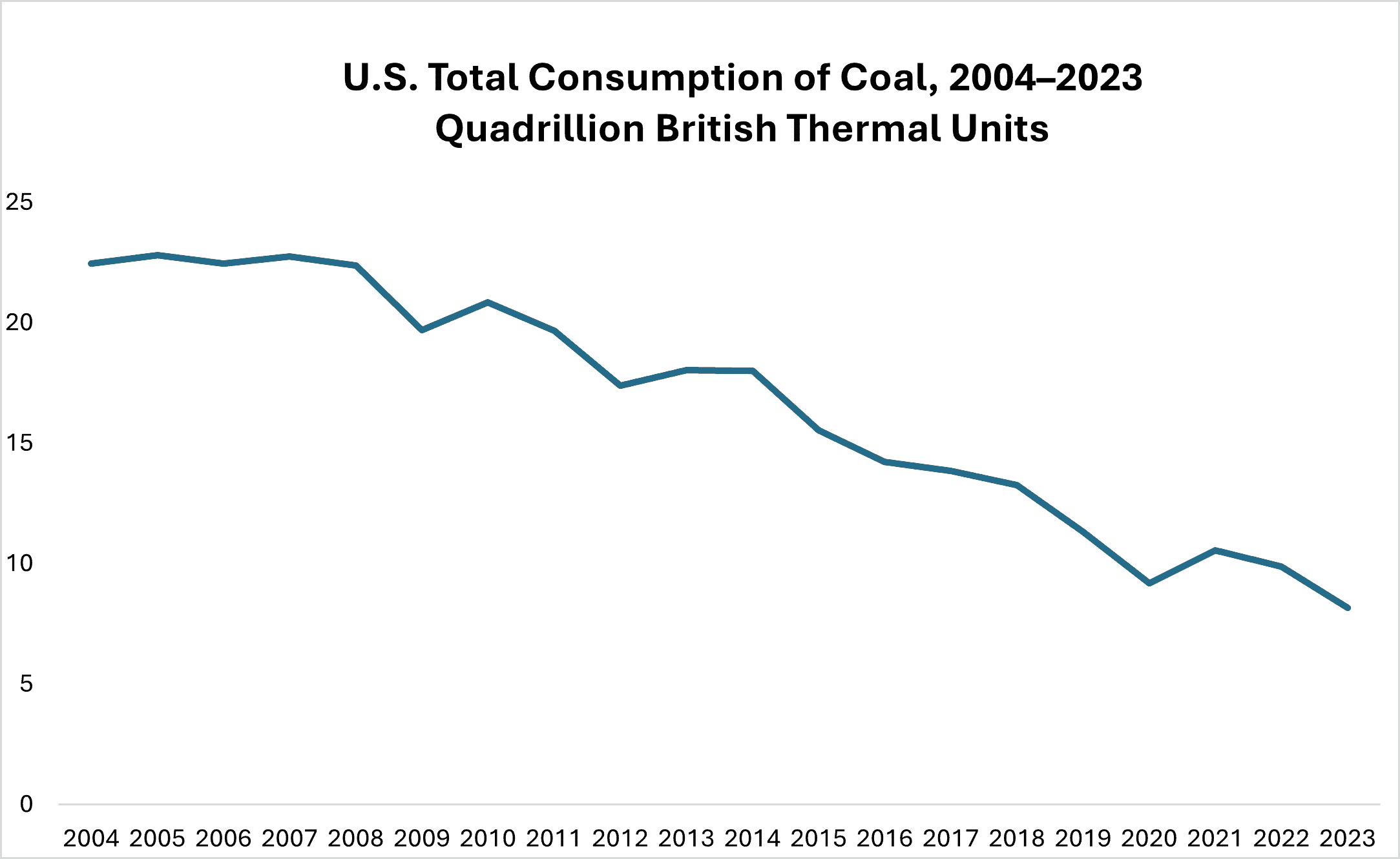
Source: Energy Information Administration
The United States has been transitioning away from coal and toward other baseload power sources such as natural gas, as it is no longer economically viable to operate many coal plants due to escalating mining costs, more stringent environmental regulations, and competition from other energy sources. Coal production is more carbon-intensive than other energy sources such as natural gas, which has become abundant and inexpensive since the shale boom.
As of May 2024, 30 percent of U.S. coal-fired power plants had already announced plans to close within the next 15 years. It’s been more than a decade since a big coal plant was built in the country.
Even with the soaring energy demand for powering data centers, the EOs may at best extend the existing coal plants’ operation timeline. They would not motivate utilities to invest in new coal production capacity simply because there is not an economic case for it.
Additionally, President Trump’s efforts to roll back relevant environmental regulations would certainly be subject to legal challenges filed by public and private entities, which would further worsen the investment environment for coal with increasing policy uncertainty.
