Research
January 21, 2026
A Semi-semiconductor Tariff
Executive Summary
- On January 15, President Trump’s 25-percent tariff on semiconductor imports went into effect; the tariff is intended to promote national security and domestic supply chains.
- At face value, this tariff impacts roughly $240 billion worth of U.S. imports, raising U.S. consumer and business costs by an estimated $31 billion.
- In reality, this tariff loses much of its potency due to the numerous tariff exemptions embedded within the executive order as well as the various trade agreements that place a cap on tariff rates, meaning tariff costs may sit as low as about $4 billion annually.
Introduction
On January 15, President Trump’s 25-percent tariff on semiconductor imports went into effect. The tariff is intended to promote national security and domestic supply chains. At face value, this tariff impacts roughly $240 billion worth of U.S. imports, raising U.S. consumer and business costs by an estimated $31 billion.
In reality, this tariff loses much of its potency due to the numerous tariff exemptions embedded within the executive order as well as the various trade agreements that place a cap on tariff rates, meaning tariff costs may sit as low as about $4 billion annually.
What Is the Tariff?
Unlike President Trump’s “Liberation Day” tariffs imposed via the International Emergency Economic Powers Act (IEEPA), the recent semiconductor tariff was implemented via Section 232 of the Trade Expansion Act of 1962 – a presidential trade authority used for national security concerns. Section 232 has historical and legal precedents as it has been used numerous times and there is a formal investigation process that occurs before trade restrictions go into effect. The investigation into semiconductor imports was first initiated back on April 1, 2025, although President Trump repeatedly threatened a tariff as high as 100 percent for months before and after the official investigation began.
What Is the Economic Impact?
This research estimates that after factoring in various offsets, trade deals, and exemptions, a 25-percent semiconductor tariff could raise costs by $4 billion in a high-exemption scenario to as much as $8 billion in a low-exemption scenario. In a medium-exemption scenario, this tariff could raise U.S. consumer and business costs by roughly $6.5 billion annualized.
Between January and October of 2025, the United States imported just over $200 billion worth of semiconductors and related components with an average tariff rate of roughly 0.7 percent. Based on this trend, this research estimates total 2025 semiconductor imports to have been around $241 billion. A straight 25-percent tariff would raise costs for U.S. consumers and businesses by nearly $31 billion when factoring in various offsets. This estimate, however, fails to consider the numerous country-based tariff exemptions and trade deals that cap the tariff rate on semiconductors. Trade deals with the European Union, South Korea, Japan, and Switzerland set a 15-percent tariff rate cap while the recent trade and investment deal with Taiwan puts a tariff-rate quota in place. This means that a significant portion of semiconductor imports from Taiwan will enter tariff-free and face a “preferential Section 232 rate” going forward, likely lower than 15 percent. Additionally, imports that are compliant with the United States-Mexico-Canada Agreement (USMCA) enter tariff-free, representing 80–90 percent of imports from Mexico and Canada.
The various tariff cost estimates are displayed in Figure 1 with their respective effective tariff rate estimates, which would be in addition to any tariffs currently in place. As the cost estimates decrease, this research assumes that the Trump Administration honors trade deal tariff caps as well as a roughly 85 percent USMCA compliance rate. In regard to the Taiwan trade deal, this research assumes that 50 percent of semiconductor imports will enter tariff-free while remaining imports face a preferential 10-percent tariff. After each of these components is factored in, tariff costs drop from $31 billion to $10 billion.
Figure 1: Semiconductor Tariff Cost Estimates ($ Billions)
|
Tariff Cost Estimate |
Effective Tariff Rate Estimate |
|
|
Straight 25% Tariff |
$30.8 |
12.8% |
|
Trade Deal Exemptions & Tariff Caps |
$10.1 |
4.2% |
|
Low Exemptions |
$8.3 |
3.5% |
|
Medium Exemptions |
$6.5 |
2.7% |
|
High Exemptions |
$4.2 |
1.7% |
|
Very High Exemptions |
$2.8 |
1.1% |
Source: The White House, Taiwan Trade Deal Fact Sheet
Besides the country-based tariff exemptions, President Trump’s executive order also lays the groundwork for significant exemptions that companies and importers can apply for based on the semiconductor’s end use. Specifically, the order states that the “tariff would not apply when the chips are imported to support the buildout of the United States technology supply chain” and that a tariff offset program may be introduced. These exemptions include semiconductors and related components used for data centers, repairs and replacements, research and development, startup companies, non-data center consumer applications, non-data center civil industrial applications, and public sector applications. Based on the vague language of the executive order, it is possible that significant portions of imports will be exempted beyond the trade deal tariff exemptions (see Figure 2 for semiconductor end use).
Figure 2: Semiconductor End Use by Category (2024)
|
End Use |
Percentage of End Use |
| Computers/AI |
35% |
| Communications/Smartphones |
33% |
| Autos |
13% |
| Consumer Electronics |
10% |
| Industrial Applications |
8% |
| Government |
1% |
Source: Semiconductor Industry Association
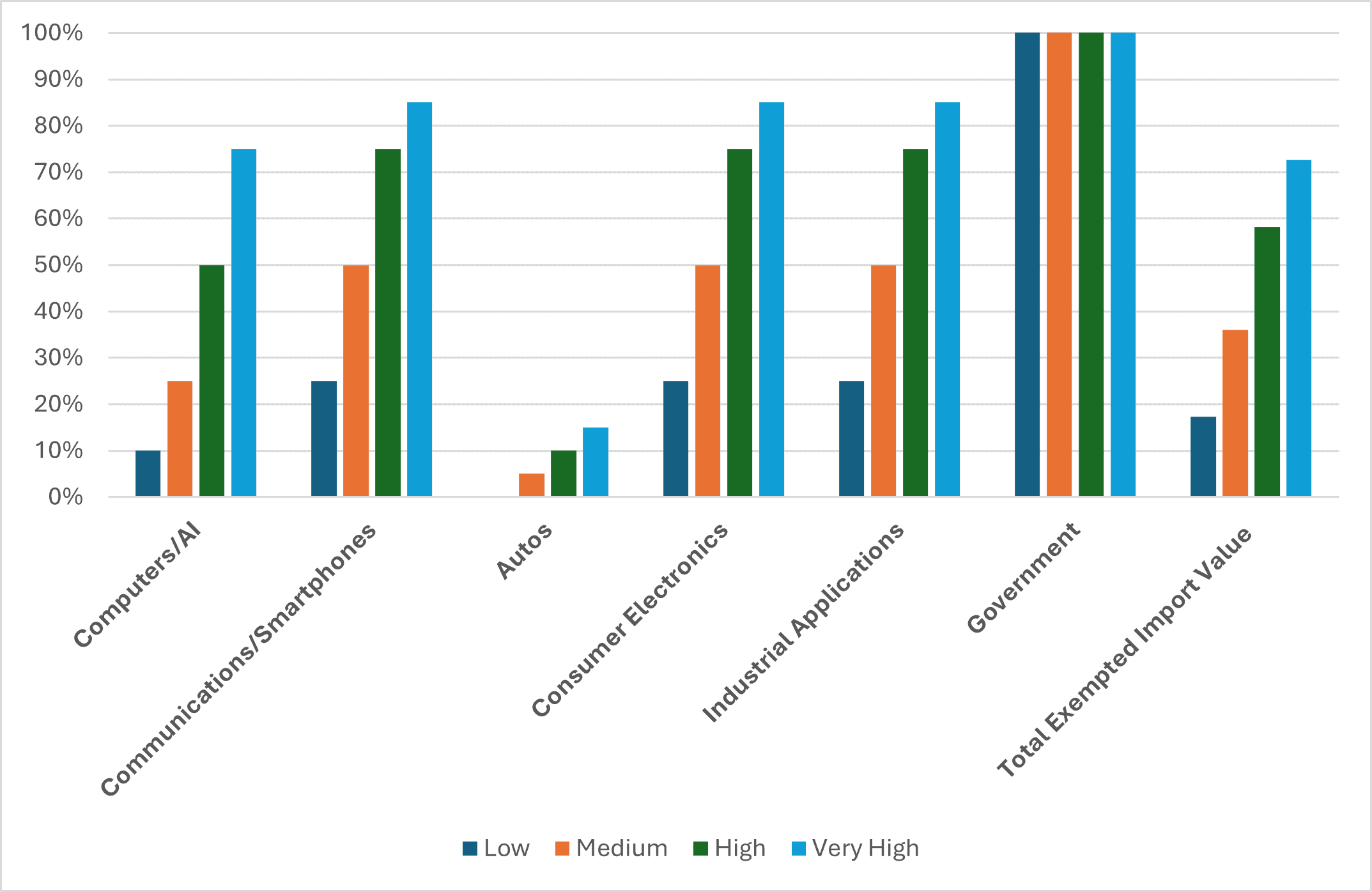
This research provides rough estimates for what percentage of each semiconductor end use category may receive tariff exemptions for the remaining import value. In the low-exemption scenario close to 20 percent receive exemptions, in the medium scenario just under 40 percent receive exemptions, and in the high scenario nearly 60 percent receive exemptions. These rates of exemption are calculated by estimating the percentage of each separate category that could hypothetically receive tariff exemptions.
Figure 3: Estimated Exemption Percentage of Each End Use Category