Research
April 14, 2025
DOJ Looks to Cut Anticompetitive Regulations
Executive Summary
- On March 27, the U.S. Department of Justice launched an anticompetitive regulations task force seeking to identify and eliminate federal and state laws and regulations that undermine competition with particular interest in the housing, transportation, food and agriculture, and health care sectors.
- Data showed that regulatory restrictions ballooned 198 percent between 1970 and 2022, while data from American Action Forum’s RegRodeo found that federal regulatory rules finalized in 2023 and 2024 cost $11,150 per household, per year, or $1.5 trillion.
- Excessively burdensome regulations stifle competitive markets, are negatively associated with firm births and deaths, and lead to regulatory capture that protects incumbents; removing them would likely foster innovation provide consumers with more choice, improved quality, and lower prices.
Introduction
On March 27, 2025, the U.S. Department of Justice (DOJ) launched an anticompetitive regulations task force seeking to reduce the regulatory burden that inhibits competition. According to the announcement, the task force will work with state and federal agencies to identify, revise, or eliminate laws and regulations that “raise the highest barriers to competition.” The task force will focus on markets that “have the greatest impact on American households,” including the housing, transportation, food and agriculture, and health care sectors. The agency invited public input.
The task force’s formation followed President Donald Trump’s January 31 Executive Order 14192, “Unleashing Prosperity Through Deregulation.” In the executive order, the president laid out a plan to reduce the federal regulatory burden by requiring an executive department or agency to identify at least 10 existing regulations to be repealed whenever it promulgates a new regulation. The task force preceded an April 9 Executive Order on Reducing Anti-competitive Regulatory Barriers, which called upon agency heads to work with the Federal Trade Commission chair and the attorney general to “review all regulations subject to their rulemaking authority and identify” rules that hinder competition.
Data showed that regulatory restrictions increased 198 percent between 1970 and 2022. Data from the American Action Forum’s (AAF) RegRodeo found that federal regulatory rules finalized in 2023 and 2024 cost $1.5 trillion, or $11,150 per household, per year. Excessively burdensome regulations stifle competitive markets, are negatively associated with firm births and deaths, and lead to regulatory capture that protects incumbents. Removing them would likely foster innovation and provide consumers with more choice, improved quality, and lower prices.
The Deregulatory Agenda
It appears that the deregulatory agenda of President Trump’s first administration will continue in his second. During his first term, Trump signed Executive Order 13771, “Reducing Regulation and Controlling Regulatory Costs,” which called for executive departments and agencies to identify at least two existing regulations to be repealed for each new regulation. To begin his second term, Trump upped the ante and signed Executive Order 14192, “Unleashing Prosperity Through Deregulation,” which called for 10 existing regulations to be repealed for every new regulation.
In lock step with executive order, the DOJ launched a task force seeking to reduce regulatory barriers that inhibit competition. The agency announced it will work with state and federal agencies to identify, revise, or eliminate laws and regulations that “raise the highest barriers to competition” while focusing on industries that most directly impact U.S. households, including housing, transportation, food and agriculture, and health care. Similarly, the Office of Management and Budget issued a request for information “solicit[ing] ideas for deregulation.”
Proceeding the DOJ anticompetitive task force, President Trump signed an Executive Order on “Reducing Anti-competitive Regulatory Barriers” that required agency heads to consult with the chairman of the Federal Trade Commission and the U.S. attorney general to review all “regulations subject to their rulemaking authority and identify those that” create monopolies, erect unnecessary barriers to entry, and otherwise limit competition.
Current Regulatory Environment
Federal, state, and local regulations are a hidden tax on consumers. Compliance costs and the increased cost of doing business are passed on to consumers in the form of higher prices of goods and services.
Data from QuantGov showed the number of federal regulatory restrictions in the Code of Federal Regulations expanded by 198 percent between 1970 and 2022, a compound annual growth rate of 2.1 percent, or 16,782 new regulations per year (Figure1).
Figure 1

*Source: QuantGov
Data from AAF’s RegRodeo showed that the finalized cost of the 636 federal regulations imposed in 2023 and 2024 totaled $1.5 trillion per year, or $11,150 per household (Figure 2).
Figure 2

*Source: AAF’s RegRodeo
Hidden Cost of Regulation
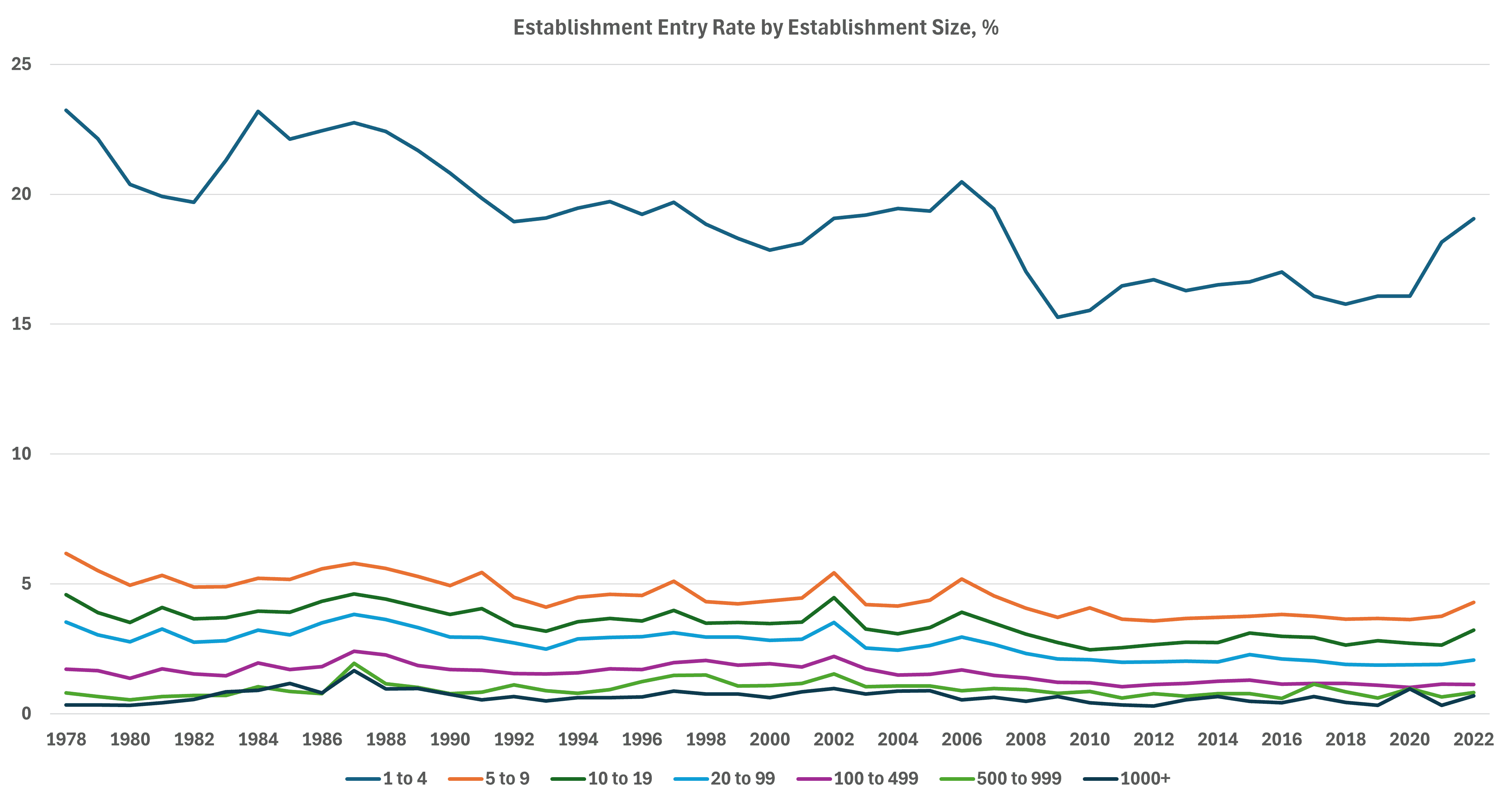
An indirect cost of regulation is the resulting protection of incumbent firms from new competitors. Increased regulatory costs can often be absorbed by incumbent firms but can be an insurmountable hurdle to the creation of new firms. Data from the U.S. Census Bureau showed that there has been a downward trend in the establishment entry rate, which is an indicator of business dynamism (Figure 3).
Figure 3
*Source: United States Census Bureau Business Dynamics Statistics
The establishment rate for firms with one to four employees declined from 23.2 percent in 1978 to 19.1 percent in 2022. It was the steepest drop among the different employment size categories, suggesting the smallest businesses are the most affected by increased regulatory costs. One study found that “a 10% increase in the intensity of regulation leads to a statistically significant 0.5% decrease in overall firm births.” The study also found that “there is a statistically significant decrease among births of small firms but no statistically significant effect on births of large firms, confirming the hypothesis that incumbent firms benefit from regulation because it deters new entrants.”
There is also evidence that large incumbents can benefit from regulatory capture. The same study found that while “regulation drives away new entrants…it does not put existing firms out of business.” In other words, there is no increase in firm deaths. The study concluded that “there is some evidence that deaths among large firms actually decrease: a 10 percent increase in regulation is associated with a 0.9 percent decrease in the deaths of large firms.”
AAF research compared the change in the 4-firm concentration level and the percent change in regulations at the 4-digit NAICS level and found a positive correlation. In other words, as regulations increased, so did the market share of the four largest firms. The relationship can be seen in Figure 4.
Figure 4

*Source: U.S. Economic Census, QuantGov, author’s calculations
AAF’s findings support the notion that increased regulations can often protect incumbent firms and increase concentration. While market concentration is not a direct indicator of market competitiveness or suggestive of antitrust infractions, it does suggest that market dynamism is inhibited by excessively burdensome regulation.
Conclusion
The DOJ’s anticompetitive regulations task force seeks to identify and eliminate federal and state laws and regulations that undermine competition.
Data showed that regulatory restrictions ballooned 198 percent between 1970 and 2022, while data from AAF’s RegRodeo found that federal regulatory rules finalized in 2023 and 2024 cost $11,150 per household, per year, or $1.5 trillion.
Excessively burdensome regulations stifle competitive markets, are negatively associated with firm births and deaths, and lead to regulatory capture that protects incumbents. Removing them would likely foster innovation and provide consumers with more choice, improved quality, and lower prices.