The Shipment
December 11, 2025
Farmer Funds Flow
(Not So) Fun Fact: The U.S. trade deals with Thailand and Cambodia are likely in jeopardy as the recent ceasefire agreement between the two countries has been suspended due to reignited border clashes.
The Bailouts Are Coming!
What’s Happening: President Trump, alongside Secretary of Agriculture Brooke Rollins and Secretary of the Treasury Scott Bessent, announced on Monday a $12-billion relief package for U.S. farmers. This financial relief program will provide $11 billion in aid for producers of cotton, corn, soybeans, wheat, peanuts, and various other row crops while the remaining $1 billion will be set aside for fruits, vegetables, and other specialty crops whose producers are in economic need. The U.S. Department of Agriculture (USDA) will provide this financial support for farmers via the Farmer Bridge Assistance Program, which is authorized by the Commodity Credit Corporation (CCC) Charter Act. Despite the president claiming tariff revenue will pay for this relief, the CCC was most recently funded by a continuing resolution. To qualify, producers must have an adjusted gross income of less than $900,000 with payments capped at $155,0000 and calculated based on the number of acres planted, production costs, and a few other factors.
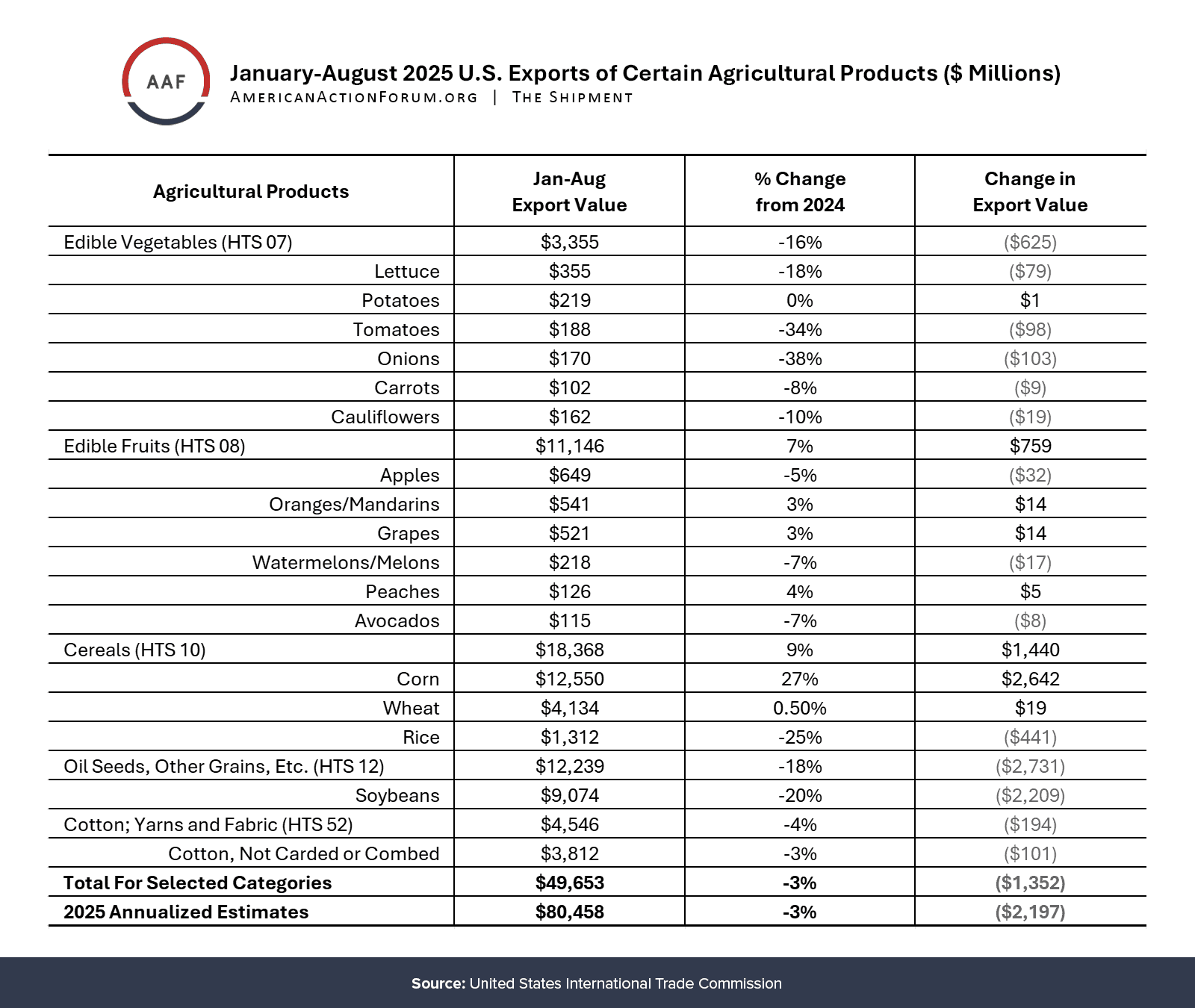
Why It Matters: Many U.S. farmers have been struggling in recent months due in part to the Trump Administration’s tariff agenda, which sparked a global trade war that reduced U.S. agricultural exports and raised costs for key inputs. The Shipment estimates that 2025 U.S. exports of row crops, cotton, fruits, and vegetables will be $2.2 billion lower than in 2024 based on the most recent U.S. Trade Commission data (see chart below). This may end up being a low-end estimate as more data come in, since trade war ramifications will have been felt well into the third and fourth quarters of 2025. At the same time, the Shipment’s 2025 tariff cost estimate for certain inputs such as fertilizers, pesticides, and farming equipment stands at between $500–$600 million. These burdens have almost certainly contributed to the 50-percent increase in farm bankruptcies during the first nine months of the year. Although recent trade deals may be welcome news for U.S. agricultural exports, many countries have begun diversifying away from the U.S. market and may not follow through on agreements. For instance, China may have agreed to purchase 12 million tons of U.S. soybeans by the end of the year, but so far it has only purchased 2.7 million tons. Secretary Bessent has since explained that the U.S.-China deal actually meant China would make these purchases by “the end of the growing season” (around February 28) but the White House fact sheet says otherwise.
While tariffs have had many negative repercussions for the U.S. agricultural industry, they only exacerbated the already present challenges faced by U.S. farmers. Congress passed a $10-billion bailout package in 2024 – well before President Trump implemented his aggressive tariff policy – to supplement other crop assistance programs. Crop prices have remained low in recent years due to higher yields, while the war in Ukraine significantly increased downstream fertilizer and production costs. Natural disasters and droughts also contribute to losses for farmers, with agricultural disaster relief and crop support estimated to reach a record $42 billion this year to compensate. These factors have combined to create a perfect storm, with many farmers facing projected revenue that is below the cost of production for many crops. Former senior economist at USDA, Shawn Arita, estimates that crop producers may lose between $35–$44 billion as a result of these issues combined with effects of the trade war.
Looking Ahead: According to the USDA press release, qualified farmers should begin receiving payments on February 28, 2026. The USDA will determine the per-crop payment rates and estimate the direct payments for eligible producers in late December so farmers can begin to plan for 2026. It will be important for farmers that payments come early in the year as this economic assistance will impact the production plans and the economic sustainability of farmers who have been hard-hit by lower exports.