The Shipment
January 8, 2026
Importing Maduro and New Tariff Delays
(Not So) Fun Fact: On Friday, the Supreme Court may announce its ruling on the case against President Trump’s IEEPA tariffs; the ruling is expected to cause volatility for global markets no matter the decision.
The United States Imports Maduro
What’s Happening: In the early hours of January 3, a U.S. military operation resulted in the capture of the Venezuelan leader, Nicolás Maduro. Responses to the ouster and arrest of Maduro have been mixed–both in the United States and abroad. What happens next is unclear. What is clear, however, is that the Trump Administration plans for the United States to “run” Venezuela for the foreseeable future.
Why It Matters: A U.S.-aligned Venezuela has several economic and geopolitical implications. Venezuela has the largest proven oil reserves on the planet, with more than 300 billion barrels – about seven times more than the United States. Venezuela’s oil reserve is currently valued at over $17 trillion. Already, President Trump has announced that the United States will be receiving 30–50 million barrels of sanctioned Venezuelan oil that is valued at $1.7–$2.8 billion, depending on the price of oil. On top of the oil assets presumably under U.S. control, Venezuela also has extensive natural gas, rare earth elements, gold, and other minerals worth hundreds of billions of dollars. It is also rumored that Venezuela has accumulated a cryptocurrency reserve of between 600,000–660,000 bitcoins, meaning the United States could seize between $55–$80 billion in bitcoin for its strategic reserve. In short, in the blink of an eye Venezuela has become a strategic asset of the United States, worth between $19–$22 trillion, and may be the single greatest acquisition in U.S. history (See Figure 1).
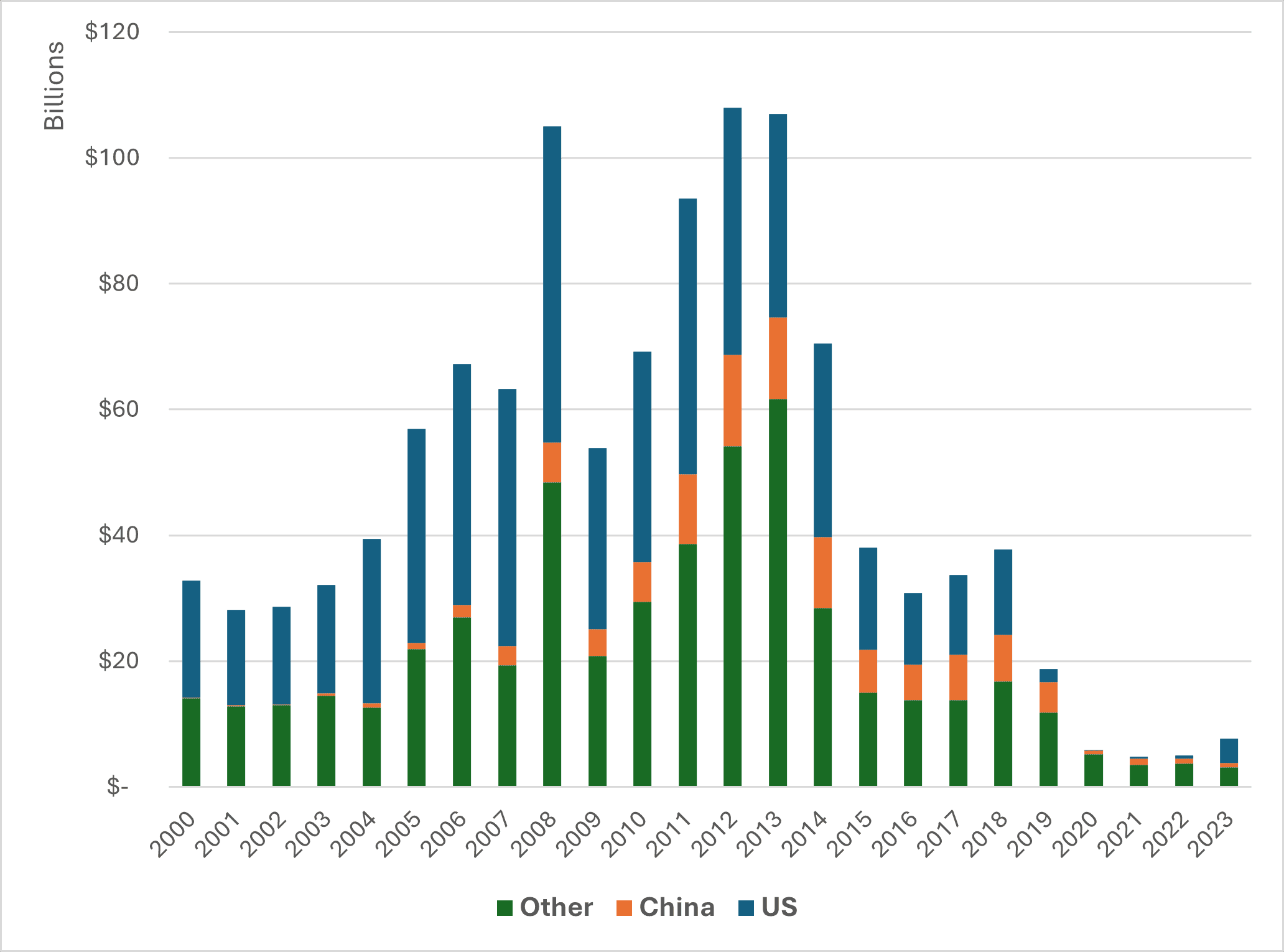
It’s one thing to effectively “run” Venezuela but it is another entirely to access and export its resources. As AAF’s Shuting Pomerleau has pointed out, Venezuela’s oil production has fallen significantly over the decades as a result of mismanagement, deteriorating infrastructure, and sanctions. Similarly, the country’s exports of crude and refined petroleum have plummeted alongside overall exports (Figures 2 and 3). The investment required just to keep oil production at the current level of 900,000 barrels a day is estimated to be $65 billion. To ramp production back up to 2 million barrels a day would require well over $100 billion, a level of investment private companies are unlikely to make without reliable assurances of Venezuela’s stability. Assuming a continued U.S. military presence in the region, U.S. oil companies could eventually re-develop the country to historic oil output levels, making it the 9th or 10th largest oil producer. Heavy crude exports would then likely go to the U.S. Gulf Coast for refinement, putting more of the world’s oil supply and production firmly in the U.S. sphere of influence. An open Venezuela would also reduce the world’s reliance on Iran and Russia for energy as well as provide the United States a small but not insignificant bargaining chip against China, which imports Venezuelan oil and has invested tens of billions of dollars to prop up the country.
Looking Ahead: The future of Venezuela remains unclear as it is unknown when new elections may be held or whether some in the Maduro regime will attempt to remain in power and fight the United States. It is also unclear whether future strikes will be conducted against the country and to what extent the administration is considering putting U.S. boots on the ground. For the time being, the United States will continue to handle the sale of Venezuelan oil to prevent oil revenue from bolstering hostile regimes. It will be years before Venezuela is able to tap into its critical mineral reserves and is unlikely to be able to do so without U.S. investment.
New Year, New Tariff Delays
What’s Happening: On December 31, President Trump amended his executive order titled “Adjusting Imports of Timber, Lumber, and Their Derivative Products Into the United States” in order to delay Section 232 tariff hikes on upholstered furniture and kitchen cabinets by one year. As a result, the tariff rate on certain furniture products will increase from 25 to 30 percent and the tariff rate on kitchen cabinets from 25 to 50 percent–but those changes won’t take effect until January 2027. Additionally, the proposed 92-percent Section 301 tariff on Italian pasta has been severely curtailed to 2–14 percent depending on the specific manufacturer. This continues the Trump Administration’s 2025 trend of repeatedly walking back, trimming down, and delaying tariffs.
Why It Matters: The two recent delays will save U.S. consumers and businesses billions of dollars in 2026 alone, a year in which the administration will likely be focused on the issue of affordability. The stated purpose for delaying the Section 232 tariff hike was that the United States Trade Representative (USTR) has been making progress negotiating with trade partners, meaning these tariffs could be brought down lower for many other countries. Notably, there are already carveouts for the European Union, United Kingdom, and Japan, which should lower the overall effective tariff rate to 15 percent. As for the pasta tariff, the announcement came directly from Italy’s Ministry of Foreign Affairs with no clear concessions by that government. This could indicate that the USTR reduced these tariffs recognizing that a 107-percent tariff rate would hurt U.S. consumers, especially those who rely on low-cost foods such as pasta. The tariff reversals also speak to the administration’s overall tariff policy that has been scattershot since January of last year. “Liberation Day” tariffs were delayed twice and modified. Exemptions were granted for smartphones, electronics, agricultural products, semiconductors, and United States-Mexico-Canada Agreement-compliant goods. Additional exemptions have been granted on a country-by-country basis. Furthermore, the numerous threats thrown around–including tariffs on movies, pharmaceuticals, BRICS countries, and European alcohol have yet to materialize.
Looking Ahead: The Trump Administration’s tariff talk has rarely lived up to the tariff reality on the ground, and this year seems likely to continue that trend. The constant backtracking will continue to make it difficult for economists to accurately estimate impacts. Perhaps more important, U.S. manufacturers and businesses will be challenged to keep track of this ever-shifting trade landscape and changing cost structures. Tomorrow, the U.S. Supreme Court may release a final decision on the legality of the bulk of President Trump’s tariffs. While this may provide temporary calm for some businesses, others may have mixed reactions, especially those that planned major investments to avoid tariffs. The market reaction may also not be fully positive as one might expect. The Trump Administration has made it clear that although it may haphazardly impose and reduce tariffs, it will continue to use tariffs as a tool no matter the Supreme Court’s decision.
Figure 1: List and Valuation of Venezuelan Resources
|
Resource/Asset |
Units | Current Value Estimate ($ Billions) |
Upper Bound Value Estimate ($ Billions) |
| Oil | 303 billion barrels |
$17,150 |
$19,695 |
| Natural Gas | 200 trillion cubic feet |
$680 |
$780 |
| Bitcoin | 600,000 to 660,000 |
$55 |
$83 |
| Rare Earth Elements | 300,000 metric tons |
$200 |
$500 |
| Gold Reserves | 161.2 metric tons |
$26 |
|
| Silver Reserves | 770 metric tons |
$2 |
|
| Gold Deposits | 7,260 metric tons |
$1,151 |
|
| Iron Ore Deposits | 4 billion metric tons |
$400 |
|
| Nickel Deposits | 407,885 metric tons |
$7 |
|
| Bauxite Deposits | 350 million metric tons |
$25 |
$27 |
|
Total |
$19,695 |
$22,670 |
Sources: USA Today, Economic Times, Firstpost, CNBC, Energy Analytics Institute, Yahoo Finance
Figure 2: Venezuelan Oil Exports
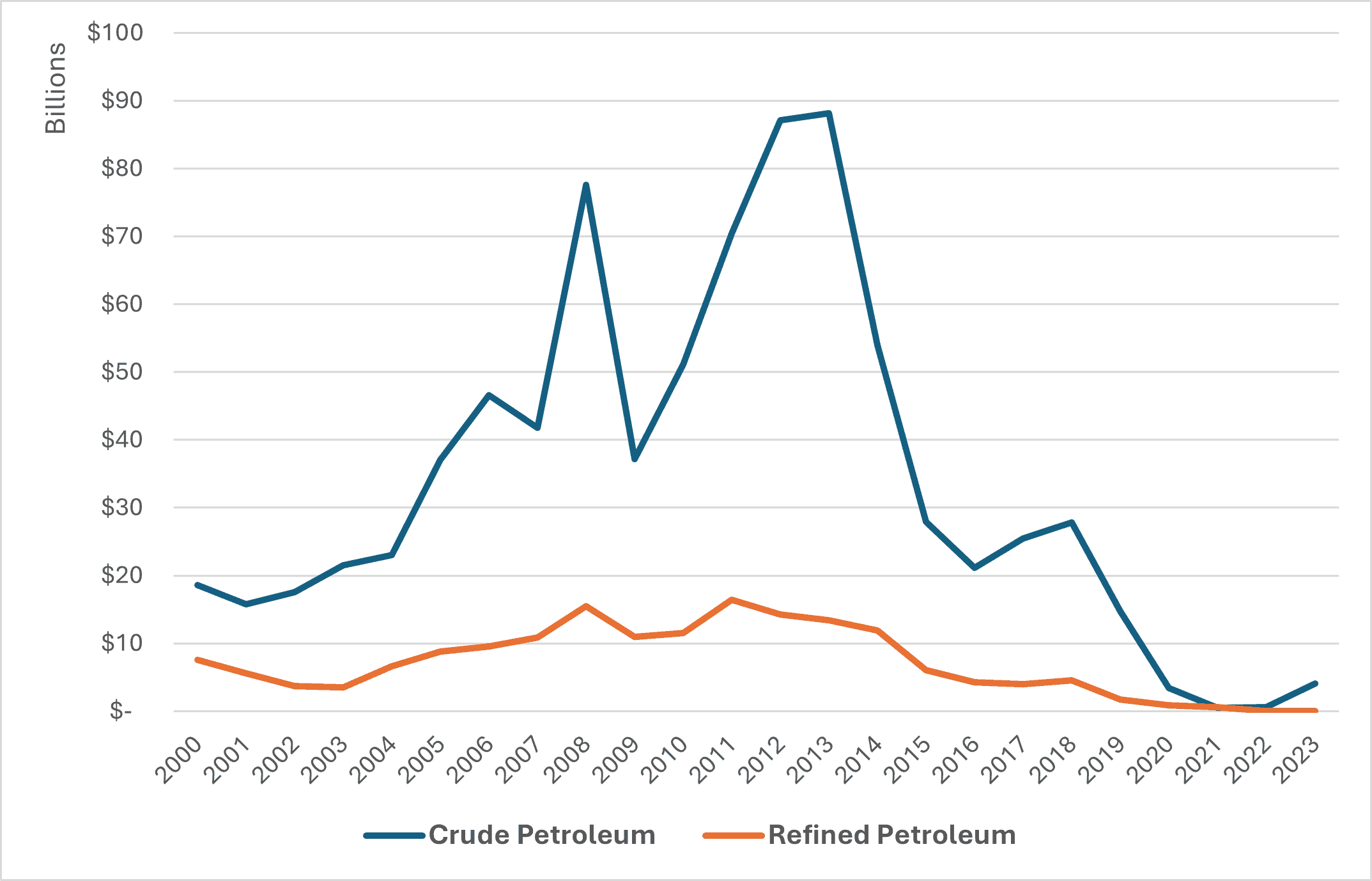
Source: The Observatory of Economic Complexity
Figure 3: Total Venezuelan Exports by Country