Week in Regulation
February 2, 2026
A Flurry of Additional Burdens
The final week of January brought a fairly sizable level of regulatory activity. There were 11 rulemakings with some kind of measurable economic effects. On net, it was a cost-adding week. Proposed rules from the Departments of Education (ED) and Labor (DOL) both brought considerable new costs and paperwork burdens. The only deregulatory measure of any significance came from the Small Business Administration (SBA). Federal agencies published roughly $1.8 billion in total costs and added 8 million paperwork burden hours.
REGULATORY TOPLINES
- Proposed Rules This Week: 40
- Final Rules This Week: 44
- 2026 Total Pages: 4,412
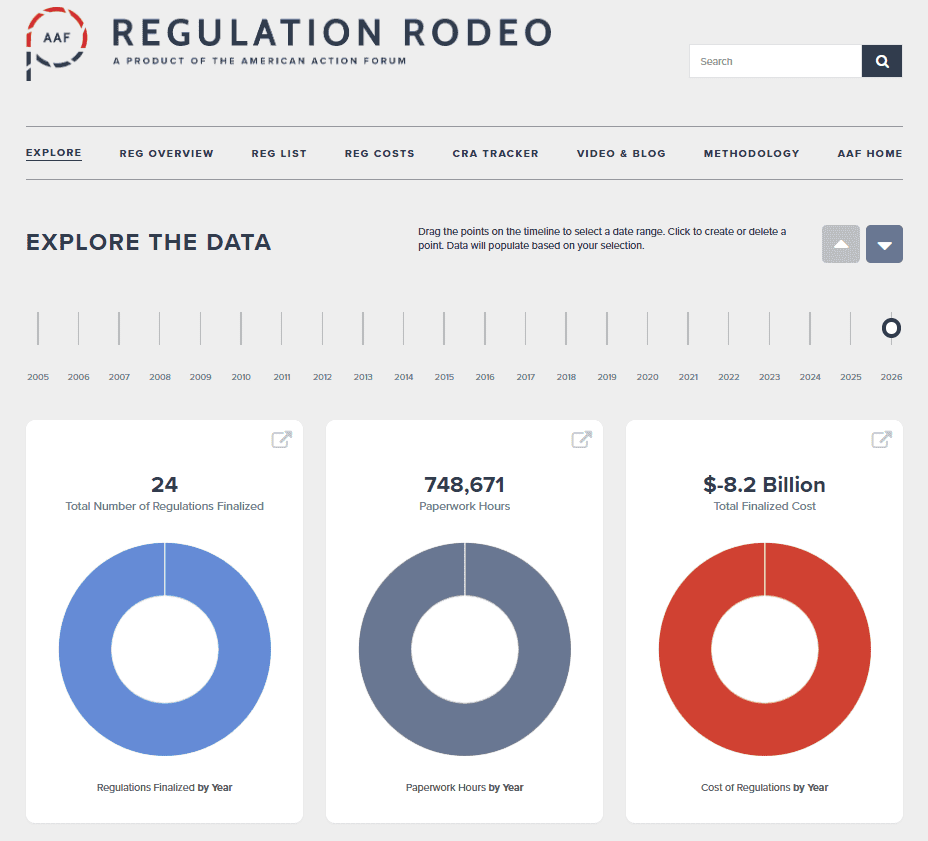
- 2026 Final Rule Costs: -$8.2 billion
- 2026 Proposed Rule Costs: $7.1 billion
NOTABLE REGULATORY ACTIONS
The most consequential rulemaking of the week was the proposed rule from ED regarding “Reimagining and Improving Student Education.” The proposal seeks:
To amend the regulations for the Federal student loan programs authorized under title IV of the Higher Education Act (HEA) of 1965, as amended (the title IV, HEA programs) to implement the statutory changes to the title IV, HEA programs included in the One Big Beautiful Bill Act (OBBB) signed into law by President Trump on July 4, 2025. These changes include establishing new loan limits for graduate students, professional students, and parents, and phasing out the Graduate PLUS Program.
Given these changes, the primary economic effects will be on the transfer payment side of the ledger. The agency expects “the downward net budgetary impacts to be −$439.7 billion from changes in transfers” between the federal government and student borrowers. Curiously, ED claims that “This proposed rule is not expected to be an E.O. [Executive Order] 14192 regulatory action because it does not impose any more than de minimis net regulatory costs.” The agency, however, then notes that the rulemaking will result in nearly 6.5 million hours of additional paperwork each year with roughly $324 million in associated costs – sums that hardly seem de minimis.
The other major cost-adding action of the week was the DOL proposed rule on “Improving Transparency Into Pharmacy Benefit Manager Fee Disclosure.” The measure would “require providers of pharmacy benefit management services and affiliated providers of brokerage and consulting services to disclose information about their compensation to fiduciaries of self-insured group health plans subject to the Employee Retirement Income Security Act (ERISA).” The administrative burdens add up to nearly 920,000 hours of additional paperwork each year. DOL estimates that the proposal’s new requirements would involve roughly $118 million in annualized costs for affected entities.
The most notable deregulatory action of the week came from the SBA final rule entitled “Improving SBA Disaster Loan Ability To Provide Meaningful and Timely Assistance.” The rule “preempts certain state and local requirements impacting the repair, rehabilitation, or replacement of damaged or destroyed property and associated activities financed by the Disaster Loan Program when such requirements cause delay in the use of SBA Disaster Loan Program proceeds.” Per the agency’s analysis, this will shorten the recovery time for affected communities and allow such areas to return to more normal economic activity sooner. SBA calculates that such savings (categorized as essentially forgone opportunity costs) amount to “$272 million in net present value.”
TRACKING TRUMP 2.0
In assessing 2026 rulemakings that include an EO 14192 determination, there have been 13 “deregulatory” rules with combined total savings of $8.7 billion. Adding that to the total that agencies produced during 2025 (at least from rules that had a clear “regulatory” or “deregulatory” designation), the Trump Administration has enacted $148.7 billion in total cost reductions thus far under the auspices of EO 14192. This rule brings nearly $360 million in paperwork-related costs, but the agency issuing it (Department of State) claims it is exempt from EO 14192 consideration since it “is issued with respect to foreign affairs-related functions.”
CONGRESSIONAL REVIEW ACT (CRA)
The only real CRA news of the week was that Democratic lawmakers in both chambers introduced respective resolutions of disapproval targeting a Trump Administration rule from the Department of Veterans Affairs regarding “Reproductive Health Services.” The American Action Forum (AAF) CRA tracker provides a full survey of activity under the law thus far into this term. As of today, members of the 119th Congress have introduced CRA resolutions of disapproval addressing 72 rulemakings across the Biden and Trump Administrations that collectively involve $137.1 billion in estimated compliance costs. Of these, 22 have been passed into law, repealing a series of Biden Administration rules that had a combined $3 billion in associated compliance costs. The Trump Administration estimates that the repeal of this rule yields an additional $936 million in savings. While the main window of CRA action has largely passed, there are still outstanding resolutions that could move legislatively. AAF will continue to monitor and update such developments as appropriate.
TOTAL BURDENS
Since the start of 2026, the federal government has published $1.2 billion in total regulatory net cost savings (with $8.2 billion in reductions from finalized rules) and 10.2 million hours of net annual paperwork increases (with 748,671 hours coming from final rules).