Week in Regulation
March 2, 2026
Proposed Rule on Asylum Applicants Brings Massive Costs
Last week was quite a lively one in the pages of the Federal Register. There were 18 rulemakings that had some kind of measurable economic effect. Coming off one of the most monumentally deregulatory weeks on record, however, this past week went in a decidedly different direction. A Department of Homeland Security (DHS) proposal regarding individuals applying for asylum brought hundreds of billions in costs that blotted out some significant deregulatory measures. Overall, federal agencies published roughly $137.3 billion in total costs and added 709,429 paperwork burden hours.
REGULATORY TOPLINES
- Proposed Rules This Week: 62
- Final Rules This Week: 49
- 2026 Total Pages: 9,952
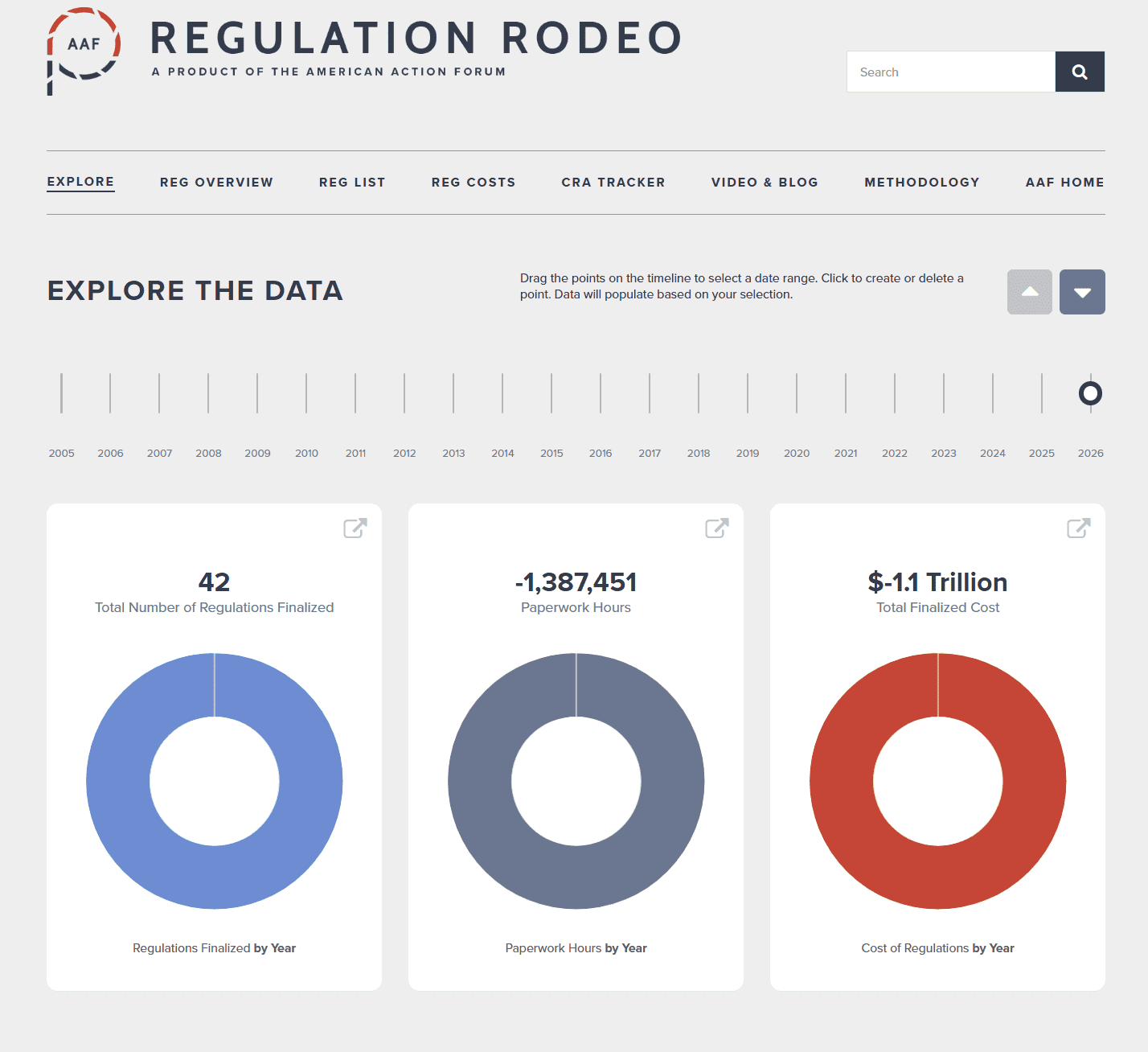
- 2026 Final Rule Costs: -$1.1 trillion
- 2026 Proposed Rule Costs: $145.7 billion
NOTABLE REGULATORY ACTIONS
The far and away most consequential rulemaking of the week was the DHS proposed rule on “Employment Authorization Reform for Asylum Applicants.” Per the agency’s summary:
The proposed rule would change filing and eligibility requirements for aliens requesting employment authorization and an employment authorization document (EAD) based on a pending asylum application. The changes include pausing acceptance of EAD applications from asylum applicants during periods when affirmative asylum average processing time exceeds 180 days, extending the waiting period to apply for employment authorization to 365 days, changing EAD application processing time requirements, and adding eligibility requirements.
The proposal follows a similarly designed rule from the first Trump term – albeit with far greater impacts this time around. The rulemaking’s requirements would exclude a significant portion of asylum seekers from the labor force which would represent “a cost to…employers through lost productivity and profits.” DHS expects this effect to present as roughly $70.4 billion in lost wages annually but posits that half of that ($35.2 billion) counts as a cost while the other half is an economic transfer to domestic workers. Across a five-year analytic window, the agency estimates total costs to be roughly $144 billion (half of the “7% discount rate; mean” estimate in Table 10). Because this action is A) still a proposed rule and B) afforded the “immigration-related functions” exception, these costs will not officially factor into the administration’s regulatory budget under Executive Order (EO) 14192.
While this DHS proposed rule represents the costliest rulemaking released by the current administration thus far, there were some substantial deregulatory actions this week as well. The Department of Labor (DOL) published its proposed rule on “Employee or Independent Contractor Status Under the Fair Labor Standards Act, Family and Medical Leave Act, and Migrant and Seasonal Agricultural Worker Protection Act.” The rulemaking is the latest volley in the regulatory back-and-forth that has developed over the past decade or so on the categorization of workers as either employees or independent contractors under the relevant statutes. This iteration of DOL estimates that these proposed changes will result in $617 million in net annualized savings for affected employers and workers (or $4.3 billion total across a 10-year window). The other major cost-cutting action of the week was this proposed rule from the Environmental Protection Agency (EPA) regarding “Accidental Release Prevention Requirements: Risk Management Programs Under the Clean Air Act; Common Sense Approach to Chemical Accident Prevention.” EPA estimates that the proposal’s changes to that program will yield $1.7 billion in net cost reductions over a 10-year horizon.
TRACKING TRUMP 2.0
In assessing 2026 rulemakings that include an EO 14192 determination, there have been 20 “deregulatory” rules with combined total savings of $1.1 trillion against one “regulatory” rule that involves roughly $70 million in costs. Adding that to the total agencies produced during 2025 (at least from rules that had a clear “regulatory” or “deregulatory” designation), the Trump Administration has enacted $1.2 trillion in total cost reductions thus far under the auspices of EO 14192. Rules for which agencies have claimed one of the EO’s exemptions have accounted for an additional $372 million in costs so far in 2026.
CONGRESSIONAL REVIEW ACT (CRA)
There were no developments of any note on the CRA front. The American Action Forum (AAF) CRA tracker provides a full survey of activity under the law thus far into this term. As of today, members of the 119th Congress have introduced CRA resolutions of disapproval addressing 74 “rules” across the Biden and Trump Administrations that collectively involve $135.7 billion in estimated compliance costs. Of these, 22 have been passed into law, repealing a series of Biden Administration rules that had a combined $3 billion in associated compliance costs. The Trump Administration estimates that the repeal of this rule yields an additional $936 million in savings. While the main window of CRA action has largely passed, there are still outstanding resolutions that could move legislatively. AAF will continue to monitor and update such developments as appropriate.
TOTAL BURDENS
Since the start of 2026, the federal government has published $953.8 billion in total regulatory net cost savings (with $1.1 trillion in reductions from finalized rules) and 28.6 million hours of net annual paperwork increases (with 1.4 million hours in reductions coming from final rules).