Weekly Checkup
February 21, 2025
NIH’s 15-percent Cap: Leaner Budgets, Stronger Science?
On February 7, the National Institutes of Health (NIH) issued guidance for the 2024 NIH Grant Policy, instituting a maximum 15-percent cap on all indirect costs associated with grants the agency issues. In its announcement, the NIH said the new guidance is intended to “ensure that as many funds as possible go towards direct scientific research costs rather than administrative overhead.”
While it is commendable that the NIH is instituting grant policies that aim to prioritize medical research and trim administrative costs, its attempt to curtail “institutional administrative overreach” may have consequences that create more problems than they solve. A blanket capping of indirect costs may punish institutions with a legitimate need for support, such as newer, less-funded, or smaller organizations – inadvertently limiting NIH’s access to a major hallmark of U.S. biomedical research: advanced intellectual property (IP) rights.
NIH grants are composed of two kinds of funding: direct costs and indirect costs. Direct costs, as the name might imply, fund needs directly associated with a given research proposal. Indirect costs, however, are defined as “those costs not readily identified with a specific project or organizational activity but incurred for the joint benefit of both projects and other activities.” They are generally negotiated as a percentage of the total cost of a grant and cover the other facility and administrative costs associated with conducting research – effectively everything from university administrative fees and maintenance to utilities and janitorial staff wages.
As explained in the NIH’s supplemental guidance, roughly 25 percent of fiscal year 2023 total competitive grant spending went to indirect administrative costs (approximately $9 billion), with some institutions charging as much as 63 percent in indirect cost rates. In the NIH policy’s current iteration, this means all grants previously approved, as well as those going forward, will be subject to the new terms and fall under the 15-percent cap. The new rate is described as aligning with the current rates from other grantmaking entities; for example, this cap is equal to the maximum indirect cost rate offered by some non-federal research foundations.
While the guidance would effectively lower total spending on indirect grant costs each year, this blanket policy may also significantly impact newer, less experienced, or less funded institutions that rely on indirect cost funding to ensure their facilities remain operational. Because this cap will be applied only to NIH funding, it may also encourage some research institutions to shift from seeking public-facing NIH grants to more private-sector or non-health agency funding options; this could lead to a sharp disruption in the IP pipeline that the federal government currently benefits from via federal grant dollars.
To better meet its stated goal, the NIH might consider altering its guidance and instituting a new approach that considers the amount of indirect funds an institution has previously received, as well as other variables that account for an institution’s available nonpublic funds (effectively anything that the institution received not given as a federal or state grant). Using this approach, NIH could strike a strong balance between reducing administrative overhead and prioritizing scientific research.
NIH Cap May Disproportionately Harm Small Research Schools
Nicolas Montenegro, Health Care Intern
On February 7, 2025, the National Institutes of Health (NIH) announced it will implement a maximum indirect cost rate of 15 percent for all research grants issued moving forward. Indirect costs are included in NIH grants to help operationalize facility and administrative needs not directly attributed to but necessary for scientific research, such as staff salaries, building maintenance, and rent. In a post on X, the NIH cited rates for several top universities next to their endowments, with the implication being that the schools can cover more of these background costs. While large research universities have historically negotiated high indirect cost rates, data show that many smaller research institutions (by amount of NIH funding received) receive similar rates.
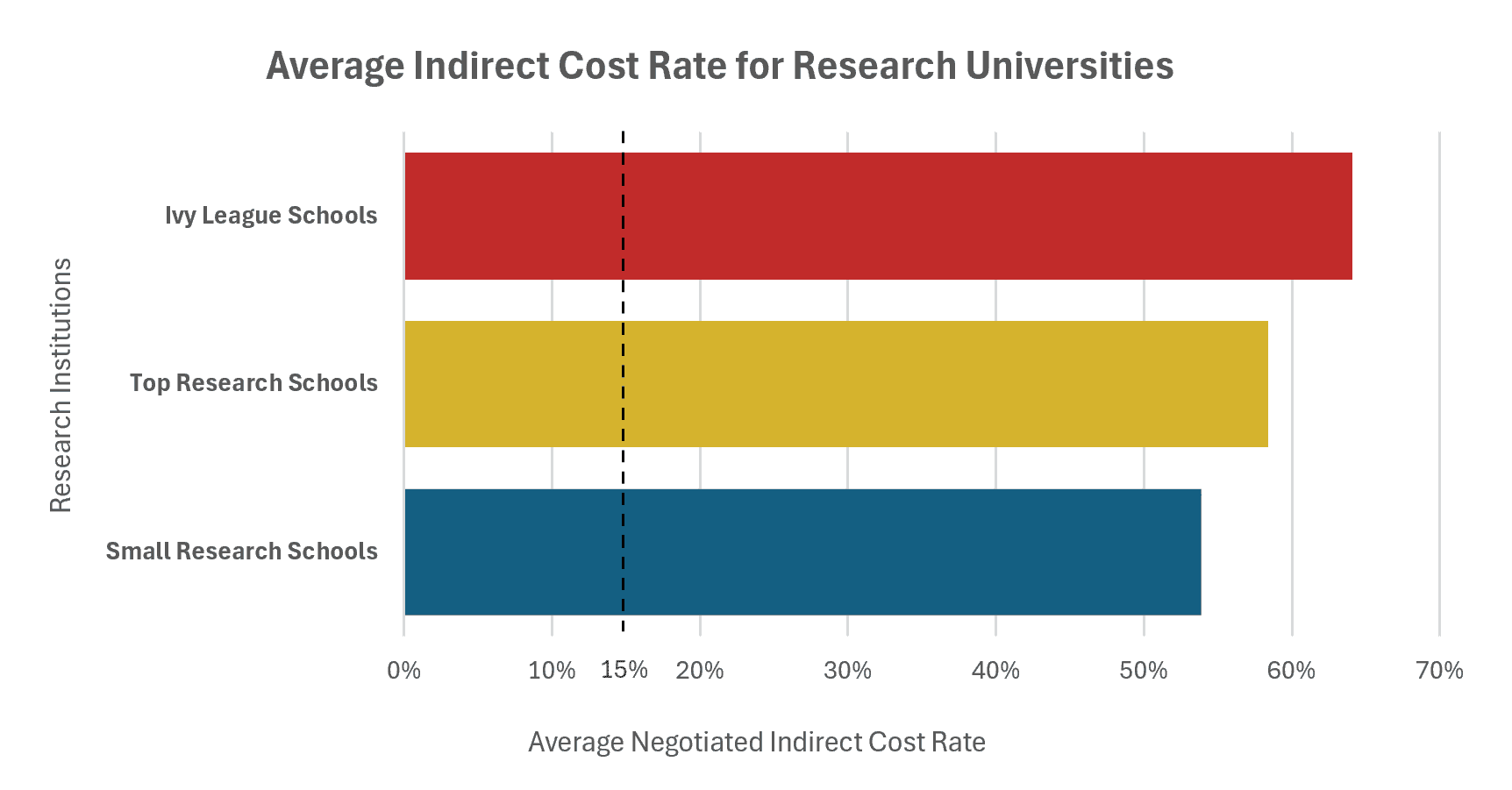
The chart below demonstrates the average indirect cost rate of 24 research universities, grouped into three tiers. The first tier, “Ivy League Schools” shows the average indirect cost rate of all eight Ivy League institutions. The “Top Research Schools” tier incorporates the average indirect cost rate of eight non-Ivy League universities with the highest total NIH grant funding received. The final tier, “Small Research Schools,” comprises the average indirect cost rate of eight universities that received less than $10 million in total NIH grant funding.
The data indicate that the average indirect cost rate for all three groups ranges between 54 and 64 percent. These figures are substantially higher than the NIH’s new guidance setting a maximum indirect cost rate of 15 percent. Notably, the data also demonstrate that smaller research schools have negotiated indirect cost rates comparable to institutions that receive more than 10 times the funding. This suggests that the scale of funding in NIH grants and the size of the research institution are not direct indications of the receiving institution’s ability to negotiate indirect cost rates, and that a blanket cap on all NIH grant recipients would disproportionately affect smaller research institutions that may be unable to make up the difference.
Sources
https://findingequilibriumfuturehighered.substack.com/p/indirect-cost-cuts-could-gut-university
https://www.science.org/content/article/big-thinking-small-universities