Weekly Checkup
February 7, 2025
Reforming Medicaid: The $670 Billion Solution
There are discussions among President Trump’s economic advisers and congressional Republicans about revisiting Medicaid reforms originally discussed during Trump’s first term. Chief among these reforms is a combined approach to revising how states receive federal reimbursements for their Medicaid populations using both block grants and per-capita caps (PCC). New research from the American Action Forum’s Center for Health and Economy estimate this block grant and PCC proposal would save the federal government approximately $670 billion over 10 years, or roughly $67 billion each fiscal year. Let’s break down those findings to better understand the benefits of these Medicaid reforms.
Under current law, the federal government reimburses state Medicaid programs at a predetermined rate, referred to as the federal medical assistance percentage, or FMAP. While this rate varies by state, the FMAP typically ranges between 50–77 percent of a state’s total uncapped Medicaid cost. To reform this, Congress has two previously reviewed measures: block grants and PCCs. Considering the federal government spent more than $805 billion in 2022 on uncapped Medicaid reimbursement (or roughly 18 percent of total national health expenditures), this new program would rein in spending by capping the total amount the federal government pays for Medicaid each year.
Block grants are designed to cap how much the federal government reimburses state Medicaid programs, based off a full year of a state’s Medicaid spending (and tied to inflation). While the less dynamic of the two options, block grants provide states with large, predetermined, upfront sums of cash, thereby allowing them to leverage their purchasing power and improve their ability to negotiate for better value-based care arrangements across their covered population.
Similarly, PCCs set caps on how much the federal government can reimburse a state Medicaid program but, notably, ties this reimbursement directly to the number of enrollees covered under its Medicaid program. Compared to its less dynamic cousin, PCCs are a much more refined and elegant solution for reining in Medicaid spending. First, PCCs have the benefit of being considerably more risk-adjusted than other options, as the function of PCC reimbursements better allows states and the federal government to accurately account for financial flows in Medicaid populations. Second, because PCCs tie a standardized reimbursement value to each enrollee, it is considerably easier for federal funding to account for and follow Medicaid enrollees across state lines. In short, PCCs allow federal funds to better serve enrollees as they roll off of the program and account for enrollee population variation through the fiscal year – leading to less fiscal waste and a more accurate Medicaid reimbursement system.
This proposal should warrant consideration. It creates a sound, predictable system, saves a significant amount of federal dollars, and ensures enrollees with the greatest needs continue to receive care.
Chart Review: FTC’s Second Interim Report Should Be Consumed With Caution
Nicolas Montenegro, Health Policy Intern
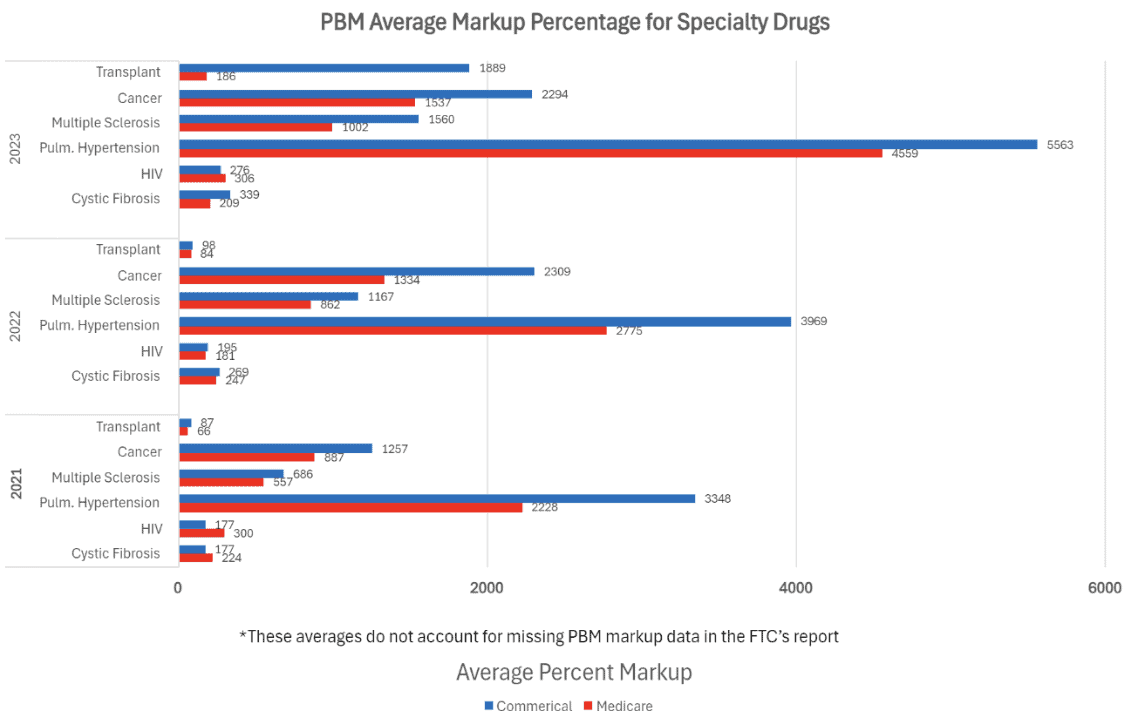
On January 14, 2025, the Federal Trade Commission (FTC) published a second interim staff report on pharmacy benefit managers (PBMs) and their impact on the prescription drug market. This updated report comes seven months after the FTC’s initial findings were broadly criticized for lacking empirical evidence and falling short of the agency’s accepted standards for conducting investigations. While newly acquired evidence highlighted in the most recent report has shed light on some potentially worrisome trends in PBM activities, the data is limited to generic specialty drugs listed by the three largest PBMs – which make up just 6.2 percent of subscriptions filled by pharmacies in the United States.
The FTC report’s data show that the average percent markup (reimbursement rate divided by the National Average Drug Acquisition Cost) across most specialty drug therapies increased from 2021–2023. This trend suggests that PBMs are negotiating increasingly higher prices that insurance pays pharmacies to fill prescriptions, while the prices pharmacies pay manufacturers for the drug remain relatively consistent. Critics of the FTC’s report argue this analysis lacks sufficient context to point fingers solely at PBMs for higher specialty drug prices. Notably, exogenous variables also contribute to higher markups; for example, shifting consumer demand and higher operating costs for pharmacies.
These data may present sufficient justification to more closely investigate PBMs’ role in the prescription drug market – but because of the FTC data’s limited scope, such inquiry should likely focus only on the specialty prescription drug market. It would be erroneous to draw broader conclusions on the overall merit of PBMs’ market activities.
Sources
https://www.ftc.gov/system/files/ftc_gov/pdf/PBM-6b-Second-Interim-Staff-Report.pdf
https://www.ftc.gov/system/files/ftc_gov/pdf/Holyoak-Statement-Pharmacy-Benefit-Managers-Report.pdf
https://cei.org/studies/ftc-flunks-interim-report/
https://www.jmcp.org/doi/10.18553/jmcp.2024.30.12.1355
https://www.healthcaredive.com/news/healthcare-supply-chain-pharmacy-costs-rise-2025-report/738928/