









Comments for the Record
September 24, 2026
Proposed Enforcement Policy Statement Regarding Personalized Pricing
Comments of Frederick C. Ashton, Jr.[1]
I. Introduction and Summary
On August 19, 2026, the Federal Trade Commission (FTC) issued for public comment a proposed enforcement policy statement[2] signaling aggressive prosecution against businesses using personalized pricing strategies without “clear and conspicuous” disclosures. This proposal is not a ban on personalized pricing, but rather effectively mandates disclosures that identify a price as personalized, the basis for personalization, and the data used. Moreover, this proposal does not address static – or regularly in place – pricing strategies such as early-bird specials, senior and student discounts, or other forms of third-degree price discrimination.
Personalized pricing – or first-degree price discrimination – is a strategy in which sellers use detailed individual customer data to charge a price based on what that data suggest the customer is willing to pay. The FTC is particularly concerned about this practice when consumers “reasonably expect” uniform pricing.
This policy statement follows the release of the FTC’s Surveillance Pricing study, congressional hearings, and enactment of state laws regulating personalized pricing amid consumer frustration with cost-of-living increases and data harvesting.
Adopting a “consumer expectations” framework could chill pricing innovation and competition while leading to subjective enforcement. Crucially, it may also unintentionally prevent vendors from extending real consumer benefits – a significant downside risk given one empirical study found that 60 percent of consumers benefited from lower prices made available through personalized pricing.
II. Personalized Pricing Refresher
Personalized pricing – or first-degree price discrimination – attempts to capture an individual’s willingness to pay. Firms use detailed individual data including internet browsing history, purchasing patterns, location information, income, and other data points – or inferences based on these metrics – to generate an estimate of an individual’s willingness to pay for a product or service, and charge a price at or close to the estimate. This pricing strategy should not be confused with third-degree price discrimination, which is a common pricing strategy that typically divides consumers into different groups – a classic example of which is a senior discount at a movie theater. The difference here is that a third-degree price discrimination strategy uses broad identifiers such as age to charge different groups different prices. These discounts are typically static, meaning that the price differences among tiers apply uniformly to everyone.
In a market where firms have some level of pricing power, both consumers and producers will have a surplus. Consumer surplus exists because buyers are willing to pay more than the market rate. Producers, meanwhile, have a surplus because they produce units at a cost lower than the final market price. Yet uniform price strategies also introduce a deadweight loss – which is the economic loss that occurs when buyers are willing to pay sellers more than it costs to produce, but below the uniform price. In other words, these buyers do not buy the good or service; the producer misses out on the potential profit, and the consumer is unable to make a desired purchase. The distribution of consumer and producer surplus, and the deadweight loss depend on the firm’s pricing power.
A firm using a personalized pricing strategy will ultimately have some customers paying above what would typically be a uniform price while other customers pay less. For example, absent personalization, a seller would charge everyone $10. Using personalization, one customer may be shown a price of $11, while another is offered a price of $8. The firm will charge different prices to each customer based on their estimated willingness to pay, with the price going as high as any customer may be willing to pay, and as low as the firm’s marginal cost – the added cost incurred from producing an additional unit – for those customers who are less inclined to buy at higher price. Personalized pricing strategies change the welfare distribution in two distinct ways. First, the consumer surplus is transferred to producer surplus when a firm can perfectly identify a customer’s willingness to pay. Second, it eliminates the deadweight loss, therefore expanding total welfare. A more detailed explanation can be found in the Appendix.
III. Shifting the Framework to Consumer Expectations
The FTC’s framework relies heavily on consumer expectations – specifically targeting practices “where consumers reasonably expect that prices for a product or service will not vary based on their personal data.” This standard would likely encourage subjective enforcement as most consumers are unlikely to know how prices are determined – whether it be uniform prices or personalized prices.
Even if a price is uniform – meaning every customer pays the same price – it reveals little to the consumer about how the price is determined. Cross-subsidization, loss leaders, captive product pricing, bundling, and decoy pricing are all types of pricing strategies, none of which requires an FTC-mandated disclosure. Making a distinction between these and a personalized pricing strategy is arbitrary. What the consumer can determine in both cases, however, is that is the price for which they can purchase the product or service.
Deceptive
The agency defined an act or practice as deceptive “if it involves a representation, omission, or practice that is material and likely to mislead the consumer acting reasonably in the circumstances, to the consumer’s detriment.” It is difficult, however, to see how this definition fits within a proposed framework that relies on a consumer’s reasonable expectations. Stretching the definition of deception under Section 5 to include scenarios where a seller fails to disclose how it prices its products or services simply because a customer holds a preconceived – and potentially inaccurate – notion of what the price represents relies on a subjective limiting principle that would likely ensnare a seemingly endless number of standard business practices.
It is difficult to argue a practice is deceptive if a customer is shown a price for a good or service and the customer ultimately pays that price.
True deception – as when a seller overtly states that every customer is offered the same price when, in fact, the price is personalized using customer data, or the advertised price differs from what is ultimately paid (excluding any transaction fees or taxes) – should be addressed by the FTC using its Section 5 authority.
Unfairness
The FTC explained that for a practice to be unfair under Section 5, it must 1) cause substantial injury to consumers, 2) is not reasonably avoidable by consumers themselves, and 3) not outweighed by countervailing benefits to consumers or competition.
Given the increase in total welfare, it is difficult to claim an injury is substantial if a seller’s estimate of one customer’s willingness to pay is higher than a uniform price but lower for another customer. Moreover, assuming the personalized price is what is ultimately paid – in other words, absent blatant deception as previously discussed – it is a price consumers can use to compare across different physical stores and shopping platforms. In other words, a consumer can reasonably avoid paying any particular personalized price.
The final component of the unfairness claim is that it is not outweighed by countervailing benefits to consumers or competition. The proposed enforcement policy assumes that disclosures come with zero additional costs when it notes that “any benefits to consumers or competition from personalized pricing may also be realized without concealing the fact and nature of the personalized pricing.” Yet requiring “clear and conspicuous” disclosure incentivizes both consumers and sellers to alter behavior. Consumers, for example, could employ techniques to hide information from sellers that would suggest a higher willingness to pay. Meanwhile, competition among sellers to innovate pricing strategies that allow them to quickly respond with targeted advertising, discounts, or other tactics to gain market share from a competitor could be stifled.
Deceptive and Unfair to Whom? The Welfare Effects Are Unclear
As with every allegation of deception and unfairness, the FTC must answer the questions: deceiving to whom? And unfair to whom? Absent blatant misrepresentation and fraud as discussed, a personalized price and a uniform price reveal little to customer with respect to how the price was determined. Moreover, as the agency acknowledged, the welfare “effects of personalized pricing on consumers are unclear.” The FTC would likely be hard pressed to find someone whose willingness to pay is below the uniform price and can now purchase the product.
Total welfare increases when firms can perfectly measure a customer’s willingness to pay. The deadweight loss is eliminated and the quantity supplied increases. While the distribution of the increased total welfare will largely depend on market conditions, a 2023 study by Dubé and Misra found that over 60 percent of consumers benefited from personalization even when overall consumer surplus declined under personalized pricing.[3]
IV. Difficulties of Perfect Personalized Pricing
For a firm to capture all the consumer surplus relies on its ability to perfectly predict what every customer is willing to pay. In practice, however, perfectly identifying this price is unlikely as the data will likely never fully reveal a customer’s maximum willingness to pay, making the welfare distribution between producers and consumers ambiguous, even leaving a potential for consumer surplus.
In a Chicago Booth Review podcast, Dubé – the co-author of the 2023 study – discussed the potential pitfalls of attempting to predict each customer’s willingness to pay, stating that, “targeting is imperfect,” and that firms “will always make statistical errors and modeling errors when we’re trying to predict behavior.”[4] Dubé concluded that the results of this “imperfect targeting” are “ambiguous.” He posited a scenario in which “the majority of customers actually are targeted at a lower price than would have been the price if everyone was required to be charged the same amount, but in spite of that, a small minority of customers are paying more.” As shown in the models above, more consumers are served when a firm can perfectly price discriminate, even if that means some are paying above what would have been the uniform price.
V. Market Forces Should Determine Pricing Strategies
It is evident that adopting this enforcement policy will raise compliance costs. Firms using internally collected data will be able to explain the type of information collected. By contrast, firms purchasing data from third-party vendors will need to conduct routine audits and ensure consumers consented to the data’s collection.
The FTC’s enforcement policy statement distinguishes price differences determined by supply and demand from prices generated using personal data. Yet a firm using individual customer information to estimate an individual customer’s willingness to pay can better assess economy-wide demand and adjust supply accordingly.
An extension of that notion is situations where sellers use personalized pricing strategies to respond quickly to a rival’s price. A competitor can issue targeted discounts, advertisements, or coupons to steal customers, ultimately driving prices lower. Requiring firms to disclose the use of personalized pricing could result in firms opting to forgo this pricing strategy, which could result in fewer discounts.
Reputational risk will likely be of concern among sellers considering personalized pricing strategies. Platforms or companies could face significant customer backlash if it is revealed such practices are in place.
Put simply, pricing strategies are themselves a form of competition. With the welfare effects of personalized pricing unclear, hampering innovation in pricing strategies could reduce overall welfare rather than expand it.
VI. Conclusion
The FTC should focus Section 5 enforcement on clear instances of fraud and misrepresentation. Adopting an enforcement approach that supplants market forces with regulation would likely stifle pricing innovation and competition that ultimately expand total welfare.
VII. Appendix
Microeconomics holds that a firm with some pricing power will maximize profits by producing a quantity of goods where marginal revenue (MR) – the added revenue gained from selling an additional unit – is equal to marginal cost (MC) – the added cost incurred from producing an additional unit. As shown in Figure 1, the firm will produce quantity Qm and charge a uniform price of Pm to all buyers.
Figure 1
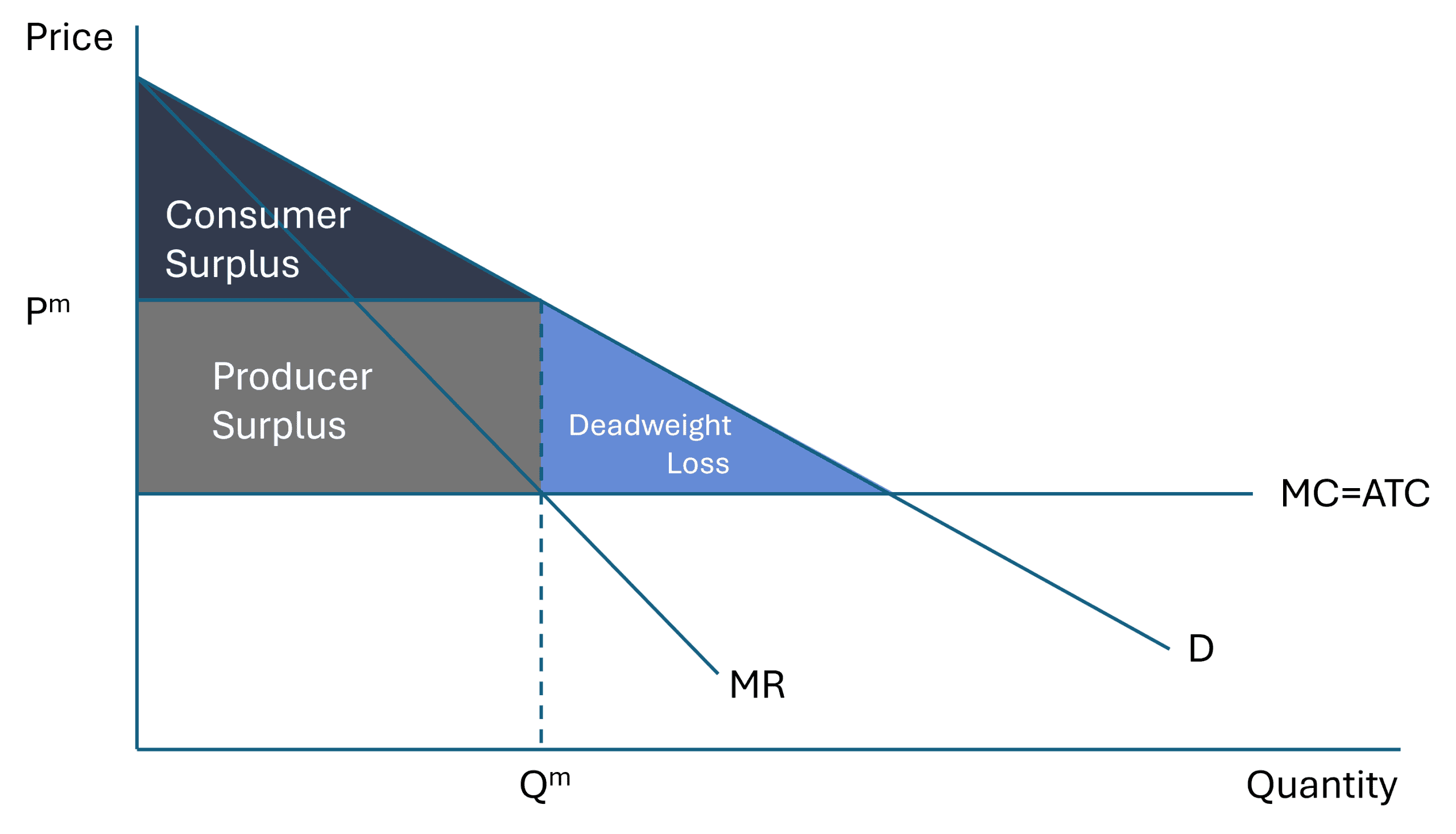
This uniform pricing strategy introduces a deadweight loss, which is the loss of economic welfare when a good is produced (or consumed) at a quantity where the marginal benefit does not equal the marginal cost. In this scenario shown in Figure 1, the market would be efficient if the firm produced where the Demand (D) curve meets the MC curve.
Figure 2 illustrates a market where a firm can perfectly estimate a customer’s willingness to pay. There is no longer a uniform price as in Figure 1, but a range of prices along the demand curve, each matching an individual’s willingness to pay. This range of prices is denoted by Pi. As shown in Figure 2, Customer 1 demands quantity Q1 and pays price P1 based on the firm’s estimate of Customer 1’s willingness to pay using individual data. Customer 5’s personal information suggests a much lower value of the product, but high enough to equal the firm’s MC, incentivizing the firm to produce one additional unit.
Figure 2
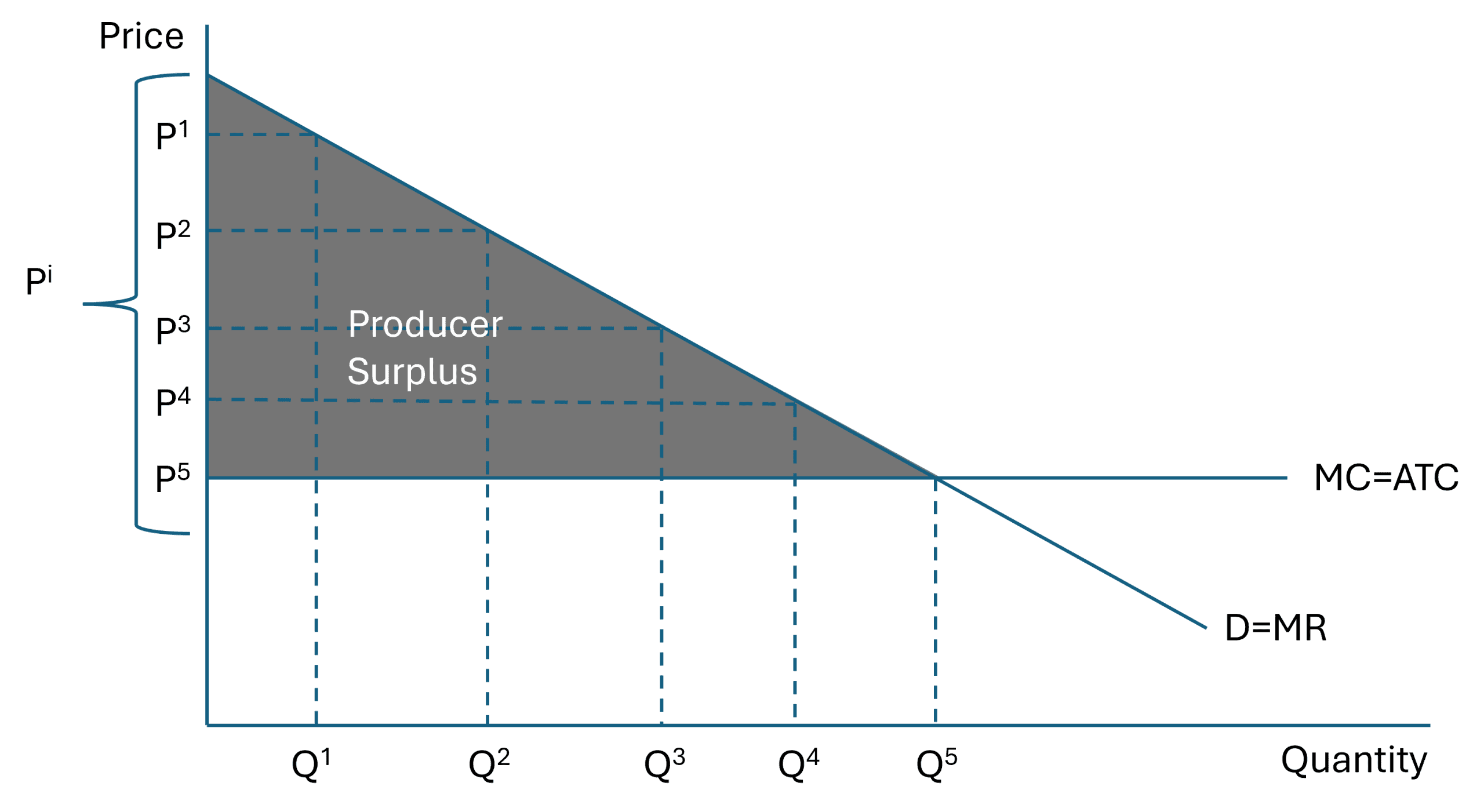
Figure 2 illustrates that personalized pricing eliminates deadweight loss and expands output, increasing total welfare. The distribution of that welfare, however, goes to the producer in markets with little competition.
[1] Frederick C. Ashton, Jr. is the Director of Competition Policy at the American Action Forum. These comments represent the views of Frederick C. Ashton, Jr. and not the views of the American Action Forum, which takes no formal positions as an organization.
[2] Federal Trade Commission, Proposed Enforcement Policy Statement Regarding Personalized Pricing,
(August 19, 2026),” https://www.ftc.gov/system/files/ftc_gov/pdf/p034101-ftc-enforcement-policy-statement-re-personalized-pricing-proposed-for-public-comment.pdf
[3] Dubé, Jean-Pierre, and Sanjog Misra. Personalized Pricing and Consumer Welfare (2023). www.chicagobooth.edu/research/center-for-applied-artificial-intelligence/research/our-faculty-research/2023/personalized-pricing-and-consumer-welfare
[4] Chicago Booth Review. Is Personalized Pricing the Future of Shopping? https://www.chicagobooth.edu/review/personalized-pricing-future-shopping

September 18, 2026
Comments for the Record
Comments to CMS on Draft Guidance, Manufacturer Effectuation of the Maximum Fair Price in 2028
Michael Baker
Dear Deputy Administrator Brooks: Thank you for the opportunity to provide comments on the Centers for Medicare & Medicaid Services’ (CMS) Draft Guidance…