









Comments for the Record
August 27, 2026
Comments to CMS on CY 2027 Hospital Outpatient Prospective Payment System (OPPS) and Ambulatory Surgical Center (ASC) Proposed Rule
Dear Administrator Oz:
Thank you for the opportunity to provide comments on the Centers for Medicare & Medicaid Services’ (CMS) proposed rule concerning the Calendar Year (CY) 2027 Hospital Outpatient Prospective Payment System (OPPS) and Ambulatory Surgical Center (ASC) Payment System (CMS-1850-P). The proposed rule presents several opportunities to better align Medicare payment with the actual resources required to furnish outpatient care. As health care policy leaders at the American Action Forum, we support policies that increase access to affordable, quality care. Policies that promote such access are largely underpinned by free market principles, competition-based economics, and innovation.
In particular, the proposed changes to payment for drugs acquired through the 340B Drug Pricing Program and the continued expansion of site-neutral payment represent meaningful steps toward reducing distortions that have developed within Medicare’s outpatient payment system. Both policies underscore the principle that Medicare should generally pay for the service or product being furnished, rather than allowing differences in provider status or acquisition arrangements to generate substantially different payments without a corresponding difference in value to the beneficiary. Relatedly, we are encouraged by CMS’ proposal to reimburse algorithmic clinical and diagnostic services under a separately payable Software as a Medical Service (SaMS) framework. These and related proposals begin to transition Medicare toward payments that appropriately reflect the value of certain advances in health care delivery and incentivize adoption of innovative tools across clinical settings.
We therefore encourage CMS to move forward with these proposals and, where its statutory authority permits, to view them as foundations for further value-oriented payment reform. At the same time, we urge the agency to exercise greater caution in using Medicare reimbursement to pursue objectives more appropriately addressed through industrial or supply-chain policy. CMS’ request for information on additional payments for domestically produced personal protective equipment (PPE) and essential medicines raises precisely this concern. Medicare payment policy should principally ensure appropriate reimbursement for the care furnished to beneficiaries; it should not become a substitute for a coherent strategy to address domestic manufacturing.
Payment for 340B-acquired Drugs Should Better Reflect Acquisition Costs
CMS’ proposed payment methodology for 340B-acquired drugs is a welcome attempt to align Medicare reimbursement with the underlying economics of the transaction. CMS’ 2026 acquisition-cost survey found that acquisition costs for 340B-acquired drugs were approximately 33.4 percent below Average Sales Price (ASP), while the ordinary OPPS payment methodology generally pays separately payable drugs at ASP plus 6 percent. CMS therefore proposes to pay applicable 340B drugs at ASP minus 33.4 percent beginning in CY 2027.
This approach should be finalized, as is preferable to maintaining a payment policy that bears little relationship to hospitals’ acquisition costs. The 340B Drug Pricing Program was created to provide eligible entities access to discounted outpatient drugs; it was not designed to require Medicare beneficiaries and taxpayers to reimburse those drugs as though the discount had never occurred. Indeed, CMS reports that in some cases a beneficiary’s coinsurance obligation alone exceeds the hospital’s acquisition cost for a 340B-acquired drug. Paying substantially above acquisition cost can convert a statutory discount into an additional reimbursement margin and thereby compound incentives already associated with participation in the program. CMS should therefore finalize a methodology that meaningfully narrows the difference between acquisition cost and Medicare payment rather than preserve the status quo.
The case for revisiting that status quo is strengthened by the extraordinary growth of 340B. The Health Resources and Services Administration (HRSA) reports that covered entities purchased more than $100 billion in drugs through the program in 2025, compared with $53.7 billion in 2022. Disproportionate Share Hospitals alone accounted for approximately $79.2 billion of the 2025 purchases. HRSA itself has cited the program’s increasing size and complexity in explaining the revised 340B Rebate Model Pilot Program, emphasizing transaction-level transparency, verification, prevention of duplicate discounts, and long-run program integrity and sustainability. Although HRSA’s rebate pilot and CMS’s OPPS proposal operate under different statutory authorities and address different transactions, their underlying reasoning is complementary: a program of this size requires payment and administrative mechanisms capable of distinguishing legitimate program benefits from unnecessary or duplicative financial advantages. CMS should view acquisition-cost-based Medicare reimbursement as part of that broader effort to bring greater discipline and transparency to the program.
We recognize that hospitals, including safety-net providers, will argue that reduced drug reimbursement could affect resources available to support other services. That concern deserves consideration, but it does not establish that Medicare should deliberately preserve payments untethered from acquisition cost. Nor should broad institutional categories substitute for evidence of actual access risk. CMS already proposes to exempt rural Sole Community Hospitals, children’s hospitals, and prospective payment system-exempt cancer hospitals from the new methodology, while Critical Access Hospitals and Rural Emergency Hospitals generally fall outside its application. To the extent CMS retains exemptions, they should be justified narrowly by identifiable statutory, payment system, or access considerations rather than by the general proposition that every dollar of existing 340B margin must be preserved.
Relatedly, CMS should retain the proposed ASP minus 33.4 percent methodology rather than adopting the alternative ASP minus 28 percent approach. The principal advantage of the proposed methodology is that it is grounded directly in observed hospital acquisition costs. While an ASP minus 28 percent methodology might slightly lessen the fiscal impact of the revised policy, the acquisition-cost survey (ASP minus 33.4 percent) provides a more direct empirical foundation than an alternative (ASP minus 28 percent) derived from estimates of statutory ceiling prices. An acquisition-cost methodology also need not be static. CMS should periodically repeat or otherwise validate the survey so that the adjustment reflects changes in purchasing patterns, discounts, and the composition of the 340B market rather than allowing a one-time estimate to become a permanent payment convention.
For similar reasons, CMS should be cautious about layering additional payments onto the survey-derived amount without clear evidence that they represent costs not already captured in the methodology. The agency’s proposal not to establish a separate pharmacy or handling add-on is reasonable insofar as the underlying acquisition-cost estimate already provides an appropriate approximation of hospitals’ costs associated with obtaining these drugs. A separate adjustment should require evidence of a distinct and material expense rather than become another mechanism through which the gap between Medicare reimbursement and acquisition cost gradually reemerges.
Implementation should likewise favor transparency without recreating the administrative complexity that reform is intended to address. Requiring hospitals to identify applicable 340B claims through the JG (drug or biological acquired with 340B Drug Pricing Program Discount), TB (drug or biological acquired with 340B Drug Pricing Program Discount, Reported for Informational Purposes), or proposed XX (drug or biological not acquired under the 340B Drug Pricing Program) modifier would provide CMS with substantially better information about the drugs subject to the new payment policy and facilitate future evaluation of its effects. CMS should therefore adopt a clear and uniform reporting requirement while minimizing duplicative documentation and coordinating, where possible, with the information infrastructure being developed through HRSA’s 340B Rebate Model Pilot Program. Better transaction-level identification can improve both agencies’ ability to oversee the program without requiring separate and unnecessarily burdensome reporting systems.
The appropriate scope of exemptions deserves particular attention. Certain providers may face genuine access or payment system considerations that warrant different treatment, but CMS should resist broad exemptions based primarily on institutional classification. Exempting large categories of hospitals weakens the relationship between the policy and its central rationale: Medicare reimbursement should most closely reflect the actual cost of an acquired drug. Any exception should therefore rest on a demonstrable statutory constraint, meaningful threat to beneficiary access, or payment system characteristic that makes application of the general methodology inappropriate. CMS could periodically revisit exemptions rather than allowing temporary or precautionary carve-outs to become permanent features of the payment system.
Finally, CMS should move expeditiously to complete the separate 340B remedy offset at the proposed 3 percent. Accelerating the annual OPPS conversion factor reduction would shorten a recoupment process that otherwise extends for many years and would better align repayment with the hospitals that benefited from the earlier increase in non-drug OPPS payments. More broadly, the rapid growth of 340B purchasing makes continued reliance on historical payment assumptions increasingly difficult to defend. A program that has expanded substantially in both dollar volume and operational complexity warrants periodic reassessment of the Medicare policies that interact with it. Revisiting those policies recognizes that preserving the program’s purpose does not require preserving every financial consequence of its current design.
CMS Should Continue Moving Toward Site-neutral Payment
We strongly support CMS’ proposal to extend its site-neutral payment policy to imaging without contrast services furnished in excepted off-campus provider-based departments (PBDs). We agree with CMS’ proposal to pay for these services at the Physician Fee Schedule (PFS)-equivalent rate rather than the higher OPPS rate, continuing the progression that began with clinic visits and was expanded to drug administration services for CY 2026.
Fundamentally, this policy advances a principle that should eventually extend well beyond imaging: When the same service can safely and appropriately be furnished in multiple settings, Medicare should not pay substantially different amounts merely because one facility bears a hospital designation. Payment differences may encourage services to migrate from freestanding physician offices into hospital outpatient departments; where comparable services can safely be performed in multiple settings, higher payment rates in one setting over another is difficult to justify. The CY 2027 proposal therefore should not be treated as an isolated adjustment to one collection of imaging codes. It provides another proof of concept for a broader transition toward site-neutrality – one that can reduce beneficiary co-insurance obligations, moderate Medicare spending, and diminish payment incentives that favor consolidation or changes in site-of-service without corresponding improvements in care.
CMS specifically asks whether it should exercise its statutory authority for additional services, and we encourage it to do so where services are demonstrably comparable across settings. Site neutrality should ultimately be understood as a general payment principle rather than a series of isolated adjustments to individual services. Any expansion should be clinically informed and should recognize genuine differences in patient acuity, resources, and access. Health policy organizations and researchers, such as the Medicare Payment Advisory Commission (MedPAC), have identified a broad range of outpatient services that can be furnished in non-hospital care settings – which are generally lower-cost settings – without compromising clinical quality or beneficiary access. In general, the services best suited for site-neutral Medicare payment are high-volume, relatively low-acuity procedures or diagnostic tests with a well-established record of being delivered successfully in freestanding physician offices or ASCs.
Accordingly, we recommend that CMS expand its list of services subject to the PFS-equivalent payment rate for off-campus PBDs in CY 2027 – beyond imaging without contrast – to include at least five additional service families: skin procedures, urology and related services, nerve injections, diagnostics and related services, and minor procedures. MedPAC identified these specific service families in its June 2023 Report to the Congress and reiterated their suitability for site-neutral payment in its most recent report, explicitly noting that they are commonly furnished safely in lower-cost settings with fewer hospital-based resources. For example, 2022 claims data reveal that about 93 percent of all level 1 skin procedures (Ambulatory Payment Classification (APC) 5051) delivered to Medicare beneficiaries in either a physician office or PBD were furnished in freestanding physician offices with presumably less resources. Nonetheless, the same claims data indicate that PBDs received approximately 320 percent more in Medicare payments on average for the same type of procedure.
We estimate that the adoption of site-neutral payment policy for these five service families, including 20 unique APCs, would save the Medicare program more than $1.6 billion over the first nine months of CY 2027. This estimate is based on the combination of claims filed from January through September 2025 and the proposed OPPS-allowed payment rates for CY 2027, compared against the potential savings from the application of CMS’ 40 percent relativity adjuster. In addition to federal savings in the Medicare program, we estimate that beneficiaries would save almost $410 million in co-insurance payments over the same period.
The table below is not an exhaustive list of suitable candidates for inclusion in site-neutral payment policies, but these specific APC service families would most align with consensus for safe and appropriate implementation across care settings.
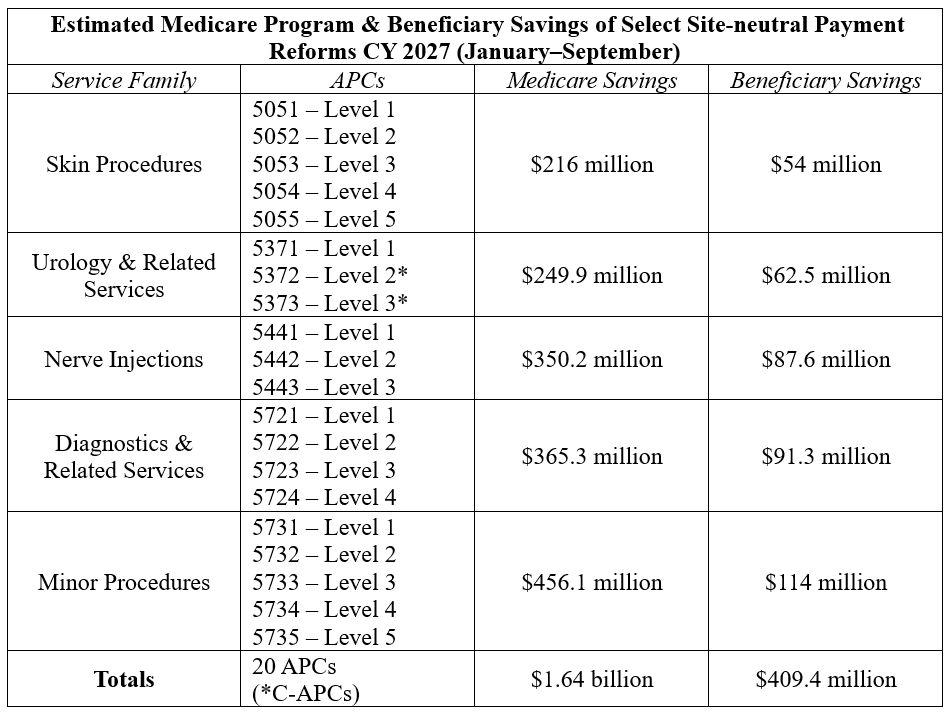
In some specific cases, however, staffing and facility availability may be harmed if inadequate considerations are given to certain providers or populations. In other cases, notably the two Comprehensive Ambulatory Payment Classifications (C-APCs) bundled with adjunctive services (C-APCs 5372 and 5373), the imposition of a PFS-equivalent rate could disrupt the established value-based reimbursement of diagnostic procedures, lab tests, or other treatments that assist in the delivery of the primary procedure. These considerations should lead to carefully defined exceptions – targeting quality measures and the retention of value-based purchasing – rather than broad categorical carve-outs. A proliferation of exemptions would hollow out site-neutrality, while concentrating the payment reductions on an increasingly narrow subset of providers.
For example, the proposed exemption for rural Sole Community Hospitals follows CMS’ existing treatment of clinic visits and drug administration and reflects the agency’s longstanding recognition that these facilities can face materially different cost and access conditions. But provider type alone should not become a sufficient justification for exemption from future site-neutral reforms. CMS should require a clear demonstration that lower payment would create a material access problem, reflect unavoidable differences in resource use, or otherwise undermine the safe provision of care. This standard would preserve necessary protections while preventing an accumulation of carve-outs that could leave the policy both narrow and disproportionately concentrated on a small subset of providers. The goal should be to identify when the service or patient population actually requires different resources, rather than assuming differences in ownership or organizational form necessarily justify different Medicare reimbursement.
Such site-neutral payment reforms would also reduce misaligned incentives created by the current payment system. Higher reimbursement for services furnished in hospital outpatient departments can influence where care is delivered and increase the value of acquiring physician practices or converting existing sites into hospital-affiliated departments. Site-neutral payment alone will not resolve broader concerns about provider consolidation, but Medicare should avoid reinforcing those trends through payment differentials that are not tied to meaningful differences in care. Reducing those incentives can improve payment neutrality while also limiting the extent to which changes in ownership or billing designation increase costs for Medicare beneficiaries.
CMS Should Broaden the SaMS Category and Protect Separate Payment for Clinically Significant Standalone Tools
We support CMS’ proposal to establish an interim payment policy for algorithmic clinical and diagnostic services while the agency continues to examine durable, long-term solutions for reimbursing Software as a Medical Service (SaMS). Specifically, we endorse CMS’ proposal to create Status Indicator “O1” for services designated as SaMS technologies, mirroring the existing Status Indicator “S” by providing separate APC payment exempt from multiple-procedure discounting. For designated SaSM technologies currently assigned an OPPS status indicating the service is conditionally packaged, we understand CMS’ decision to preserve its existing requirements for separate payment. At the same time, we strongly urge the agency to reevaluate the underlying clinical and economic rationale for conditionally packaging each of the affected SaMS technologies and to ensure a clearly defined pathway for transitioning these services to separate payment when the evidence supports direct reimbursement.
As CMS points out, rapid developments in the use of software-based technologies – including the advent of artificial intelligence – have materially changed health care delivery and management across clinical settings. These tools perform meaningful assistance for medical professionals by analyzing complex clinical information and generating actionable outputs that directly inform diagnosis, treatment planning, and clinical decision-making. Despite the observed value to both practitioners and patients, these technologies frequently face significant barriers to adoption, in part due to ineffective Medicare payment policy. Health systems often absorb the cost of recurring software licenses, cloud computing, and electronic health record (EHR) integration as bundled administrative overhead costs. This challenge can create a principal-agent problem, where practitioners recognize the necessity of algorithmic tools, but health system ownership ultimately blocks implementation to avoid a perceived financial loss on the SaMS. Establishing a predictable payment for SaMS technologies under Status Indicator “O1” may help eliminate this friction by providing an APC payment that appropriately reflects the operational costs required to furnish algorithmic medical services.
To fully realize the potential of the interim payment policy, CMS should regard CY 2027 as vital proof of concept to expand SaMS designations beyond the relatively narrow list comprised primarily of image-analysis diagnostics to include a broader range of algorithmic software. Specifically, the agency should broaden its interpretation of how SaMS technologies may support “clinical functionality” and “treatment planning” to encompass any algorithmic software used to analyze longitudinal clinical data – such as prior treatment history, biomarker profiles, and progress notes storied in the EHR – to inform potential medical interventions. Expanding designations to also encompass non-imaging tools, such as clinical trial matching platforms or guideline-concordant care pathway tools, would directly align with the agency’s stated goal of reducing payment rate variation across similar technologies.
Although we recognize the agency’s concerns regarding payment differentials and the challenges of accurately capturing the underlying costs of SaMS technologies in fixed APC payment amounts, we believe this interim framework is a necessary evolution in Medicare policy: moving past the outdated practice of treating all software as bundled administrative overhead and toward a model that acknowledges software-based technologies performing algorithmic analysis to assist clinical decision-making as standalone clinical assets. By establishing Status Indicator “O1” as a temporary separate payment framework for SaMS while refining the approach as utilization and cost data matures, CMS can safeguard Medicare program integrity, mitigate access disruptions, and ensure reimbursement policy keeps pace with technological advancements.
Medicare Payment Should Not Become an Industrial-policy Tool for Domestic PPE and Essential Medicines
We share the administration’s goal of ensuring a resilient supply of essential medicines and medical supplies. Recent shortages and the experience of the COVID-19 pandemic provide ample reason for policymakers to examine vulnerabilities in medical supply chains. The more difficult question is whether Medicare reimbursement is the appropriate mechanism for addressing those vulnerabilities. We encourage the agency not to finalize a policy concerning domestically manufactured PPE and certain essential medicines.
CMS has authority to determine appropriate payments to hospitals, and there can be circumstances in which unusual resource costs appropriately affect reimbursement. But a payment adjustment intended expressly to induce hospitals to prefer domestic products is qualitatively different from ensuring adequate payment for furnishing Medicare-covered care. The ultimate objective here is to shape upstream manufacturing investment and the geographic composition of the medical supply chain. Hospital reimbursement is an inappropriate instrument for achieving that goal. The limits of that approach are visible in CMS’ existing domestic N95 policy: Fewer than 100 hospitals reported the information necessary to determine the payment adjustment in FY 2024. CMS notes that administrative burden may explain some of this low participation, but limited uptake nonetheless counsels against simply broadening the same mechanism to additional products.
More important, the constraints on domestic production cannot necessarily be solved through marginally higher hospital reimbursement. For example, there is a current lack of sufficient domestically produced nitrile butadiene rubber for medical gloves, and CMS is considering allowing foreign rubber to be used in otherwise domestic products. This conundrum illustrates the broader difficulty: resilient pharmaceutical and medical-supply manufacturing depends on upstream inputs, capital investment, manufacturing capacity, regulatory predictability, workforce, procurement commitments, and sustainable long-run demand. Medicare can compensate a hospital for paying more for a domestic product, but that does not mean Medicare is well positioned to build the industrial ecosystem necessary to make that product competitive. If the administration wishes to expand domestic medical manufacturing, policies outside Medicare reimbursement should bear the principal burden of doing so.
CMS Should Ask Congress to Reconsider Broad Budget Neutrality Laws
Although not expressly covered in this proposed rule, we believe that CMS should ask Congress to revisit statutory budget neutrality provisions to enable the agency to capture savings associated with these and other future reforms. Budget neutrality serves an important role when CMS is recalibrating payment weights or making routine adjustments within the OPPS. It is less defensible, however, when the agency has identified a discrete overpayment or payment distortion and is required to redistribute the resulting savings elsewhere in the system rather than allow those savings to accrue to Medicare.
The contrast between CMS’ proposed 340B and site-neutral policies illustrates the problem. For the proposed reduction in payment for imaging without contrast at excepted off-campus provider-based departments, CMS is relying on its authority under section 1833(t)(2)(F) of the Social Security Act to develop a method for controlling unnecessary increases in the volume of outpatient services. CMS interprets that authority as permitting the policy to operate on a non-budget-neutral basis, meaning that reductions in payments for affected services are not offset by higher payments elsewhere in OPPS. By contrast, the proposed 340B acquisition-cost methodology remains subject to OPPS budget-neutrality requirements. CMS therefore estimates that the policy would reduce payments for 340B-acquired drugs by approximately $4.55 billion in 2027, but those reductions would be offset through increased payments for other OPPS services rather than retained as Medicare savings.
That distinction should prompt Congress to reconsider whether existing budget-neutrality requirements are appropriately tailored to the types of reforms CMS is now pursuing. The objective should not be to abandon budget neutrality for ordinary payment system recalibration, but to create targeted authority for reforms that correct demonstrable overpayments, eliminate unjustified site-of-service differentials, or otherwise remove payment distortions. The imaging proposal provides a useful example of how such reforms can produce genuine program and beneficiary savings when CMS has appropriate statutory flexibility. Congress should ensure that other similarly situated reforms are not prevented from doing the same simply because they arise under a different provision of the OPPS statute.
Conclusion
The CY 2027 OPPS proposed rule presents CMS with several opportunities to improve the consistency and discipline of Medicare outpatient payment. We encourage the agency to move forward with reforms that more closely align 340B reimbursement with acquisition costs, expand site-neutral payment where services can be furnished comparably across settings, and establish a predictable framework for emerging technologies such as Software as a Medical Service. At the same time, CMS should be cautious about using Medicare reimbursement to pursue broader industrial-policy objectives, including domestic sourcing of PPE and essential medicines, when more direct policy tools are better suited to those goals. Finally, CMS should work with Congress to ensure that statutory budget-neutrality requirements do not prevent well-designed payment reforms from generating genuine savings for beneficiaries and the Medicare program.


September 24, 2026
Comments for the Record
Proposed Enforcement Policy Statement Regarding Personalized Pricing
Fred Ashton
Comments of Frederick C. Ashton, Jr.[1] I. Introduction and Summary On August 19, 2026, the Federal Trade Commission (FTC) issued for public comment…