The Daily Dish
January 30, 2026
A Closer Look at Health Care Cost Fears
The headline in The Wall Street Journal jumped off the page: “Health Insurance Is Now More Expensive Than the Mortgage for These Americans,” but closer examination indicated that it applied only to those Americans getting insurance in the Obamacare marketplaces. The CBS News headline applied more broadly: “Paying for health care is now Americans’ top financial worry, KFF poll finds.” The Washington Post version read: “The cost of health care, not food or rent, is now Americans’ top worry.”
Scary stuff.
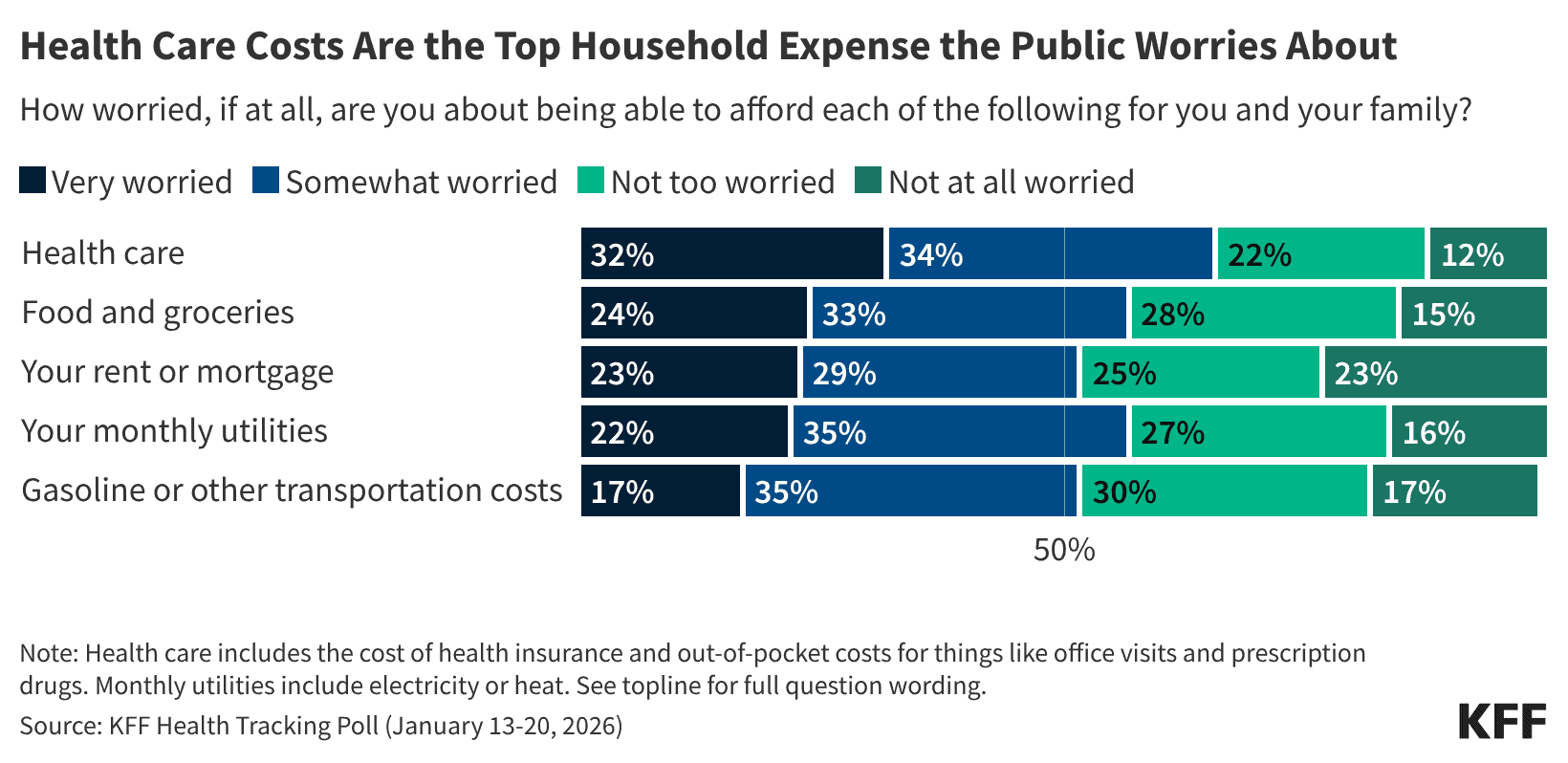
Upon closer inspection, one finds that all roads lead to the KFF surveys. Now, KFF does health care policy full time so its finding that health care costs are a top concern is comparable to finding that being hit by a hammer is the top concern in a survey of nails. Still, the results are food for thought:
The public was given a list of household expenses families worry about. A third (32%) say that they are “very worried” about their ability to afford health care for them and their families – more than say the same about affording food and groceries (24%), rent or mortgage (23%), monthly utility bills (22%), or gasoline and other transportation costs (17%).
The more complete summary:
Given this, Eakinomics started poking around the data, beginning with the Consumer Price Index (CPI) for December. One aspect of the data is the share of each item in households’ spending. For example, Shelter is 35.514, while Medical Care Services – which includes physicians, dentists, eye care, hospital services, nursing homes, health insurance, and others – is only 6.779. Taken at face value, it is hard to reconcile that with the “health care is eating the family budget” theme of these news stories.
But the CPI focuses on the prices of things paid for by the household. Perhaps Americans are more sophisticated than one might suspect. That majority gets its health insurance at work, and may recognize that as health care costs rise, premiums inevitably must follow, and wage compensation gets squeezed.
If one looks at the most recent Bureau of Labor Statistics data on employee compensation, they show that in June 2025, the average for civilian workers was $48.05 per hour. Of this, cash was $33.02 and benefits $15.03. But health insurance was only $3.75 of that total. That’s not zero – 8 percent of compensation – but it’s not the major cost, either.
Both these calculations are averages, which can mask bigger impacts among subsets of households. But if health care is the dominant cost for most families, it should be at least reflected in the averages.
So we are left with a bit of a puzzle. The surveys suggest that health care costs (or “affordability”) is a big deal, but the data suggest that this seems implausible for the household sector as a whole. This story is not over, so stay tuned.
Fact of the Day
Since the start of 2026, the federal government has published $2.9 billion in total regulatory net cost savings and 2.2 million hours of net annual paperwork increases.