The Daily Dish
September 2, 2026
Affordable Housing – Lessons from NYC
The United States has an affordable housing issue, problem, or crisis. Which of these depends on how optimistic one is. (If you are at all optimistic Torsten Slok’s Daily Spark from Tuesday will cure you.) In the course of any discussion about “what to do,” however, the point is inevitably made that most of the policy levers are in the hands of local governments. This was brought home vividly by a paper entitled How NYC Council Legislation Impacts Affordable Housing (hat tip: Thomas Kingsley) prepared for the New York Housing Conference (NYHC).
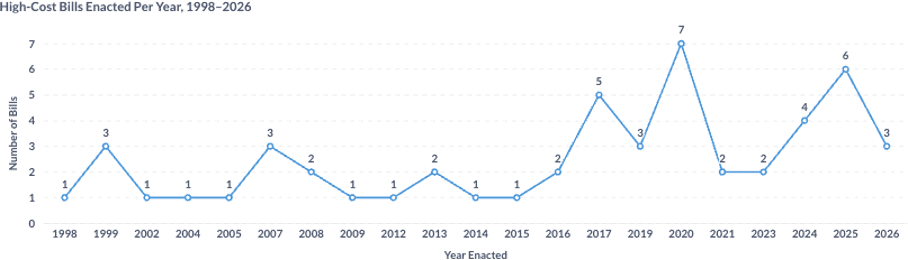
The input is every New York City Local Law enacted between 1998 and 2026. There were 3,364 laws total, and the analysts identified 39 high-impact laws. “Over half of the 39 high-impact laws were passed after 2016, a period in which the de Blasio administration accelerated Council legislation and the city shifted its focus from one-time construction requirements toward energy, climate, and operating mandates.” See the chart below.
The output is a set of estimates of the impact of these laws.
The central finding is that NYC Council legislation has added meaningful costs to affordable housing production and operations, concentrated in four categories of legislation: wage and labor mandates (prevailing wage and the Construction Justice Act); energy and climate compliance (the Energy Code cycle and LL97); construction site safety (Site Safety Training and the Site Safety Manager threshold); and recurring building inspections (the Facade Inspection and Safety Program). A longer set of smaller compliance obligations adds to the total. Our cost modeling suggests that costs are in the tens of thousands of dollars per unit on the construction side, and in the low thousands per door per year on the operating side.
Of course, the point of the laws was not to make housing less affordable. The goals were higher wages in construction, safer job sites, and lower greenhouse gas emissions. But it turned out that those goals were pursued at considerable cost. Restrictive zoning and other laws provide clear benefits to their communities. The question is whether the tradeoffs have been made clear and are estimated accurately.
The value of a study of this kind is that it may spark a reevaluation of those tradeoffs, and provide the impetus to revisit the legislation.
Fact of the Day
Across all rulemakings last week, federal agencies published roughly $1.1 billion in total cost savings but added 41,582 paperwork burden hours.