The Daily Dish
October 8, 2026
Inflation Expectations
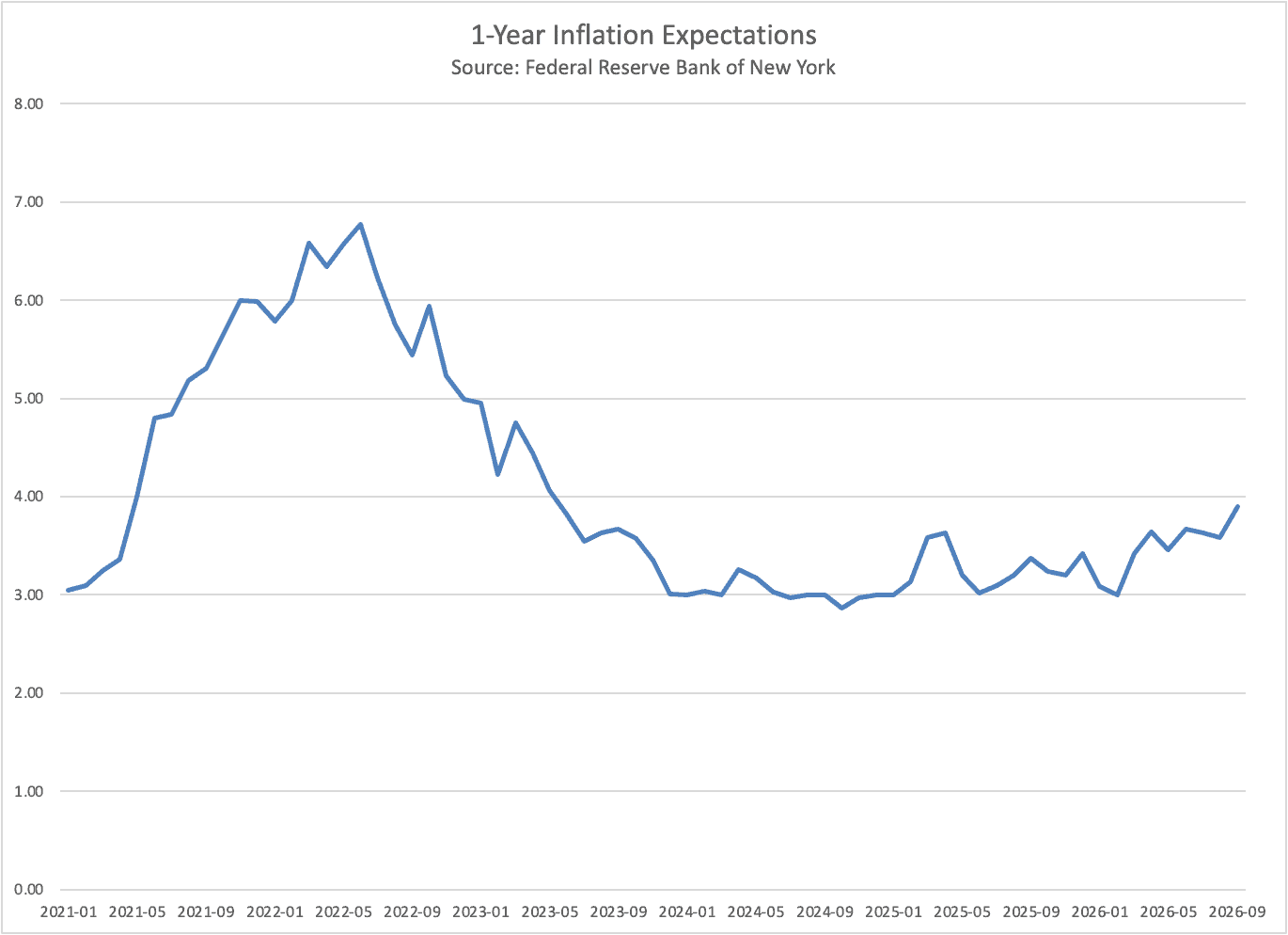
Yesterday the Federal Reserve Bank of New York released the September survey of consumer expectations, including new data on inflation expectations. The median inflation expectations for one year ahead increased by 0.3 percentage points to 3.9 percent. It is 3.3 percent for the three-year-ahead horizon and 3.0 percent at the five-year-ahead mark. It should trouble the Federal Reserve consumers do not believe inflation will fall to the 2-percent target over the next five years.
The recent evolution of one-year inflation expectations is shown in the graph below. Obviously, the explosion of inflation in 2021 was accompanied by a sharp rise in expected inflation, rising from 3.0 percent and peaking at just below 7.0 percent in early 2022. By comparison, inflation as measured by the consumer price index peaked at 9.1 percent in early 2022. Inflation expectations did return to the 3-percent level in 2024 but have crept upward since.
Inflation expectations are a crucial part of inflation and disinflation dynamics. For example, if people confuse a one-time increase in the cost of an item (e.g., a tariff) with ongoing price increases (i.e., inflation), they will behave as if facing inflation. They will ask for wage increases that compensate for future increases of the same size, even though they are not actually forthcoming. What happens? The upward pressure on wages turns into more upward pressure on prices. Voila! The consumer was right – prices continued to rise and are now expected to rise further. Expectations transform a one-time event into sustained inflation.
The release noted that median home price growth expectations remained unchanged at 3.0 percent. Also:
Among commodities, median year-ahead expected price changes increased by 0.2 percentage point to 4.8% for gas, by 0.2 percentage point to 5.5% for food, and by 0.1 percentage point to 9.2% for medical care. Median year-ahead expected price changes increase by 1.4 percentage points to 7.5% for the cost of a college education and by 0.2 percentage point to 6.8% for rent.
The September data are a stark tribute to the negative sentiment on “affordability” that is found across the economy. They also serve as a reminder that there is a lot of work to be done in getting inflation truly under control.
Fact of the Day
The total value of China’s listed imports from the United States was between $14.6–$20 billion in 2025.