The Daily Dish
August 20, 2025
Invoking March-in Rights: Undermining a Pillar of Innovation Policy
“To promote the Progress of Science and useful Arts, by securing for limited Times to Authors and Inventors the exclusive Right to their respective Writings and Discoveries….”
The first language protecting the right to innovation in the United States appeared in none other than the Constitution. In Article 1, Section 8, the Founding Fathers directed Congress to ensure the protection of intellectual property advancements, and it has done so. But the Trump Administration’s recent threats to invoke “march-in rights” – an ability to grant a compulsory license on a privately owned patent if the invention was developed with federal funding – indicate its intent to undermine that founding principle.
The Bayh-Dole Act has been one of America’s most important economic engines. Enacted in 1980, it enabled universities, small businesses, and nonprofits to retain ownership of inventions developed with federal funding. In the early 1980s, the private and public shares of U.S. R&D funding were roughly equal. But by the 2020s, the private sector was investing the lion’s share. The chart below shows this shift from federally driven research investments to both industry and others.
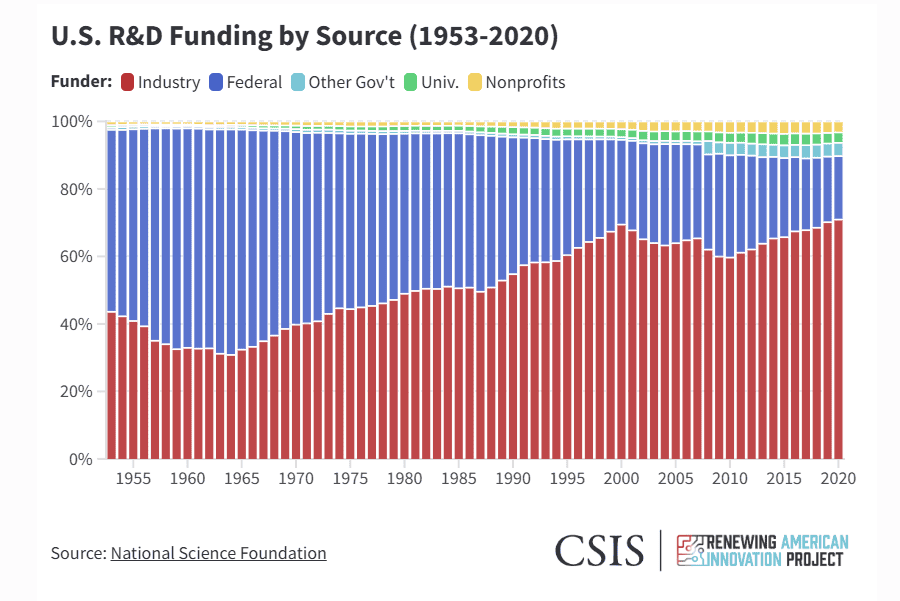
Source: National Science Foundation, CSIS
Now the federal government is undermining the public private support model by threatening the invocation of march-in rights as a blunt instrument for personal vendettas and unrelated policy and political goals. Intended as a narrow safeguard – allowing the government to relicense a patent only if the invention wasn’t being appropriately made available to the public – march-in rights have never been invoked in Bayh-Dole’s history.
Leveraging this authority is a gross distortion of the law’s intent. Bayh-Dole was designed to unleash innovation by giving inventors certainty that their rights would be protected. If innovators fear any successful product developed with even modest federal funding could later have its patent stripped away and relicensed because of mercurial political demands, much of the innovation we take for granted will evaporate.
This is not a hypothetical concern. Early-stage technologies are fragile. Translating a university discovery into a market-ready product can require more than a decade of development and billions in capital. That capital flows because investors know their intellectual property will be secure. Undermining that trust would send a chilling message: The federal government reserves the right to seize your patent if it doesn’t like you or how you run your company or institution.
Proponents argue this is necessary to protect taxpayers. But as the chart below shows, thousands of startups would be at risk, and transformative technological breakthroughs as a direct result of the Bayh-Dole protections would vanish.
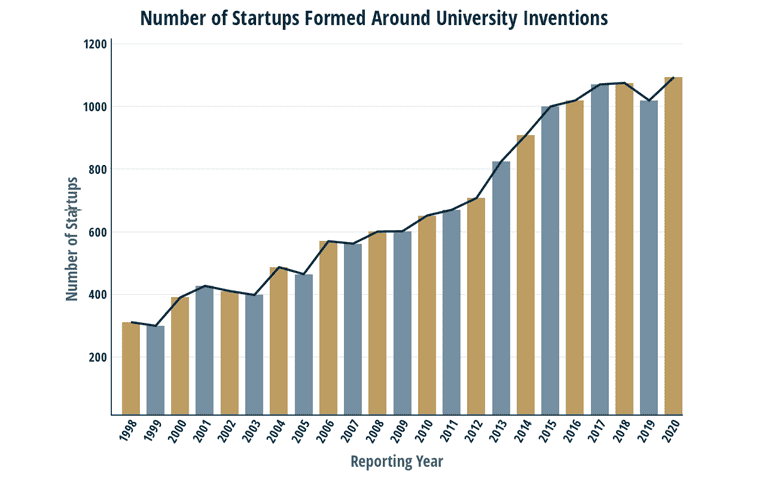
Source: Bayh-Dole Coalition
Even the threat of Bayh-Dole march-in rights to seize and relicense Harvard’s patents sets a dangerous precedent that no intellectual property is safe. Pharmaceutical companies, for example, which invest billions to commercialize federally seeded research, would face risks that their patents could be stripped away over political or pricing disputes. Such uncertainty would chill investment, slow drug development, and undermine U.S. leadership in life sciences.
The federal government should not abuse Bayh-Dole by turning march-in rights into a political weapon. Congress and the Administration should instead focus its energies on reaffirming the U.S. government’s commitment to protecting Americans’ intellectual property and innovation.
Fact of the Day
Routine childhood immunizations in the United States from 1994–2023 are estimated to have prevented around 508 million cases of illness, 32 million hospitalizations, and more than 1 million deaths.