The Daily Dish
April 13, 2026
March CPI Inflation
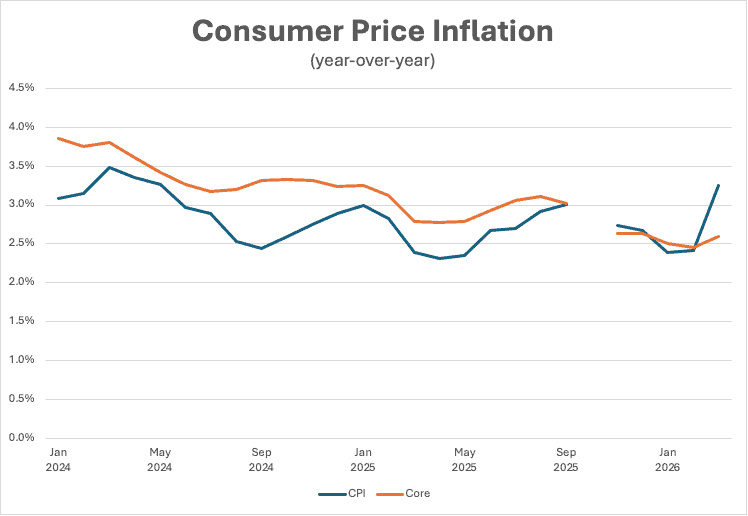
Friday the Bureau of Labor Statistics (BLS) released the March data for the Consumer Price Index (CPI), which included the impacts of the war with Iran on energy prices. As expected, prices rose sharply. Top-line CPI inflation was roughly 1 percent for the month, while the core (non-food, non-energy) inflation was 0.3 percent. This translated into a noticeable uptick in year-over-year inflation (see below; the gap is due to the government shutdown). CPI inflation was 3.3 percent, while the core came in at 2.6 percent.
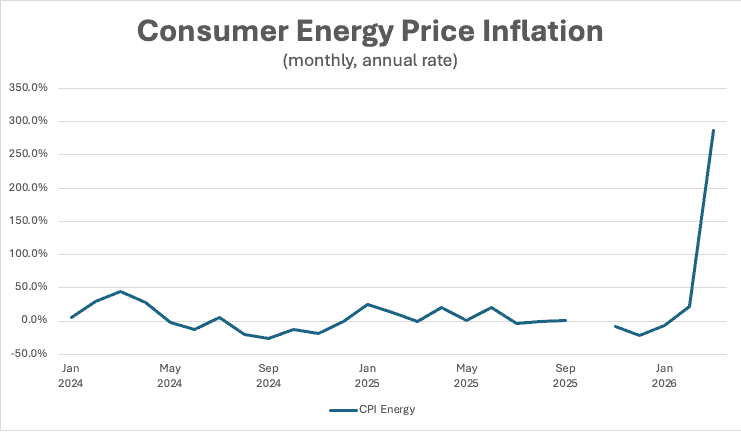
Of course, the heart of the inflation uptick was energy prices in the CPI, which rose 11.9 percent for the month.That translates into an annualized inflation rate of 287 percent for the month of March. This is a textbook energy price shock (see below).
Now, in the bad old days – pre-horizontal drilling, pre-hydraulic fracturing – this would have been a recipe for trouble on both the inflation and recession fronts. The global oil price shock will produce some cost-push inflation as fuel and petrochemicals prices rise and businesses pass higher costs on to consumers. If the oil price hike is truly transitory, this upward pressure will reverse shortly. Accordingly, the Federal Reserve should simply “look past” the energy shock and keep policy set to return inflation to the 2 percent target. As of this writing, however, talks have broken down and the president has announced a naval blockade of Iran, so the duration and severity of the energy shock is unclear.
Higher oil prices are also a tax on consumers (and non-energy businesses) due to higher prices for gasoline, fuel oil, and other products. This tax cuts into the demand for other goods and services. This used to be the primary impact of energy price shocks and the reason oil price spikes generated recession pressures. Now that the United States is a net exporter of oil, some of the transfer from consumers to producers stays inside U.S. borders and stimulates spending by those whose incomes are tied to oil production. In addition, it can stimulate investment in the energy sector, with knock-on benefits for manufacturers.
The upshot is that while there may be some headwinds to growth, they are far from large enough to ensure a recession. Is an oil price shock good news? No, but it is something that should slow growth by less than a percentage point in 2026.
Fact of the Day
On January 1, 19 states raised their minimum wage; three more states and the District of Columbia are scheduled to increase theirs later this year.