The Daily Dish
May 11, 2026
The Search for “Affordable” Jobs
Friday the Bureau of Labor Statistics released the employment report for April. The top line showed the labor market created 115,000 jobs and the unemployment rate remained at 4.3 percent. The job creation is well above the average of 21,000 jobs per month over the past year. Perhaps even better, the jobs were not exclusively in health. Health care and social assistance contributed 54,000 jobs, but transportation and warehousing contributed 30,000, and retail trade added 22,000. It is not exactly broad-based job growth, but it is a step in the right direction.
Now comes the bad news. Yes, the unemployment rate stayed unchanged – but not because additional jobs were created to accommodate a growing labor force. Instead, it was the opposite. Labor force participation declined from 61.9 percent to 61.8 percent and the labor force shrank by 92,000. In the household survey, the number of people employed fell by 226,000.
But the really poor development was growth in wages. Average hourly earnings rose at an annual rate of 1.9 percent in April and by 4.2 percent for production and non-supervisory workers. The inflation data for April will be released Tuesday, but it seems highly likely that it will exceed the wage growth. This would continue the downshift that began in March. As shown in the table below, year-over-year, inflation-adjusted wage growth dropped by a percentage point in March.
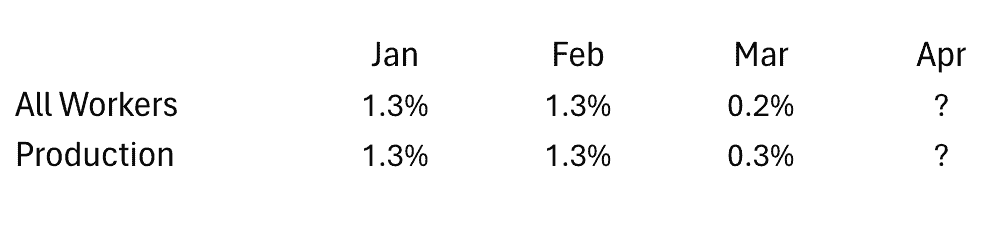
A continuation of this trend would be reminiscent of economic performance in 2021 and 2022. In those years, unemployment remained low, but high inflation resulted in negative real wage growth. People went to work and got further behind as they did it.
Creating jobs is important. Creating jobs that come with real wage growth is even more important.
Fact of the Day
Internet traffic over wired and wireless broadband connections more than doubled between 2019 and 2024.