The Daily Dish
May 7, 2026
National Small Business Week
The release of the monthly jobs report from the Bureau of Labor Statistics (BLS) falls during national small business week, so it is fitting to look at small business employment and discuss the impact of current policies on its growth.
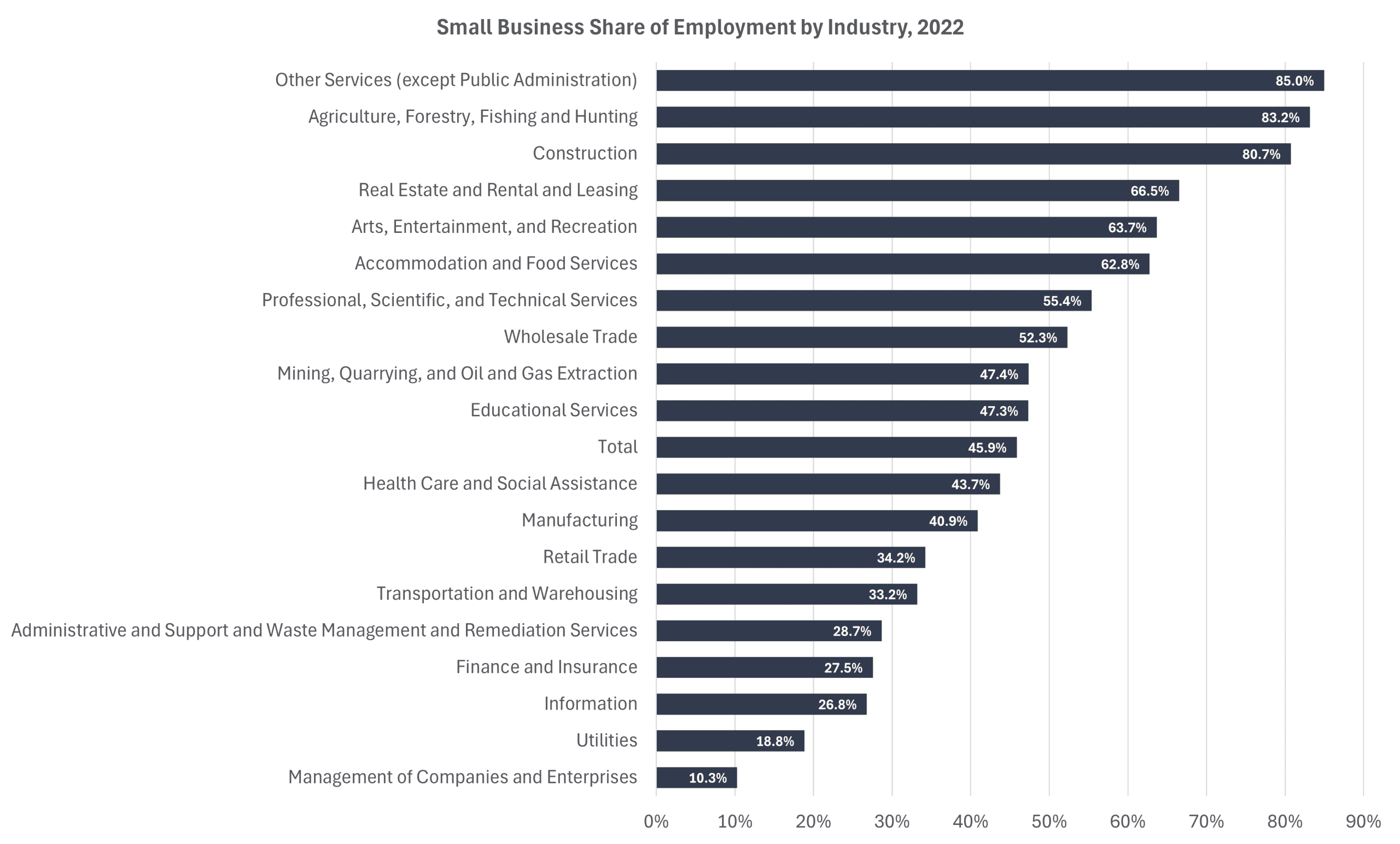
Data from the Census Bureau’s Statistics of U.S. Businesses (SUSB) showed that 45.9 percent of total employment came from small businesses – defined as enterprises that employ fewer than 500 people – in 2022. Small businesses accounted for most of the employment in eight industries, including more than 80 percent in three industries.
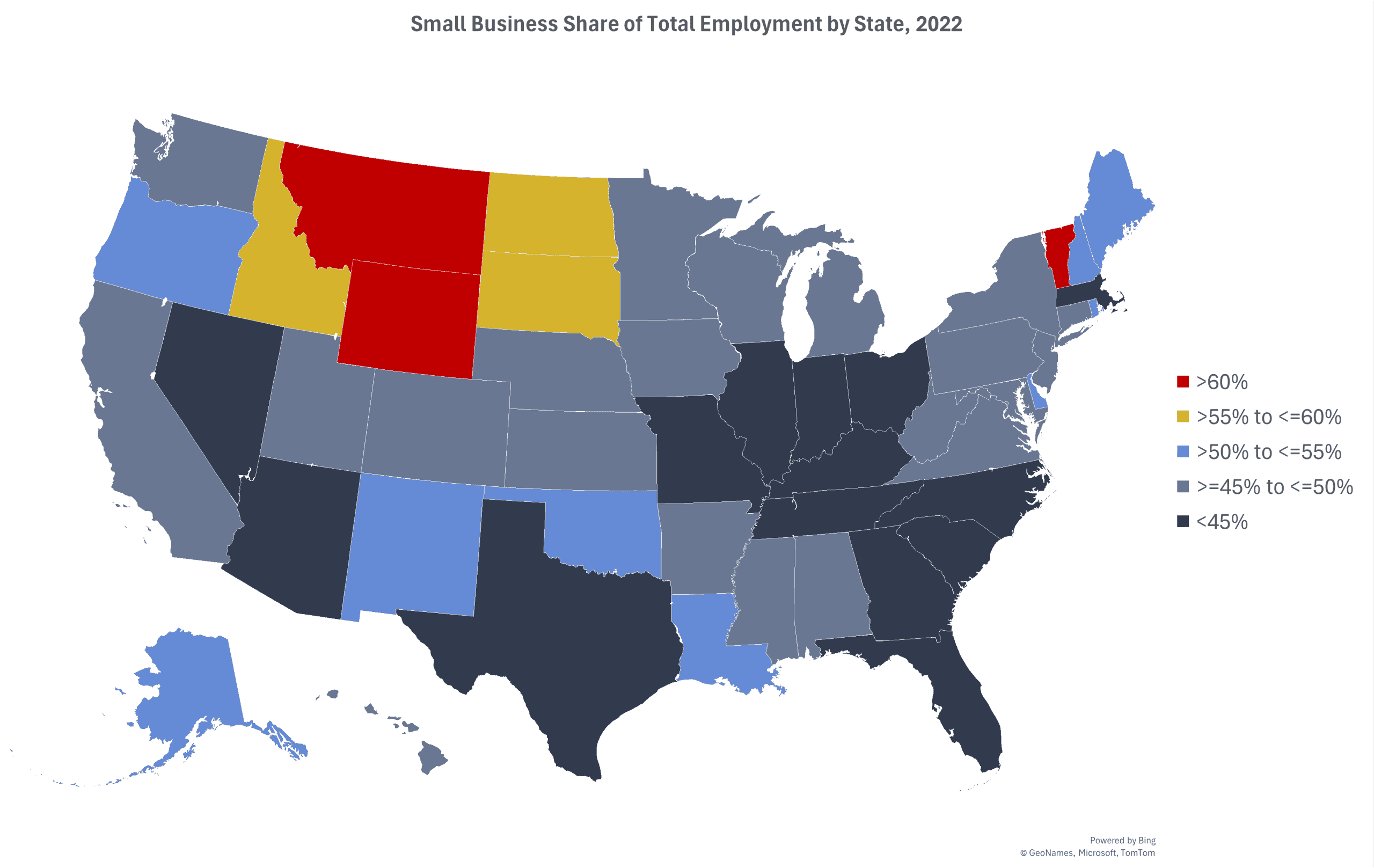
Small businesses are also critical to the employment landscape across geographies, representing the majority of employment in 15 states. Montana enjoys the largest share of small business employment at 66.3 percent, while Florida has the smallest share at just under 40 percent.
It is not simply small businesses’ share of employment that matters, but their contribution to overall employment growth. The Business Employment Dynamics statistics from BLS showed 2.3 million net private sector jobs were created between Q12023–Q3 2025, of which small businesses created 1.3 million, or 58 percent, of the total. Nearly 80 percent of the gains in small business employment were created by firms employing fewer than 250 people.
Regulatory relief and tax changes have been strong tailwinds for small business growth. The repeal of the beneficial ownership information reporting requirement alone saves businesses an estimated $8.4 billion annually. Provisions in the Tax Cuts and Jobs Act, including enhanced expensing and bonus depreciation, supported small business bottom lines.
Yet many of these constructive developments have been undercut by tariffs. American Action Forum Trade Policy Analyst Jacob Jensen (subscribe to his weekly trade newsletter The Shipment if you have not already) estimated that small businesses – those with fewer than 500 employees – incurred $85 billion in direct tariff costs. Although President Trump’s ability to impose tariffs under the International Emergency Economic Powers Act (IEEPA) was struck down by the Supreme Court, other tariffs are still in place, and their effects have weighed on small business hiring.
Recent data from Intuit showed that businesses with 1–9 employees, roughly 10 percent of total employment, sank 13 straight months from 13 million in March 2025 – immediately following the IEEPA tariff announcement – to 12.6 million in April 2026. Small businesses operating in sectors acutely sensitive to tariffs saw the largest drops in employment: manufacturing (-38,600), construction (-33,000), retail trade (-41,900), and transportation and warehousing (-35,900).
After losing its battle in court, the administration has begun refunding the ill-gotten tariff revenue. Jensen found that 330,000 importers are eligible for nearly $166 billion in refunds. He explained that only 17 percent of importers have completed the process to receive the refunds, suggesting that the process is “arduous and not well known to most importers, particularly small businesses.”
While small businesses remain the workhorse of the U.S. labor market, the recent pullback in hiring underscores how the harmful effects of tariffs – and the whipsaw fashion in which they are changed – may somewhat offset, or even erase, other policy victories of the Trump Administration. Boosting hiring among small businesses will ultimately require a more stable policy environment.
Freddy’s Forecast: April Jobs
A quick recap of where we’ve been: The March jobs report showed payrolls increased by 178,000, a sharp reversal from the downwardly revised 133,000 job losses in February. The unemployment rate ticked continued to remain anchored, settling at 4.3 percent.
Since the last report, data from ADP showed the pace of private-sector hiring picked up in April to 109,000 workers to payrolls, the fastest pace since January 2025. Small business hiring did the heavy lifting, adding 65,000 jobs during the month while large firms increased headcount by 42,000. Construction led the goods-producing industry gains, adding 10,000 jobs. Manufacturers gained 2,000 jobs, halting a monthly job-cutting streak that began in April 2024. Service-providing industries added 94,000 workers as education and health services sector (+61,000) continued to lead.
The Job Opening and Labor Turnover Survey data from BLS showed the labor market continued to hold steady. The March hiring rate reached 3.5 percent, the highest in nearly two years, while the layoff rate rose to 1.2 percent, the highest since October.
Initial jobless claims inched higher in the most recent week ending May 2 to 200,000 but remained low. The four-week moving average, which smooths out weekly volatility, was 203,250. Continuing claims, meanwhile, fell 10,000 during the week of April 25 to 1.766 million.
For April, expect payrolls to increase by 65,000 – a deceleration from the strong March report – and the unemployment rate to hold steady at 4.3 percent. Any positive payroll number would mark the first back-to-back monthly gain since April and May of 2025. Growth in average hourly earnings holds steady at 0.2 percent for a 3.7-percent annual gain.
Fact of the Day
Since the start of 2026, the federal government has published $940.6 billion in total regulatory net cost savings and 42.1 million hours of net annual paperwork increases.