The Daily Dish
August 5, 2025
Tariffs and the Stock Market
One of the puzzling features of the past several months has been the co-existence of the 100-year storm of tariffs and the high and rising stock market. After all, if and only if foreign sellers lower their prices by the amount of the tariff will U.S. businesses be unaffected. Either firms will have to “eat” the tariffs – kiss the profits goodbye – or consumers will face higher prices and buy less – kiss revenue growth goodbye. Surely an equity market analyst will grasp this in a heartbeat, and prices reflect this diminished reality.
On closer inspection, this may not be so mysterious after all. Among the most affected products are autos, whose prices are governed in part by auto tariffs, steel tariffs, aluminum tariffs, and country/universal/reciprocal tariffs. But the market capitalization of General Motors is, for example, only $50 billion, while total market capitalization of the S&P 500 is in the range of $52 trillion. By contrast, the market capitalization of NVIDIA is just under $4.5 trillion and is relatively unaffected by tariffs. In short, the tech giants that drive current market valuations are not the target of the trade war.
But will this change? Among the sectors that President Trump has identified as constituting a national security threat is semiconductors. Won’t a semiconductor tariff bring the tech giants to their knees, and the stock market along with it?
Maybe.
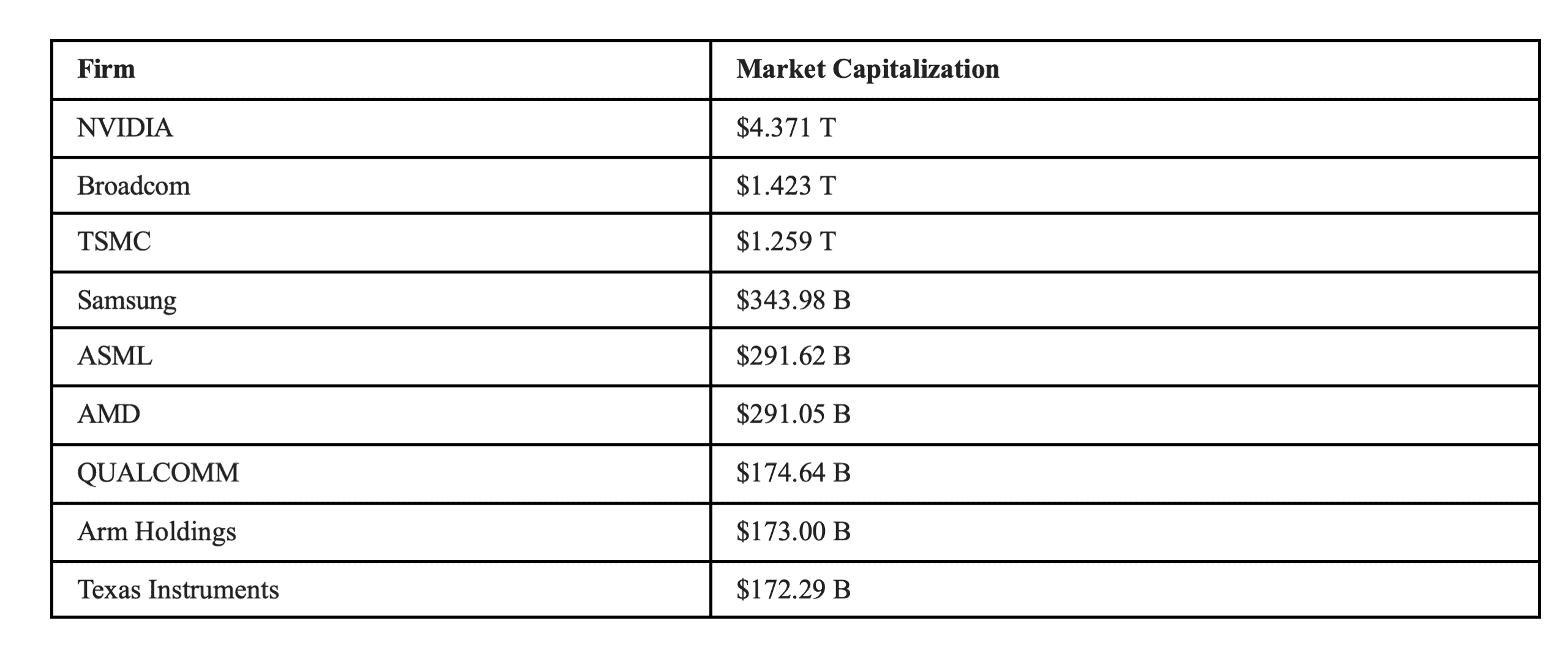
On the one hand, the semiconductor industry is not large. The sector has been estimated by The Kobeissi Letter to constitute 12.1 percent market share of the S&P 500. Put differently, the combined market capitalization of the top 10 global chip companies is in the range of $6.5 trillion, compared to the $52 trillion total market capitalization of the S&P 500. Perhaps the semiconductor tariff would be another policy the market can look past.
On the other hand (apologies, President Truman) the semiconductor tariff might have quite broad impacts. The Information Technology and Innovation Foundation finds that a 25-percent tariff on semiconductor imports would reduce U.S. economic growth by 0.18 percentage points. One reason is that downstream industries use semiconductors in everyday devices such as temperature sensors in household appliances, electronic devices, medical devices – CT scanners or MRI machines – and cars. This argues that the impacts might be quite large.
The semiconductor tariff decision looms in the near future. One way or the other, we will find out the answer.
Fact of the Day
Across all rulemakings, agencies published $801.4 billion in total cost savings and cut 87,007 paperwork burden hours.