The Daily Dish
November 18, 2025
The Backdoor Tariff on Biofuels
U.S. energy policy has a long history of being anything but market-driven. A good example is the Renewable Fuels Standard (RFS), which is a federal mandate to blend biofuels with transportation fuels (think ethanol and gasoline). Under the Environmental Protection Agency’s (EPA’s) proposal,the amount of biofuel blended into fuels would rise to 1.7 billion ethanol-equivalent gallons (EEGs) in 2026 and 2.1 billion EEGs in 2027.
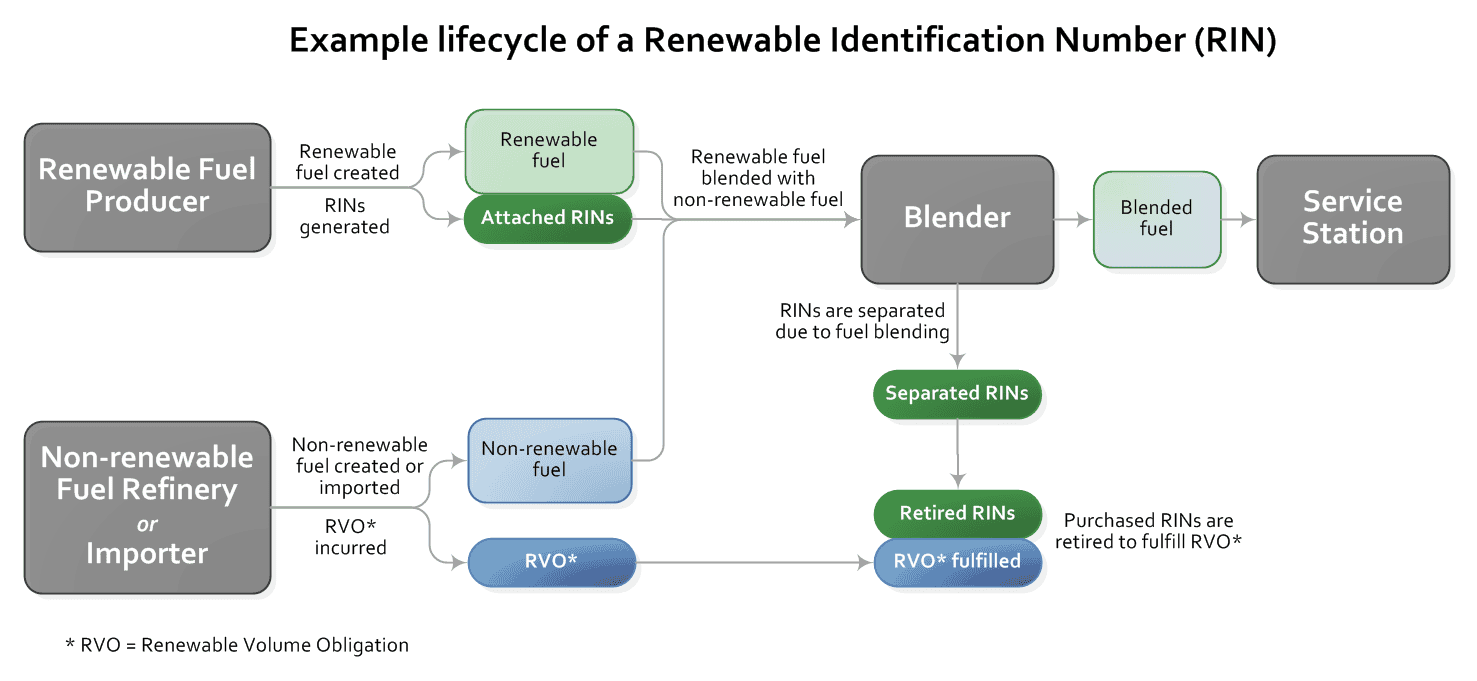
That’s good news for farmers, but not exactly a market-driven energy outcome. But now comes the interesting part. A feature of the RFS system is Renewable Identification Numbers (RINs), which are tradeable credits for blending biofuels. As shown in the handy diagram (below) copied from the EPA website, with each gallon of biofuels produced there is assigned a corresponding RIN. When a refinery or blender blends the biofuel, it holds on to the RIN. Another refinery can meet some or all of its RFS obligations by buying the RIN from the first blender, essentially transferring the credit to the second refinery.
Notice that if the first refiner is more efficient than the second, it may be cheaper for the latter to purchase the RIN than to buy the biofuel and blend. And because the first refiner can blend at low cost, there is money to be made by purchasing the biofuel, blending, and selling off the RIN. Both come out ahead, making the system more economically efficient. This cost minimization has been a feature of the RFS for years.
Enter the Trump EPA, which proposes to cut the value of a RIN for imported biofuels by 50 percent – the moral equivalent of a tariff on imported biofuels. Like explicit tariffs, this proposal would hurt the price of imports and raise the attractiveness and price of domestic biofuels. Again, this would be good news for farmers, but would be bad news for refiners of all types because it raises the cost of blending from all sources.
A hidden tax/tariff is still a tax/tariff, and thus works contrary to the Trump Administration’s stated desire to get – and keep – gasoline prices down. Perhaps the administration might inform the EPA of its goals?
Fact of the Day
Across all rulemakings, federal agencies published roughly $2 billion in total cost savings and cut 7.1 million paperwork burden hours.