The Daily Dish
April 7, 2026
The President’s Budget
This past Friday morning, about seven hours ahead of the expected release time, the Trump Administration released the president’s budget for fiscal year 2027 (which begins October 1, 2026). AAF’s Jordan Haring has a nice analysis. Eakinomics has three basic areas of concern about this budget: its structure, its foundation, and its proposals.
The structure of the budget seems designed solely to obfuscate and confuse. The basic budget document contains only the president’s proposals for appropriating defense and non-defense discretionary spending. There is no basic budget table that shows receipts, discretionary outlays, mandatory outlays, net interest costs, deficits, and debt under current law for the next 10 years. There is no table or tables that summarizes the proposals for discretionary spending and taxes and mandatory spending, or the path of the budget under all the president’s proposals.
It is possible to dig through the supplemental volumes and find something that looks close to current-law receipts and current-law mandatory spending. With those in hand and some assumptions about interest costs, it is possible to cobble together a basic budget table. But no one should ever have to do that. The only thing one can conclude is that if all the numbers were in one place, they would paint a picture the administration is trying to suppress.
The second point is that the budget is built on a foundation of unrealistic economic assumptions. This table is reproduced from Haring’s paper:
The budget is assuming real growth at 3 percent or higher, even though there is essentially no growth in the labor force. This is basically all productivity growth and a risky bet for formulating a budget. With that growth it is assumed that there will be lower unemployment and similar inflation to the Congressional Budget Office and the Federal Reserve. But somehow 10-year interest rates will be dramatically lower. Huh?
Haring’s take: “The budget also includes a set of economic projections that are more optimistic than those from other forecasters.” (Understatement, thy name is Jordan Haring.) Eakinomics’ take: Don’t bother building the budget table mentioned above. With a fantasy forecast as the starting point, it doesn’t teach you anything.
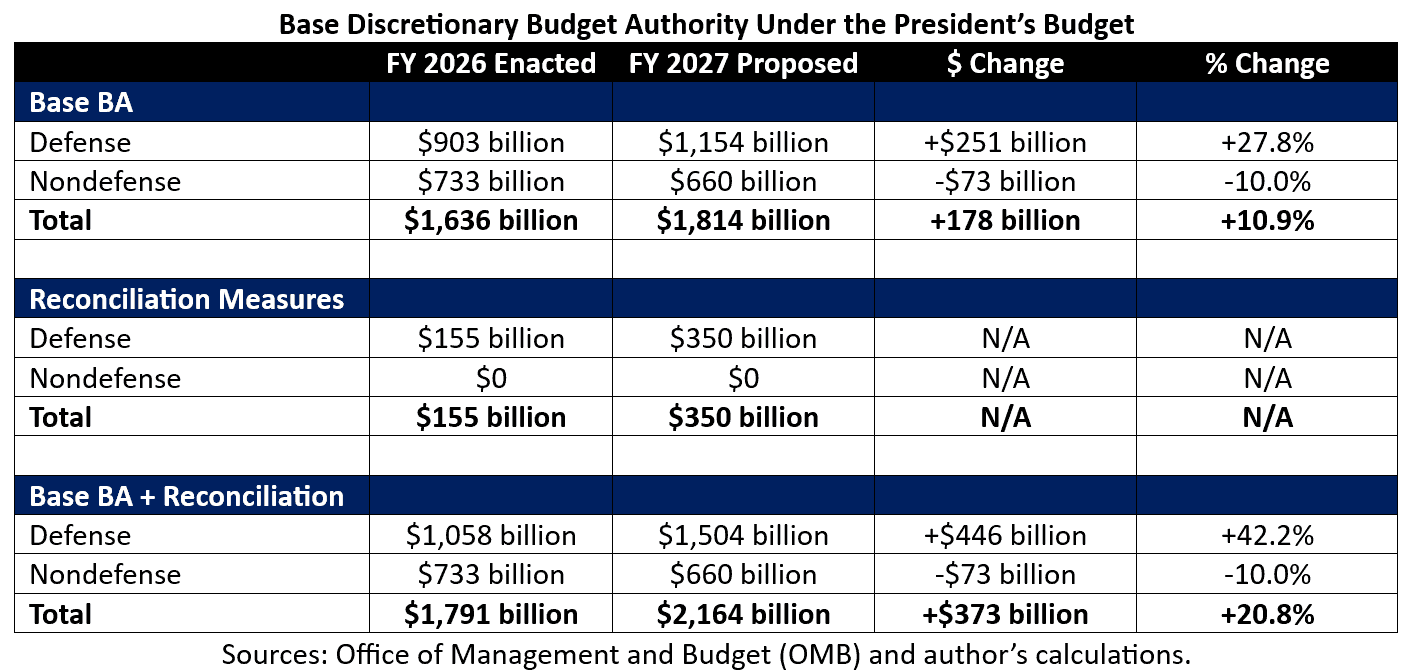
Finally, there are the proposals themselves. Wait! There are no mandatory proposals. That’s right, Social Security and Medicare are more than half of all non-interest spending over the next 10 years, will grow faster than revenues, and will both see their trust funds become exhausted, but there is no need to change anything. Mandatory spending is 70 percent of the fundamentally broken budget and there is no need to change anything. And the tax code is evidently perfect as well.
The discretionary proposals (see Haring for a careful discussion) will get all the attention. But in the absence of the remainder, this budget is simply not serious about, well, budgeting.
Fact of the Day
Across all rulemakings last week, federal agencies published roughly $33.9 billion in total costs but cut 162,690 paperwork burden hours.