The Daily Dish
January 29, 2026
The Robots Are Coming
The headline in Bloomberg said “Amazon to cut 16,000 corporate positions to trim bureaucracy,” while the Financial Times countered with “Amazon to axe another 16,000 corporate jobs” and elaborated: “Cuts will bring total number of lay-offs to 30,000 over past three months amid higher spending on AI.” That’s right, the dreaded AI (artificial intelligence) strikes again.
Headlines of this ilk appear all the time and Eakinomics gets it. The goal is to maximize heart palpitations, engender the ability to visually verify rising blood pressure, and…sell newspapers. But let’s calm down for just one second. One of the reasons that the robots are coming is that they can do arithmetic. So, let’s do some arithmetic.
Amazon is cutting 30,000 jobs, at least in part because of the promise of AI. Sounds like a lot. But in December 2025, there were 164 million people (will that soon include robots?) employed in the United States. That is 0.02 percent, or roughly the same chances as the Pirates ever winning a pennant. Not much of a threat.
On the other hand, 30,000 is close to 10 percent of Amazon employment. So, if every firm is ultimately going to have its “Amazon Moment,” then 16.4 million jobs are facing robo-elimination and the unemployment rate will jump from 4.4 percent to 14.4 percent. That sounds horrible!
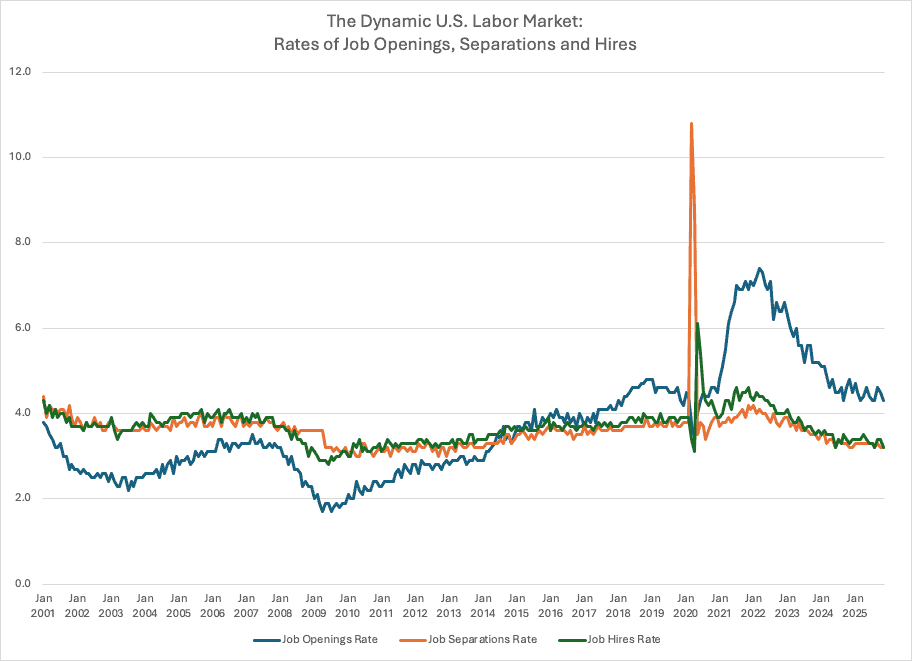
Except that the U.S. labor market had 5 million “separations” (job losses, including quits) in November 2025 alone. So 16.4 million jobs lost is just a bit over 3 months of business-as-usual job destruction in the United States. Put differently, the rate of job separation is a bit above 3 percent (see chart below) so three months of this creates 10 percentage points of new unemployment.
So the robots are coming, but labor-market suffering is well-practiced and the robots will have a hard time fazing the bone, muscle, and GLP1-resistant fat set. But more to the point, in the same month of November, the labor market had over 5 million “hires.” In the same way that jobs are regularly destroyed, new jobs are regularly created. As the chart shows, by and large the opposing forces remain balanced over the long term.
As exemplified by the pandemic, however, there are periodic large shocks to the labor market. When this occurs, not only do job separations jump, over time job hiring responds strongly as well. AI may be a large shock that arrives over time, but history suggests that the U.S. labor market has the wherewithal to survive it.
When the robots arrive, they will bring new jobs and “help wanted” signs with them. Slow your heartbeat, relax, and make no hasty newspaper purchases.
Fact of the Day
The United States dominated AI funding in 2025, with $159 billion, or 79 percent, of investment going to U.S.-based companies.