








The Daily Dish
October 19, 2026
The State of the Federal Budget
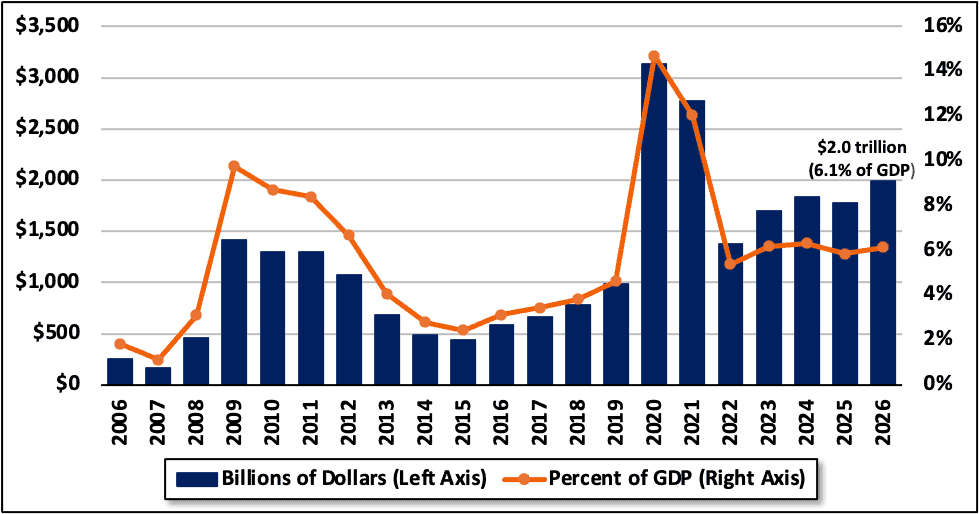
This past week, the U.S. Treasury closed the books on Fiscal Year 2026 (FY2026), which ended on September 30. After a whopping $1.8 trillion deficit in FY2025 – 5.8 percent of gross domestic product (GDP) – one might hope that the gusher of red ink might abate somewhat. Alas, it was not to be. The Monthly Treasury Statement showed a $2.0-trillion budget deficit for the year – the net effect of $7.4 trillion of spending and $5.4 trillion of revenue collections. Jordan Haring’s new insight provides a thorough autopsy of the fiscal year.
Economic growth did produce an additional $169 billion in revenue collections, but this was overwhelmed by $305 billion in higher mandatory and discretionary spending and $81 billion in higher interest payments. The $217-billion increase in the deficit is hardly surprising. The president had a lifetime of supporting tax-and-spend liberals before grafting onto a conservative political party to produce a no-tax-and-spend budgetary Frankenstein. The recent trajectory of deficits is shown in the chart (below) reproduced from Haring’s work.
Annual Budget Deficits, FY 2006–2026 (Billions of Dollars and Percent of GDP)
Sources: CBO, U.S. Department of the Treasury, and author’s calculations.
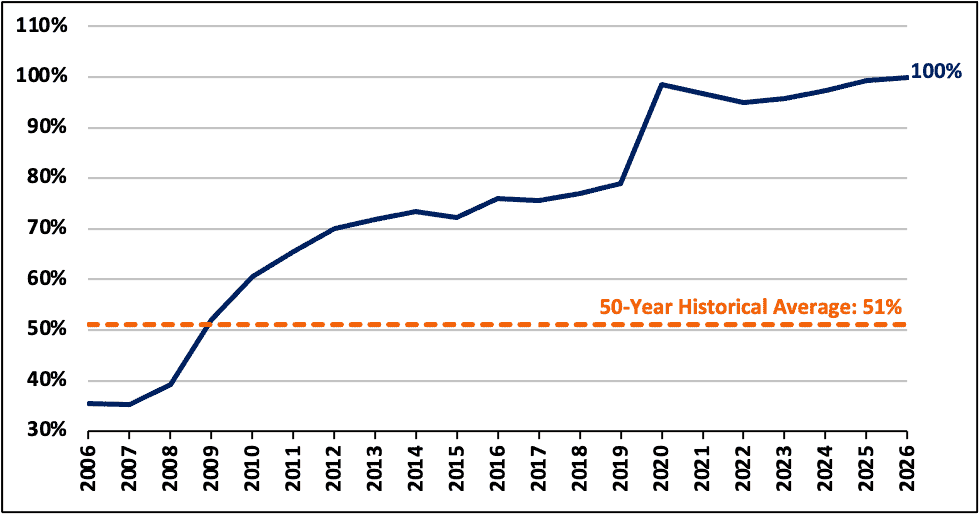
The annual red ink has produced a steady rise in the federal debt to 100 percent of GDP, roughly double the historical average. (See, below, again reproduced from Haring.)
Federal Debt Held by the Public, FY 2006–2026 (Percent of GDP)
Sources: CBO, U.S. Department of the Treasury, and author’s calculations.
These results are a reminder that the federal budget outlook is unsustainable, and this has been widely understood for years. Clearly, the politics of the federal budget must change, but especially at the very top. Over the course of the past three administrations, fiscal stewardship has morphed from missing to reckless.
Fact of the Day
According to CBO, federal revenue collections rose by $169 billion (3 percent) between FY 2025 and FY 2026, from $5.2 trillion to $5.4 trillion.