The Daily Dish
September 17, 2025
Whither the Dollar?
One of the striking features of the economic environment has been the recent, rapid decline in the value of the dollar. As one can see in the graph below, the recent peak in the dollar was in January 2025. Since then, it has declined by roughly 10 percent.

To be fair, the recent decline comes at the end of a long-term rise in the dollar (see below) from its lows in the aftermath of the Great Recession.
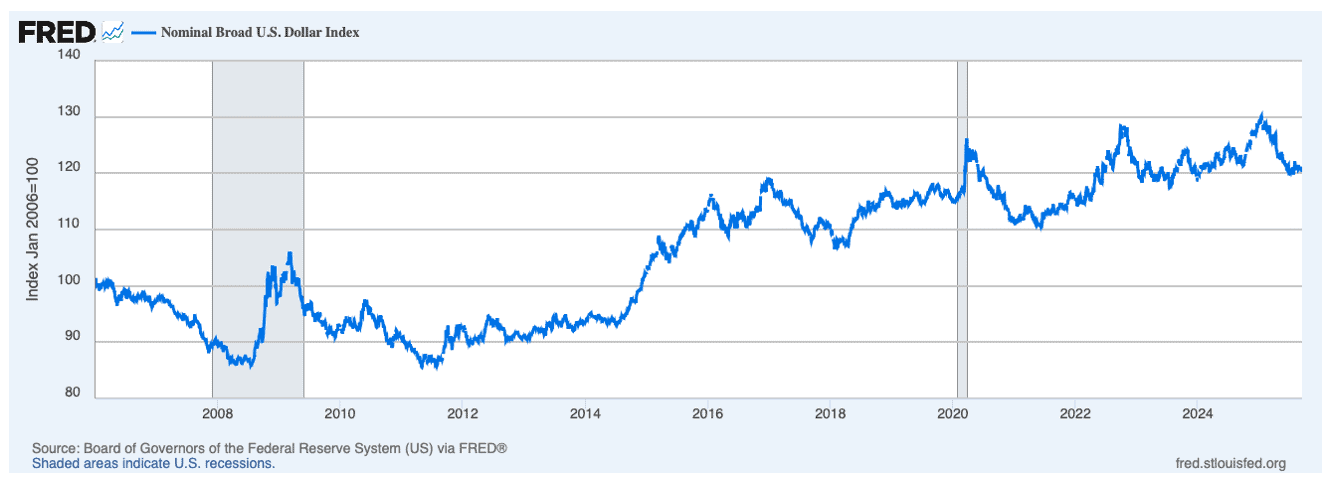
These graphs raise the question: What will determine the future of the dollar?
Let’s put aside for the moment the mysticism that accompanies notions like the dollar as a barometer of national testosterone or special status as a reserve currency. In plain terms, the exchange rate is a price – the price of acquiring dollars.
Why might one want dollars? You want dollars to buy American stuff – goods and services. You want dollars to make American investments – build factories, buy equities, or buy Treasuries. Of course, all of these “wants” are measured relative to the same activities outside the United States. The bottom line is that if the U.S. economy is relatively strong, the dollar will be strong. On the other hand, if the U.S. economy appears to be weakening, the dollar will follow suit.
But there is a hitch to this story: inflation. If inflation in the United States starts running hot – all else the same – then the dollar must weaken to offset the higher prices and keep U.S. goods attractive.
So, did the recent decline in the dollar reflect inflation developments, or a change in the real competitiveness of American goods, services, and investments? A quick way to tell is to compare the nominal exchange rate – as shown in the first graph – with the inflation-adjusted exchange rate. The graph (below) shows the exchange rate adjusted for inflation in the United States and abroad.
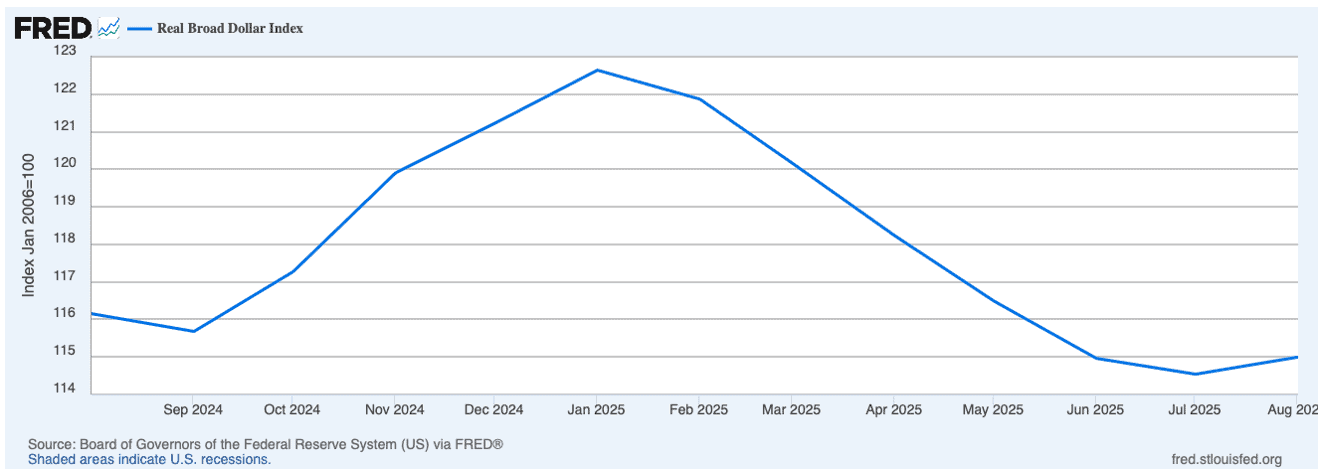
It looks essentially the same as the first graph, so the decline must be driven by what they have in common: the real economy. It is unlikely that there has been a noticeable change in goods and services over the past eight months. By the process of elimination, something about the investment climate seems to have shifted.
The United States has long been the premiere place on the planet for investment dollars. Any diminishment of that status is troubling, and further declines in the dollar should put policymakers on alert.
Fact of the Day
On a monthly basis, the prices of sewing machines, coffee, tomatoes, certain clothing, and apples have risen between 3.5 and 9.1 percent.