Insight
November 7, 2025
Can the President Withhold Federal Funds From New York City?
Executive Summary
- President Trump recently said he would withhold federal funding from New York City if Zohran Mamdani won its mayoral election; now that Mamdani has won, time will tell if the president takes steps to withhold funding from the city.
- New York City’s $115.9 billion fiscal year 2026 budget includes $7.5 billion of federal funding, which primarily goes toward social services, education, and housing.
- The president’s threat to withhold federal funding from New York City brings up the issue of impoundment and whether the president can legally circumvent federal funding decisions made by Congress to withhold federal funds from New York City.
Introduction
President Trump recently said that if Zohran Mamdani won the New York City mayoral election “…it is highly unlikely that I will be contributing Federal Funds, other than the very minimum as required, to [New York City].” In the wake of Mamdani’s victory, the president seemingly walked back his earlier comments, saying “We’ll help him. We want New York [City] to be successful. We’ll help him. A little bit, maybe.” Only time will tell if the president maintains his earlier stance and takes steps to withhold federal funding from New York City.
New York City’s fiscal year (FY) 2026 budget includes $7.5 billion of federal funding, the equivalent of 6.4 percent of its $115.9 billion budget. The federal funding the city receives primarily goes toward social services, education, and housing.
The threat to unilaterally withhold federal funding from New York City brings up the issue of impoundment and whether the president can legally circumvent funding decisions made by Congress and withhold federal funding from New York City.
How Much Federal Funding Does New York City Receive?
In late June, the New York City Council adopted a $115.9 billion budget for fiscal year (FY) 2026, which began on July 1, of which $7.5 billion – or 6.4 percent – comes from federal funding. Federal funding is provided to New York City in the form of categorical grants.
Of the $7.5 billion of federal funding, 47 percent ($3.5 billion) goes toward social services agencies, 28 percent ($2.1 billion) goes toward education, and 12 percent ($880 million) is devoted to housing. Another 4 percent ($289 million) goes toward health, 1 percent ($86 million) goes toward transportation, and 1 percent ($81 million) is devoted to uniformed agencies such as the New York City police and fire departments. The remaining 6 percent ($471 million) goes toward miscellaneous other matters.
Breakdown of FY 2026 Federal Funding to New York City
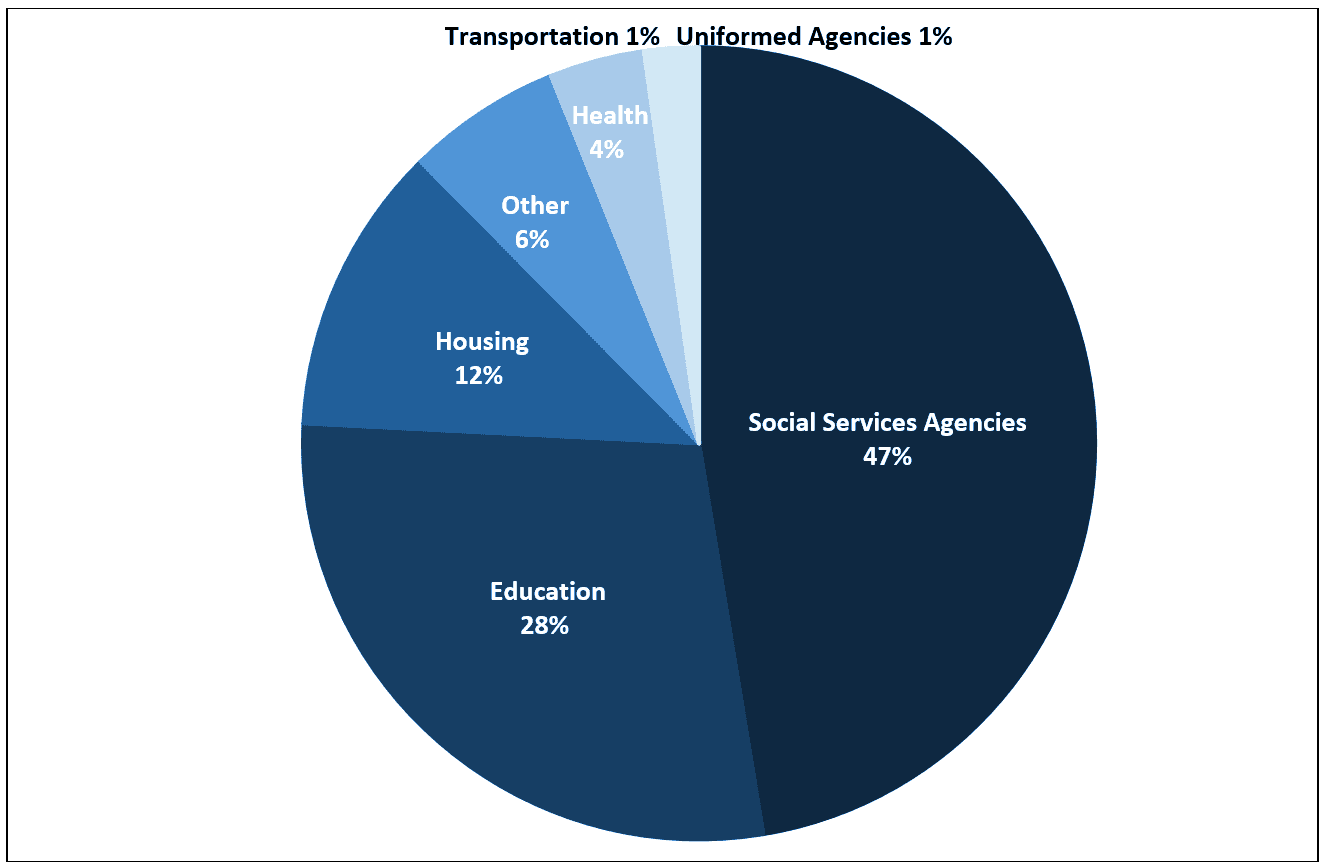
Sources: Office of the New York State Comptroller and author’s calculations.
The largest individual federal funding streams to New York City include Temporary Assistance for Needy Families, Title I education grants, special education grants, and Medicaid funding, among others.
Top Federal Funding Streams to New York City
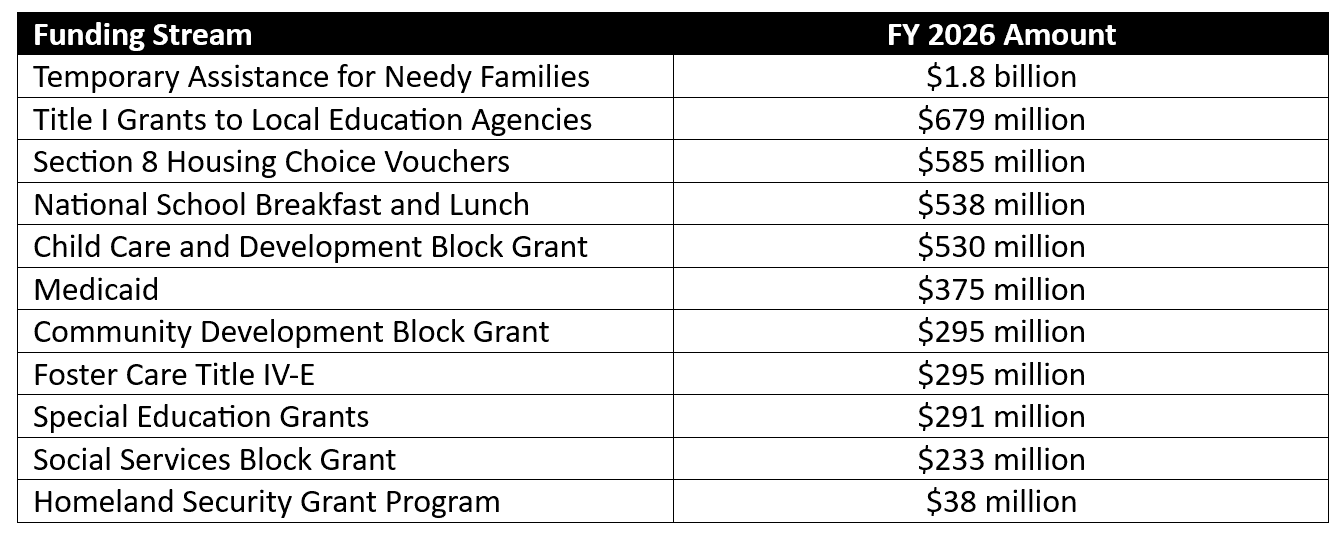
Source: Office of the New York State Comptroller.
Can the President Withhold Federal Funds From New York City?
The threat of withholding federal funds from New York City brings up the issue of presidential impoundment authority.
Article I of the U.S. Constitution gives Congress the authority to appropriate funds and to impose taxes – otherwise known as “the power of the purse.” The executive branch, meanwhile, is responsible for spending the appropriated funding for the purposes Congress intended. As head of the executive branch, the president can theoretically circumvent Congress’ power of the purse and order federal agencies not to spend certain funds appropriated by Congress, but instead either defer spending the funds or rescind them altogether through a process established in the Impoundment Control Act of 1974 (ICA). This process is known as impoundment and presidents have used their impoundment authority when Congress has appropriated funding for a purpose that is no longer needed.
Notably, the ICA limits the executive branch’s impoundment authority and codifies Congress’ power of the purse. Title X of the ICA – Impoundment Control – outlines procedures to keep the president and other executive branch agencies from unilaterally replacing Congress’ spending decisions with their own. The ICA limits impoundments by sorting them into two categories: deferrals and rescissions. It also outlines a fast-track process in Congress to disapprove a proposed deferral. For a proposed rescission, the ICA provides a different fast-track process for Congress to approve the proposed rescission (for more on impoundment, see here).
If the president does not follow the ICA’s process for deferrals or rescissions and unilaterally withholds congressionally appropriated funding that is an unconstitutional act of impoundment. To legally withhold funding from New York City, the president would need to alert Congress of his intent to either defer or rescind federal funding from the city and Congress would have the final say over whether the president can withhold the funding. A unilateral withholding of the funds would open the executive branch up to legal challenges.
Prior to Mamdani’s election, the executive branch attempted to unilaterally withhold $12 million of federal funding to New York City’s Metropolitan Transit Authority for counterterrorism policing in the city’s subway system. In response, New York City filed a motion in support of New York state’s case against the executive branch to prevent it from revoking the funding. Any future attempts to universally withhold federal funding from New York City are likely to meet the same legal challenge.