Insight
July 1, 2026
CBO’s Estimate of the President’s FY 2027 Budget
Executive Summary
- The Congressional Budget Office (CBO) has released its estimate of the president’s fiscal year (FY) 2027 budget; CBO analyzed the budget’s mandatory and discretionary spending proposals, but did not publish comprehensive projections of debt, deficits, revenue, and spending under the plan.
- Combining this CBO estimate with its earlier baseline budget and economic projections shows that debt held by the public would increase from 100 percent of gross domestic product (GDP) at the end of FY 2026 to 121 percent in FY 2036 under the budget — significantly above a projected 94 percent of GDP using the Office of Management and Budget’s (OMB) assumptions.
- Budget deficits under the president’s plan would be $7.7 trillion higher over the FY 2026-2036 budget window using CBO’s assumptions than under those of the OMB; this is largely driven by CBO’s and OMB’s different baseline and economic assumptions.
Introduction
The Congressional Budget Office (CBO) has released its analysis of the spending proposals in the president’s fiscal year (FY) 2027 budget using its own assumptions to evaluate the budget’s policies.
The president’s budget, which the Office of Management and Budget (OMB) published in April, was atypical in that it only included the administration’s FY 2027 discretionary spending request and an economic forecast and did not include comprehensive tables outlining the fiscal impact of the budget. OMB’s supplemental information, however, provided enough information to calculate reasonable projections of debt, deficits, spending, and revenue under the budget with OMB’s assumptions.
The same is true for CBO’s estimate of the President’s budget. CBO only estimated the impact of the budget on mandatory and discretionary spending. CBO’s regular budget and economic data, however, provided enough information to calculate reasonable projections of debt, deficits, spending, and revenue under the budget with CBO’s assumptions.
Using CBO’s assumptions, federal debt held by the public would rise from an estimated 100 percent of gross domestic product (GDP) at the end of FY 2026 to 121 percent of GDP in FY 2036 — significantly higher than a projected 94 percent of GDP using OMB’s assumptions. Budget deficits would be $7.7 trillion higher over the FY 2026-2036 budget window with CBO’s assumptions, driven largely by baseline and economic differences between CBO and OMB.
The Fiscal Impact of the President’s FY 2027 Budget
The president’s budget typically presents a comprehensive plan for mandatory and discretionary spending and revenue for the next decade. This year’s budget only included a FY 2027 discretionary spending request and an economic forecast. As a result, no comprehensive tables outlining the fiscal impact of the budget were provided. Luckily, the supplemental tables in Analytical Perspectives provided enough information to calculate reasonable projections of debt, deficits, spending, and revenue under the budget with OMB’s assumptions.
The same goes for CBO’s estimate of the president’s budget. CBO only estimated the impact of the budget on mandatory and discretionary spending. Luckily, CBO’s regular budget and economic data provided enough information to calculate reasonable projections of debt, deficits, spending, and revenue under the budget with CBO’s assumptions.
Debt, Deficits, Revenue, and Spending Under the President’s FY 2027 Budget
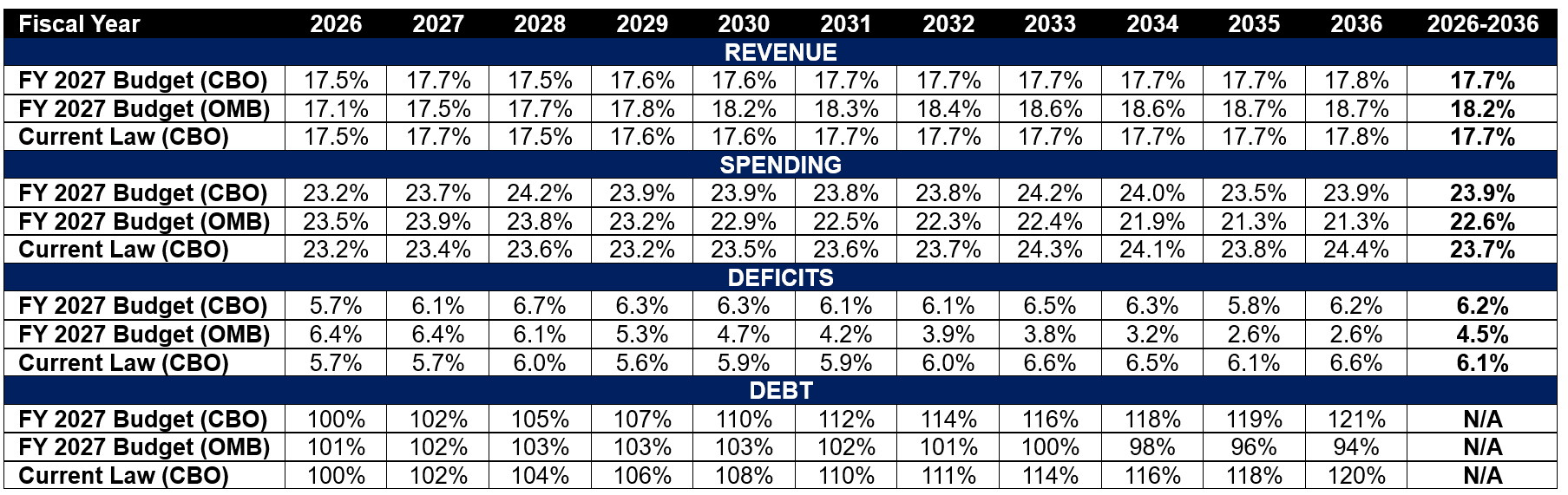
Debt under the president’s budget would rise over the next decade, from an estimated 100 percent of GDP at the end of FY 2026 to a new record of 107 percent of GDP by FY 2029 and to 121 percent of GDP by the end of FY 2036. While debt-to-GDP would be one percentage point higher in FY 2036 than projected under current law, it would be significantly higher than an estimated 94 percent of GDP using OMB’s assumptions.
Debt Held by the Public Under Current Law and President’s FY 2027 Budget (percent of GDP)

Sources: CBO, OMB, and author’s calculations.
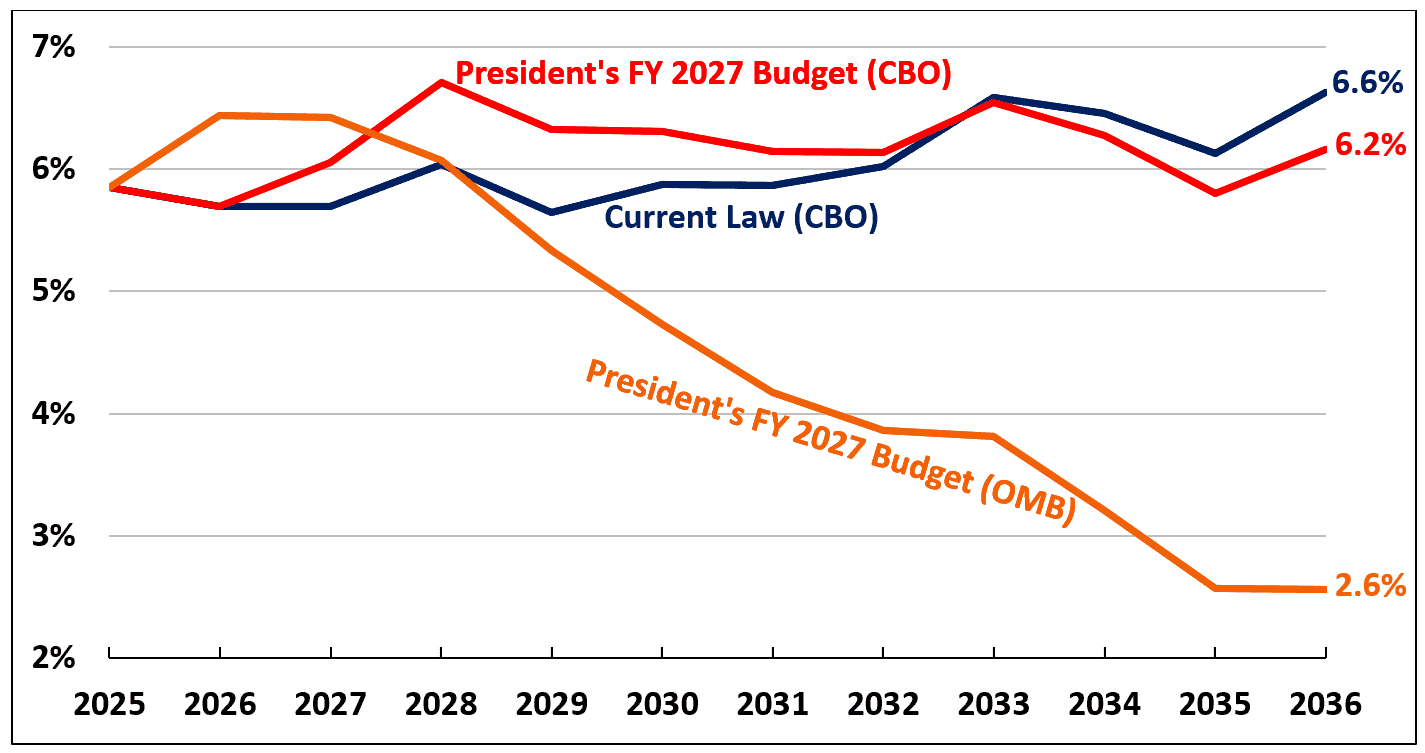
Using CBO’s assumptions, the budget deficit would rise from 5.7 percent of GDP ($1.8 trillion) in FY 2026 to a peak of 6.7 percent of GDP ($2.3 trillion) in FY 2028. From there, the deficit would fall as a share of GDP but continue to grow in nominal dollars, reaching a projected 6.2 percent of GDP ($2.9 trillion) in FY 2036. This would be lower than the projected 6.6 percent of GDP ($3.1 trillion) deficit under current law but more than double the projected 2.6 percent of GDP ($1.3 trillion) deficit with OMB’s assumptions.
Budget Deficits Under Current Law and President’s FY 2027 Budget (percent of GDP)
Sources: CBO, OMB, and author’s calculations.
The president’s budget did not include any revenue proposals, so estimates of revenue under the budget are assumed to be the same as under current law using CBO’s assumptions. Specifically, revenue would rise from 17.5 percent of GDP ($5.6 trillion) in FY 2026 to 17.8 percent of GDP ($8.3 trillion) in FY 2036. These estimates differ from projected revenue under the president’s budget using OMB’s assumptions, which finds revenue would rise from 17.1 percent of GDP ($5.5 trillion) in FY 2026 to 18.7 percent of GDP ($9.8 trillion) in FY 2036.
Using CBO’s assumptions, spending under the president’s budget would grow from 23.2 percent of GDP ($7.4 trillion) in FY 2026 to 24.2 percent of GDP ($10.1 trillion) in FY 2033. From there, spending would fall as a share of GDP but continue to grow in nominal dollars, reaching a projected 23.9 percent of GDP ($11.2 trillion) in FY 2036. This would be lower than the projected 24.4 percent of GDP ($11.4 trillion) spending under current law but in line with the projected $11.2 trillion of spending using OMB’s assumptions, though spending would total only 21.3 percent of GDP.
Budget Projections Under Current Law and the President’s FY 2027 Budget (percent of GDP)
Sources: CBO, OMB, and author’s calculations.
Differences Between CBO’s and OMB’s Estimates of the President’s FY 2027 Budget
Under the president’s budget, budget deficits over the 10-year window would total $26.6 trillion (6.2 percent of GDP) with CBO’s assumptions, which is $1.3 trillion (0.2 percentage points of GDP) lower than under current law, but $7.1 trillion (1.8 percentage points of GDP) higher than projected using OMB’s assumptions. At the same time, debt-to-GDP in FY 2036 would be much higher – 121 percent using CBO’s assumptions versus 94 percent using those of OMB.
The majority of the disconnect between CBO’s and OMB’s projections is driven by significantly different economic forecasts. CBO assumes real GDP, on a fourth-quarter-over-fourth-quarter basis, to grow an average of 1.8 percent per year through 2036. OMB, meanwhile, assumes fourth-quarter-over-fourth-quarter real GDP growth of 3.0 percent per year. The difference between CBO’s and OMB’s growth projections is the driver of the $7.8 trillion of lower revenue under the budget using CBO’s assumptions. Differences in spending projections, driven mainly by lower inflation and interest rate projections in OMB’s economic forecast, reduce the difference between the two estimates by $697 billion.
Differences Between CBO’s and OMB’s Estimates of the President’s FY 2027 Budget

Sources: CBO, OMB, and author’s calculations. Numbers may not sum due to rounding.
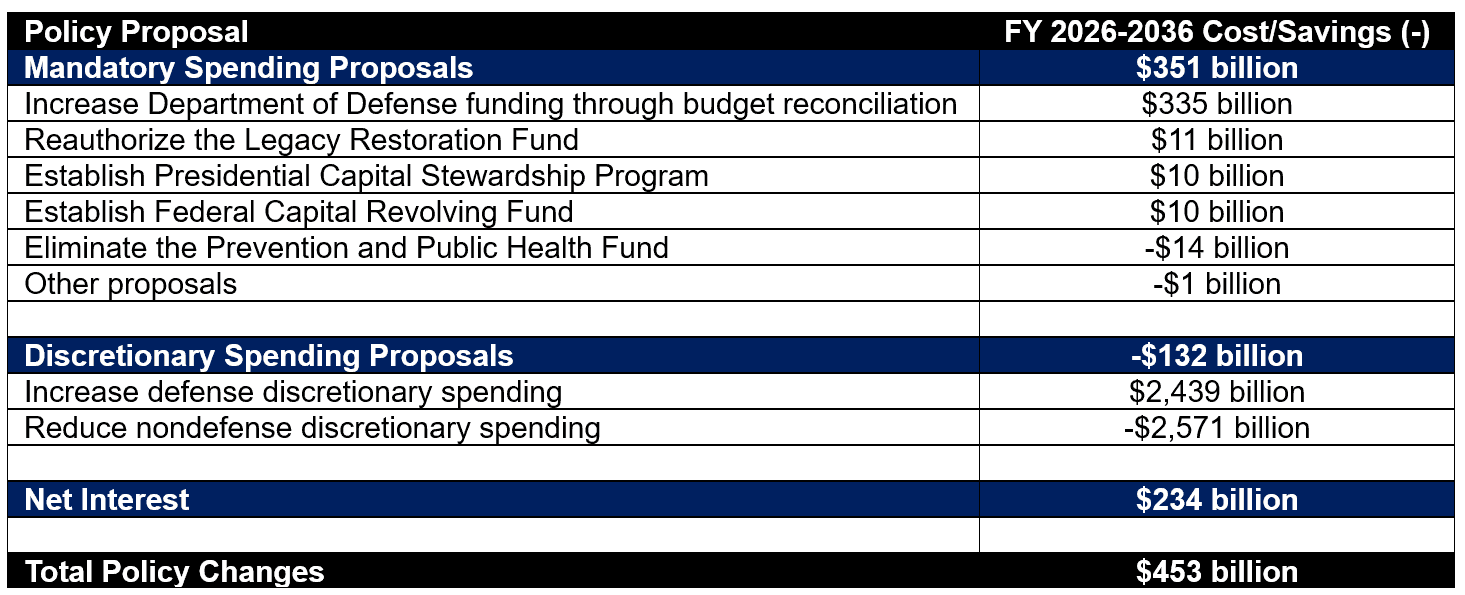
Using CBO’s assumptions, the policy changes proposed in the president’s budget would cost $453 billion over the FY 2026-2036 budget window. This includes a $351 billion increase in mandatory spending, a $132 billion decrease in discretionary spending, and a $234 billion increase in net interest costs from the budget’s policy changes.
Policy Changes in the President’s FY 2027 Budget
Sources: CBO and author’s calculations. Numbers may not sum due to rounding.
CBO estimates the president’s proposal to increase Department of Defense funding through the budget reconciliation process would increase mandatory spending by $335 billion over the FY 2026-2036 period. Proposals to reauthorize the Legacy Restoration Fund and to establish both a Presidential Capital Stewardship Program and a Federal Capital Revolving Fund would increase mandatory spending by a combined $30 billion. These increases would be partially offset by $14 billion of savings from a proposal to eliminate the Prevention and Public Health Fund and $1 billion from other mandatory spending reductions.
On the discretionary side, CBO estimates the budget’s proposal to boost defense discretionary budget authority (BA) to $1.2 trillion in FY 2027 would translate into $2.4 trillion of higher defense discretionary outlays over the FY 2026-2036 window. Meanwhile, the proposal to reduce nondefense discretionary BA to $721 billion in FY 2027 would reduce nondefense discretionary outlays by $2.6 trillion over the same period. Together, CBO estimates $132 billion of savings over the FY 2026-2036 budget window from the budget’s discretionary spending proposal.
The policy changes in the president’s budget would increase interest payments on the national debt by an estimated $234 billion through FY 2036 using CBO’s assumptions.