









Insight
January 20, 2026
Emergency Energy Auction to Prevent Data Center-driven Rate Increases
Executive Summary
- The Trump Administration reached an agreement with a bipartisan group of governors to direct PJM (a regional transmission organization that manages the United States’ largest grid) to hold an emergency electricity auction to make tech companies pay for the construction of new power plants; the goal is to ensure the rapid expansion of artificial intelligence (AI) data centers does not increase electricity costs for residential customers.
- Major challenges to implementing the plan include the long lead time it takes to build a new power plant and add electricity to the grid, and the potential push back from PJM as it tries to retain its independence in managing the region’s wholesale electricity market.
- This insight provides an overview of the agreement, reviews potential challenges, and analyzes the major trends in the PJM electricity market.
Introduction
President Trump recently met with several governors of both parties and reached an agreement to direct PJM (a regional transmission organization that manages the United States’ largest grid and covers 13 states and Washington, D.C.) to hold an emergency electricity auction. The auction is intended to make tech companies pay for the construction of new power plants in the region.
This unprecedented effort by the administration to intervene in a regional electricity market is aimed at ensuring the rapid expansion of artificial intelligence (AI) data centers does not lead to increased energy costs for residential households.
Major challenges to implementing the plan include the long lead time it takes to build a new power plant and bring electricity to the grid, and the potential push back from PJM as it tries to retain its independence in managing the region’s wholesale electricity market.
This insight provides an overview of the agreement, reviews potential challenges, and analyzes the major trends in the PJM electricity market.
Overview of the Trump-Governors Agreement
Surging electricity prices have gained significant media attention, emerging as a primary point of political debate across both the federal and state governments. For the past few months, political finger-pointing over high energy bills has intensified. Republicans are blamed for repealing clean energy subsidies via the One Big Beautiful Bill Act, while Democrats face criticism for their pivot away from fossil fuels.
In early January, President Trump announced on Truth Social that his administration is working with major U.S. tech companies to secure their commitment to pay for the costs associated with building AI data centers so “Americans don’t ‘pick up the tab’ for their [power] consumption, in the form of paying higher [utility] bills.” He also added: “I never want Americans to pay higher [electricity] bills because of [data centers].”
There are two major components in the “Statement of Principles Regarding PJM” document signed by Energy Secretary Chris Wright, Interior Secretary Doug Burgum, and a bipartisan group of 13 governors in the PJM region.
Emergency wholesale electricity auction
The agreement proposes that PJM hold an emergency electricity auction in which tech giants bid for 15-year power purchase contracts to help pay for the costs associated with developing AI data centers, regardless whether they use the electricity.
This would be a novel mechanism to have hyperscale customers directly foot the bill for their data centers’ enormous electricity consumption by funding the construction of new power plants, most likely natural gas or nuclear power plants due to their 24/7 reliability as opposed to renewable energy.
It would also work around the lengthy process for utilities to build new power plants—they would need to first obtain regulators’ approval to build a new power plant by making a case for the need to satisfy increasing electricity demand. The costs of building the new power plant would have to be apportioned to different groups of customers pending the regulators’ permission.
Extend a cap on PJM’s capacity auctions
It includes a two-year extension to the federally approved cap ($329.17/megawatt(MW)-day) placed on PJM’s capacity market auctions—which do not reflect the prices of energy purchased, but the ability to produce electricity when needed. PJM’s capacity market coordinates wholesale electricity among power generators and utilities for reselling the electricity to consumers. The goal of a capacity market auction is to reward power suppliers that invest in capacity to meet future peak load requirements to ensure reliable operation of the grid.
Potential Challenges to Execution of the Agreement
If implemented successfully, this plan is estimated to yield approximately $15 billion for building new power generation plants in the PJM region.
There will be two major challenges to the execution of the plan:
- It will not provide immediate relief to the grid: The administration and the governors are pushing PJM to hold the emergency auction by the end of September this year. Once the funding is secured, it would take energy developers several years to build a new power plant due to the time needed to obtain siting permits and procuring necessary parts and equipment. For example, building a new combined-cycle natural gas power plan takes about 50 months, whereas hyperscalers could complete the development of a data center as quickly as less than two years. The mismatch of the timeline in electricity supply and demand would inevitably pose a big challenge to ensuring other customers are not affected by the data center expansion.
- PJM’s potential pushback: As the PJM grid operator did not participate directly in the discussions or the signing of the agreement, it remains to be seen whether it will follow the administration’s request to move forward with plan. There might be potential pushback from PJM against the plan as it tries to retain its independence in overseeing the country’s largest grid. Notably, PJM released a proposal on the same day to the Federal Energy Regulatory Commission on its plan to address the reliability and rising cost concerns in the power market caused by large-scale customers such as data centers.
AI Data Centers Are Putting Significant Strain on the PJM Grid
American Action Forum’s previous insight explained why AI data centers are so power hungry—their electricity demand is expected to grow rapidly from 4.4 percent of total U.S. electricity in 2023 to between 6.7–12 percent by 2028. As a result, some states saw drastic increases in nominal electricity prices from July 2024 to July 2025. For example, the District of Columbia and New Jersey, both in the PJM region, saw the largest percent increases of 24.5 percent and 21.6 percent, respectively.
Summer peak load in the entire PJM region is estimated to increase by 48 percent from 2025–2045, exceeding the current generating capacity in PJM by around 45,000 MW. As shown in Figure 1, for the Dominion Energy delivery zone (DOM Zone)—the electricity market covering most data centers in Virginia and parts of North Carolina—PJM has increased its load forecasts significantly, with the steepest jump between the forecast in 2022 and 2023 primarily driven by data centers’ growing demand.
As a result, Virginia—known as “Data Center Alley”—has recently approved a new rate class for hyperscalers to protect other ratepayers from rising electricity costs associated with data center expansion.
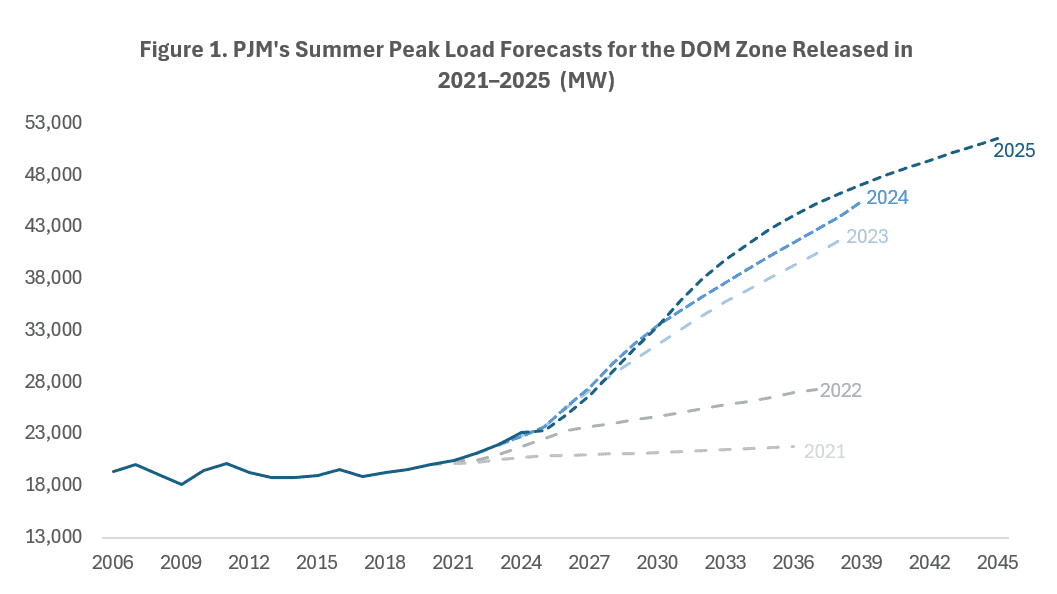
Source: PJM
Notably, as shown in Figure 2, AI data center demand contributed to an 833-percent increase in PJM’s capacity market auction price for 2025–2026 compared to the previous year. This indicates a tremendous growth in power demand driven by data centers and the pressure it has put on PJM’s generation capacity.

Source: PJM
Looking Forward
The agreement between the administration and state governors to mitigate the energy-price impact of AI data centers on PJM residential customers indicates the enormous challenges utilities are facing in meeting data centers’ growing power demand. A successful rollout of the plan must address some of PJM’s reliability and price constraints due to the AI boom. It remains to be seen whether this unprecedented plan will be implemented, and if so, how it ultimately affects PJM’s electricity supply and prices for non-hyperscale customers.
