Insight
September 10, 2026
Hedge Funds in the Treasury Market
Executive Summary:
- As the world’s largest tradable debt market, at about $30 trillion in value, the market for U.S. Treasury debt securities (Treasuries) serves as the foundation of the global financial system, setting the benchmark for the cost of many financial assets.
- In response to elevated debt issuance, the effects of post-2008 regulatory changes, and the needs of traditional asset managers, hedge funds have increased their holdings of Treasuries to record highs; much of this increase has been accomplished using complex trading strategies, such as the cash-futures basis trade, which require hedge funds to take on significant amounts of debt to achieve profitability.
- This debt-driven growth in hedge funds’ Treasuries holdings offers both potential benefits and risks to the U.S. economy and financial system, including reduced government borrowing costs, more efficient financial markets, and increased vulnerability in the stability of the financial system; this insight discusses the role of hedge funds in the Treasuries market, the basis trade, and the trade’s potential implications.
Introduction
As the United States’ national debt has continued to grow, so too has the market for U.S. Treasury debt securities (Treasuries). At roughly $30 trillion in value, this market is the world’s largest tradable debt market. (Although the national debt recently eclipsed $40 trillion, about $10 trillion of this debt is either non-tradable securities held by the public or debt owed to other federal agencies such as the Social Security Trust Funds; more details are .) Because of both the size of this market and the United States’ leading economic role in the world, Treasuries form the foundation of the global financial system, serving as the cost benchmark for all sorts of financing.
Many types of financial institutions hold Treasuries, including central banks, private banks, and traditional asset managers such as pension funds. While hedge funds – a type of private investment fund loosely-defined by the use of borrowed money (known as leverage in the financial world) and non-traditional trading strategies – have long held Treasuries, these holdings have increased to a record high of about 8 percent of outstanding Treasuries, more than any single foreign country currently holds. This increase has come about in response to three factors: (1) the need for investors to feed the United States’ continued issuance of debt; (2) the effect of post-2008 regulatory reforms on the ability of traditional institutions to handle this debt; and (3) the desire by some traditional asset managers to purchase Treasury futures (a promise to buy a Treasury for a predetermined price at a set future date). To effectuate this increase in Treasury holdings, hedge funds have relied on complex trading strategies, such as the basis trade, which require significant amounts of borrowing to be profitable.
This largely debt-driven growth in hedge funds’ Treasuries holdings has both potential benefits and risks for the U.S. economy. On the one hand, increased participation of hedge funds in the Treasury market may lower U.S. borrowing costs. It may also make financial markets more efficient by enabling traditional asset managers to construct their desired portfolio. On the other hand, however, hedge funds’ use of leverage to purchase Treasuries creates a vulnerability in the stability of the financial system if hedge funds are forced, as they were in 2020, to sell their Treasuries to raise cash to meet funding requirements from their lenders. This insight discusses the growing role of hedge funds in the Treasury market and these potential implications for the U.S. and global financial systems.
Hedge Funds Overview
A hedge fund is an investment fund limited to accredited investors (for more on accredited investors, see the American Action Forum’s previous primer) that typically uses a combination of high borrowing and nontraditional (as well as traditional) investment strategies, with the goal of providing investors with profits regardless of the state of the overall financial market. In the financial world, this kind of borrowing by hedge funds and other firms to increase profitability is known as leverage.
Hedge funds are further known for often pursuing investment strategies that “hedge” financial risk, which is the practice of making investments whose risk profiles cancel each other out. For example, a hedge fund may invest in one asset that increases (decreases) in value when bond yields rise (fall), while at the same time investing in another asset which decreases (increases) in value when bond yields rise (fall). It should be noted, however, that the extent to which hedge funds hedge their investments varies, with some taking on more risk than others.
Across all strategies, the hedge fund sector has grown to record highs. According to the U.S. Treasury’s Office of Financial Research, the number of qualifying hedge funds – funds with net assets of at least $500 million and a specific management structure – reached 2,152 in Q1 2026. (According to economists at the Federal Reserve, qualifying hedge funds account for about 85 percent of gross hedge fund assets.) Qualifying hedge funds’ gross assets also rose to a record of about $12.6 trillion. While this number still pales in comparison to the total assets of commercial banks, which are approaching $26 trillion, it is noteworthy that qualifying funds’ gross notional exposure – a measure of total investments in financial markets that does not consider the interactions between different investments – increased to about $42 trillion.
Treasury Market Overview
To understand the role of hedge funds in today’s Treasury market, it will also be helpful to briefly review the Treasury market, which consists of about $30 trillion in tradable Treasury debt securities and functions as the foundation of the global financial system. The Treasury market consists of three main segments. The cash Treasury market is where Treasuries are bought and sold on the spot. The repurchase (repo) market allows Treasury holders to borrow money by selling Treasuries to a lender with the promise to buy them back later at a higher price. It is through this repo market that hedge funds take on the significant leverage that has made them a big player in the Treasury market. The third segment of the Treasury market is Treasury futures – financial contracts that require the buyer of the future to purchase a Treasury from the seller at a preset price on a predetermined future date.
The Treasury market has changed in significant ways over the course of the 21st century. Most notably, as shown in Figure 1 below, it has exploded in size as federal debt has exploded, rising from only $3 trillion in 2002 to $30 trillion today. As the market has expanded, the number and composition of investors in Treasuries have also expanded and changed to accommodate increasing debt issuance. For instance, foreign investors (both official and private) held about 50 percent of Treasuries in the late 2000s, while today they only hold about 40 percent (with statistical adjustments to more accurately reflect holdings by hedge funds in the Cayman Islands).
Figure 1
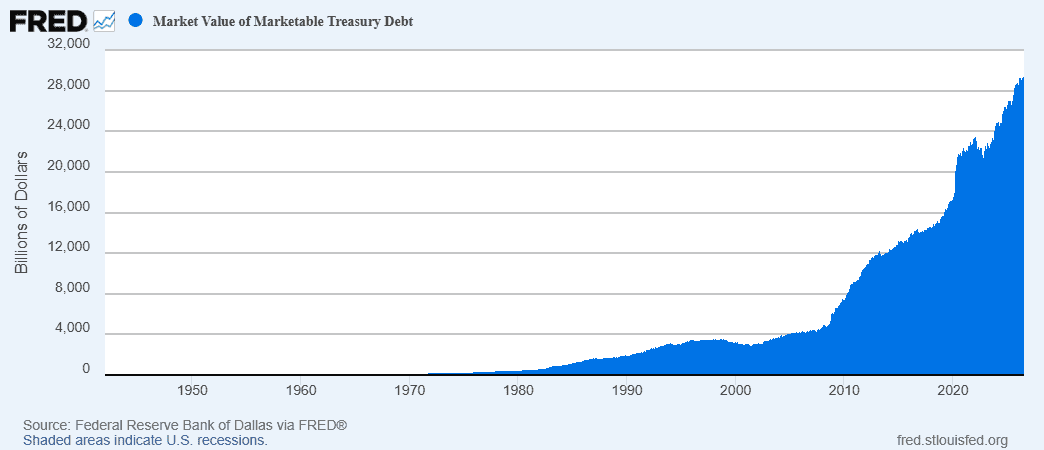
A more recent change in Treasuries’ investor profile has been the growing significance of private investors, including “mutual funds, hedge funds, and other nonbank financial intermediaries.” Indeed, in its 2025 annual report, the U.S. Treasury’s Financial Stability Oversight Council (FSOC) wrote that “the composition of the investor base has shifted toward more price-sensitive [private] investors such as hedge funds.” Moreover, the IMF reports that U.S. private domestic investors financed “almost $5 trillion in US public debt” – roughly 1/6 of the outstanding market – from 2022 to 2025. Overall, this increase in private sector investment into U.S. treasuries has turned private investors into the marginal buyer of U.S. debt, giving them significant control over the borrowing costs paid by the U.S. Treasury on its debt issuance.
Hedge Funds in the Treasury Market
With growing Treasuries holdings and influence over the Treasury market, hedge funds are chief among these private investors. Indeed, hedge funds now own about 8 percent of outstanding Treasuries, having seen their ownership double between 2023 and 2025. As the Financial Times has reported, this means that “hedge funds now own more Treasuries than are officially registered to Japanese, Chinese and Saudi Arabian investors combined.” (Official Treasury holding data can be misleading, especially for Chinese holdings, as Treasuries held in an account in a third-party country are counted as being owned by that third-party country rather than the country of origin of the investors.)
There are multiple factors that might be driving hedge funds’ increasing ownership of Treasuries. A first factor could be the effect of post-2008 financial crisis regulatory reforms on traditional buyers of Treasuries. Specifically, by raising the capital requirements for many financial institutions, these regulatory reforms have limited the ability of some of these institutions to purchase Treasuries. Some of these reforms may also have incentivized financial institutions to purchase riskier assets than Treasuries, which are considered risk-free, so that these institutions can earn higher returns from their more limited pool of assets. With continued issuance of Treasury securities, this limitation has meant that other non-traditional buyers of Treasury securities, such as hedge funds, have been given room to step up their purchases.
The second factor, as explained by economists at the Dallas Fed, is that “treasury supply has substantially outpaced the growth of traditional real-money buyers.” Simply put, there are too many debt securities relative to the amount of money available to traditional investors to purchase debt securities. Hedge funds have therefore been purchasing Treasuries that may have previously been bought by these other investors.
The Basis Trade
The third driving factor behind hedge funds’ growing purchases of Treasuries is the changing investment decisions of traditional investment managers. Specifically, as economists Anil Kashyap and Jeremy Stein explain, “institutional asset managers, including pension funds, insurance companies, mutual funds, and exchange-traded funds,” have significantly increased their purchases of Treasury futures to give themselves some exposure to long-term financial assets without forcing them to own these assets outright and use up their limited funds. The consequence of this increased demand for Treasury futures is that their prices have increased, often to levels that exceed the cash price of buying a similar Treasury on the spot. This price discrepancy between the cash and futures price of Treasuries is known as the “basis.” As the futures contract’s predetermined date of delivery arrives, the two prices usually converge to eliminate the basis, meaning there is a low-risk opportunity for an investor to profit through the “basis trade” by buying a Treasury at a lower price than they sell a future and making off with the difference between the two prices when they buy back the future and sell the Treasury upon price convergence. Figure 2 below visualizes the mechanics of this trade.
Figure 2

Source: Brittanica Money
Hedge funds have pursued the basis trade by buying significant amounts of cash Treasuries while selling large quantities of Treasury futures to traditional investment funds. Indeed, according to economists at the Dallas Fed and the Fed Board of Governors, the basis trade has become “the primary driver of hedge fund Treasury holdings.” As of September 2025, the basis trade accounted for about 35 percent (roughly $830 billion) of hedge funds’ total treasury holdings according to economists at the Fed.
The basis trade is, however, more complicated than just taking advantage of the basis. There are two related complications worth mentioning. The first is that the profit to be made from each individual basis trade is extremely small, as the basis between the two prices is quite small. The second is that, because of this small profit opportunity from each individual trade, hedge funds borrow a significant amount of money from the repo market to increase the value of their basis trades and make the overall strategy more profitable. To borrow this money, hedge funds will (1) sell their Treasuries to investors with a promise to buy them back in the future for a slightly higher price; (2) use the proceeds from that sale to buy more Treasuries; (3) sell those Treasuries back in the repo market; (4) buy more Treasuries; and (5) rinse and repeat. In some cases, borrowed money finances up to 99 percent of the total value of a hedge fund’s basis trades. As will be discussed in the following section, this high borrowing has implications for the U.S. economy and financial system.
Potential Implications of the Basis Trade
The first two potential implications of the basis trade are relatively simple. The first is that hedge funds’ demands for cash Treasuries to offset their futures sales might be absorbing increased debt issuance by the U.S. Treasury Department and, therefore, keeping down government borrowing costs. (Further research is needed to understand whether this plausible implication is in fact happening). The second implication is that hedge funds are improving the efficiency of the market for U.S. Treasuries, the most important financial market in the world, by buying Treasuries and selling futures to enable other traditional asset managers to more efficiently allocate their portfolio of assets.
The third potential implication of the basis trade is that hedge funds’ use of leverage (i.e. borrowed money) to boost their basis trades poses a potential threat to the stability of the financial system. The source of this risk is that both hedge funds’ lenders in the repo market – who lend them cash to buy Treasuries – and the exchanges on which hedge funds’ sell futures contracts require hedge funds to keep a certain amount of funds (in the form of a treasury security in the case of the repo market) at the lender/exchange to protect the lender/exchange from any risk of losses. (For instance, if the hedge fund does not have the funds to repurchase the security, the fund’s repo lender would seize the Treasury and be able to sell it itself to raise cash.) In both cases, the amount of funds that a hedge fund must maintain is not constant, but is instead subject to financial conditions, including the size of the basis, health of the hedge funds, the value of the futures contract, and volatility in financial markets.
A change in financial conditions that abruptly increases hedge funds’ funding requirements to either repo lenders or futures exchanges could therefore force hedge funds to sell their Treasuries to quickly raise more funding. (Figure 3 below visualizes such a situation in which the price differential between cash Treasuries and Treasury futures grows rather than shrinks.) This forced selling of Treasuries – a “fire sale” – could destabilize the Treasury market by overwhelming market participants capacity (or desire) to buy these for-sale Treasuries. Fire sales of Treasuries by one investor can also reduce the value of Treasuries held by other investors, creating a cycle in which an increasingly large pool of investors needs to sell Treasuries to meet funding constraints as the value of Treasuries continues to decline with each new fire sale. Forced sales of Treasuries by hedge funds could therefore have a cascading, destabilizing effect throughout the Treasury market and, by extension, the global financial system.
Figure 3
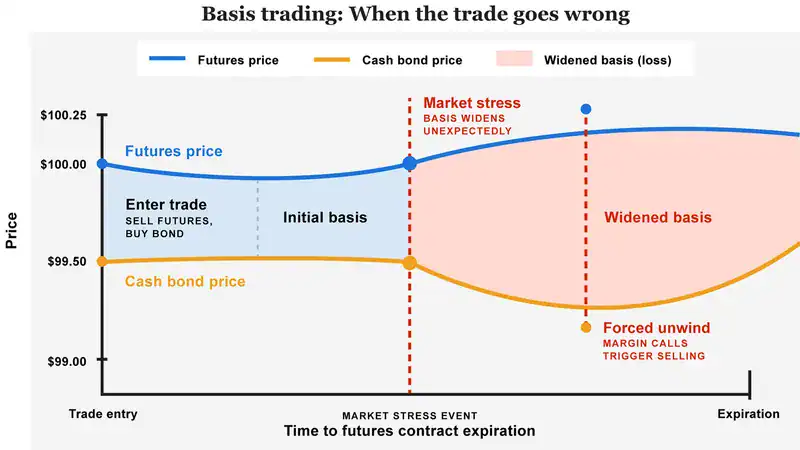
Source: Britannica Money
The Pandemic Example
To illustrate the significance of instability in the Treasury market, it is useful to review the Treasury market instability at the beginning of the Covid-19 pandemic, in which hedge funds played a significant role. (It is important to emphasize here that hedge funds were not necessarily the cause of this instability but rather were just one contributor among many to Treasury market instability.) At that time, the Treasury market did not behave in the way that the financial world had come to expect; when a negative financial shock hit the world, investors would normally buy Treasuries, which are perceived to be extremely low risk. In the face of a global pandemic with an uncertain future, however, investors across the world sold assets of all risk profiles, including U.S. Treasuries, in the hopes of raising cash.
These massive sales sharply reduced the prices of Treasuries. This price movement in turn negatively impacted hedge funds’ basis trades, forcing many funds to fire sale Treasuries to meet funding constraints. According to research done at the Bank for International Settlements (BIS), hedge funds eventually sold at least $180 billion in Treasuries at the beginning of the pandemic. (Due to data limitations, the BIS research could neither account for Treasuries sold to non-U.S. investors nor could it pinpoint the exact volume of Treasuries sold because of issues with basis trades.)
In the face of all this selling of Treasuries – which, according to the BIS research cited above, totaled about $750 billion across Q1 2020 sales by foreigners ($287 billion), domestic mutual funds ($266 billion), and the household sector, which includes hedge funds ($196 billion) – seized up. Measures of market efficiency such as the bid/ask spread (the difference between the highest price offered by a buyer and the lowest price offered by a seller) reached their most concerning levels since the 2008 global financial crisis. Many Treasury market intermediaries – the financial institutions who act as a middleman between buyers and sellers of Treasuries – were unable to carry out this necessary and important function.
To calm this dysfunction, the Federal Reserve decided to step in. On March 23, 2020, the Fed announced that it would “continue to purchase Treasury securities … in the amounts needed to support smooth market functioning.” In plain English, the Fed committed to buying as many Treasuries as necessary to ensure the Treasury market – and by extension the global financial system – did not collapse. Although the precise extent to which hedge funds’ sales of Treasuries contributed to the Treasury market instability and this unprecedented policy step is unknown, the early pandemic market dynamics and the Fed’s unprecedented response highlight the magnitude of the financial vulnerability presented by large holdings of Treasuries by leveraged investors such as hedge funds.
Conclusion
Because the U.S. Treasury market is the foundation of the global financial system, it is important to monitor developments in this market. A recent shift is that hedge funds have increased their ownership of Treasuries to record highs, driven, in large part, by highly leveraged strategies such as the basis trade. Although this debt-driven growth in hedge funds’ Treasuries holdings could help reduce government borrowing costs and/or improve financial market efficiency, hedge funds’ use of leverage to amass these positions creates a potential vulnerability in the stability of the financial system. Given the importance of the Treasury market and these possible implications of hedge funds’ growing role in that market, policymakers should continue to monitor Treasury market dynamics and the composition of Treasury ownership.