









Insight
April 2, 2026
New NRC Nuclear Reactor Licensing Rule: Overview and Implications
Executive Summary
- The Nuclear Regulatory Commission (NRC) has finalized a new commercial reactor licensing framework, marking the agency’s first comprehensive regulatory overhaul since 1989.
- Designed to address the inefficiencies of the previous process—which saw only two reactors become operational in nearly 40 years—the new rule updates the approval process with broad applicability, increased flexibility, and modernized risk assessments.
- This insight evaluates the NRC’s new licensing framework within the broader U.S. nuclear energy landscape and concludes that the modernized process is a critical milestone for accelerating the deployment of next-generation reactors.
Introduction
The Nuclear Regulatory Commission (NRC), an independent U.S. regulator responsible for issuing licenses for new nuclear reactors, published a final rule on a new reactor licensing process on March 30, 2026. The new rule, commonly referred to as “Part 53” (as opposed to the previous Part 50-52 regulations), aims to “provide optionality and make licensing advanced nuclear reactors faster, simpler, and more cost-effective while continuing to prioritize safety.” It will be effective on April 29, 2026. This new rule is a major milestone in U.S. history of nuclear regulatory framework, as it marks the first new reactor licensing rule in decades—with the previous rule in place since 1989.
Notably, only two nuclear reactors approved under the1989 licensing process have reached commercial operation. The new rule updates the approval process with applicability, increased flexibility, and modernized risk assessments to address the inefficiencies of the previous process.
This insight evaluates the NRC’s new licensing framework within the broader U.S. nuclear landscape, concluding that the modernized process is a critical milestone for accelerating the deployment of next-generation reactors.
Overview of the New Rules
The new rule, titled “Risk-Informed, Technology-Inclusive Regulatory Framework for Commercial Nuclear Plants,” is designed to help fast-track nuclear energy deployment by providing “greater regulatory stability, predictability, and clarity to the licensing process.” NRC started working on updating its licensing regulations in 2019 in response to the Nuclear Energy Innovation and Modernization Act.
The 186-page new reactor licensing process covers several important aspects:
- Broad applicability: It is applicable to any type of reactor, including both traditional and new generation of reactors. Unlike the old rule, which covered only traditional water-cooled reactors, the new regulatory framework will accommodate advanced reactors that have new technological features in fuel, coolant, and reactor size.
- Increased flexibility: It sets up “a performance-based approach” that gives reactor designers and operators more flexibility in how they construct and run power plants. This new framework is designed to encourage efficiency and innovation by permitting applicants to establish high-level safety objectives and demonstrate how their reactors meet the objectives. This is a major shift from previous regulations built on a prescriptive approach requiring specific methods or processes.
- Modern risk assessment: The new rule adopts a “risk-informed” framework that provides “substantial flexibility” for reactor developers to ensure public health and safety through tailored risk metrics specific to the design of their reactors. This departs from the traditional risk assessment requirement, the “single-failure criterion”—which means the nuclear reactor can still carry out its safety function even if any single component fails.
U.S. Nuclear Energy Landscape
Despite stagnant public support since the 1979 Three Mile Island accident, nuclear energy remains a critical power source, providing 20 percent of U.S. electricity and half of its carbon-free energy. American Action Forum’s (AAF) previous insight provided an overview of the renewed U.S. interest in nuclear energy.
As shown in the chart below, the vast majority of U.S. nuclear reactors were built between 1970 and 1990. Following the 2016 launch of Watts Bar Unit 2, the only recent additions to the fleet were Georgia’s Vogtle Units 3 and 4, which entered service in 2023 and 2024.
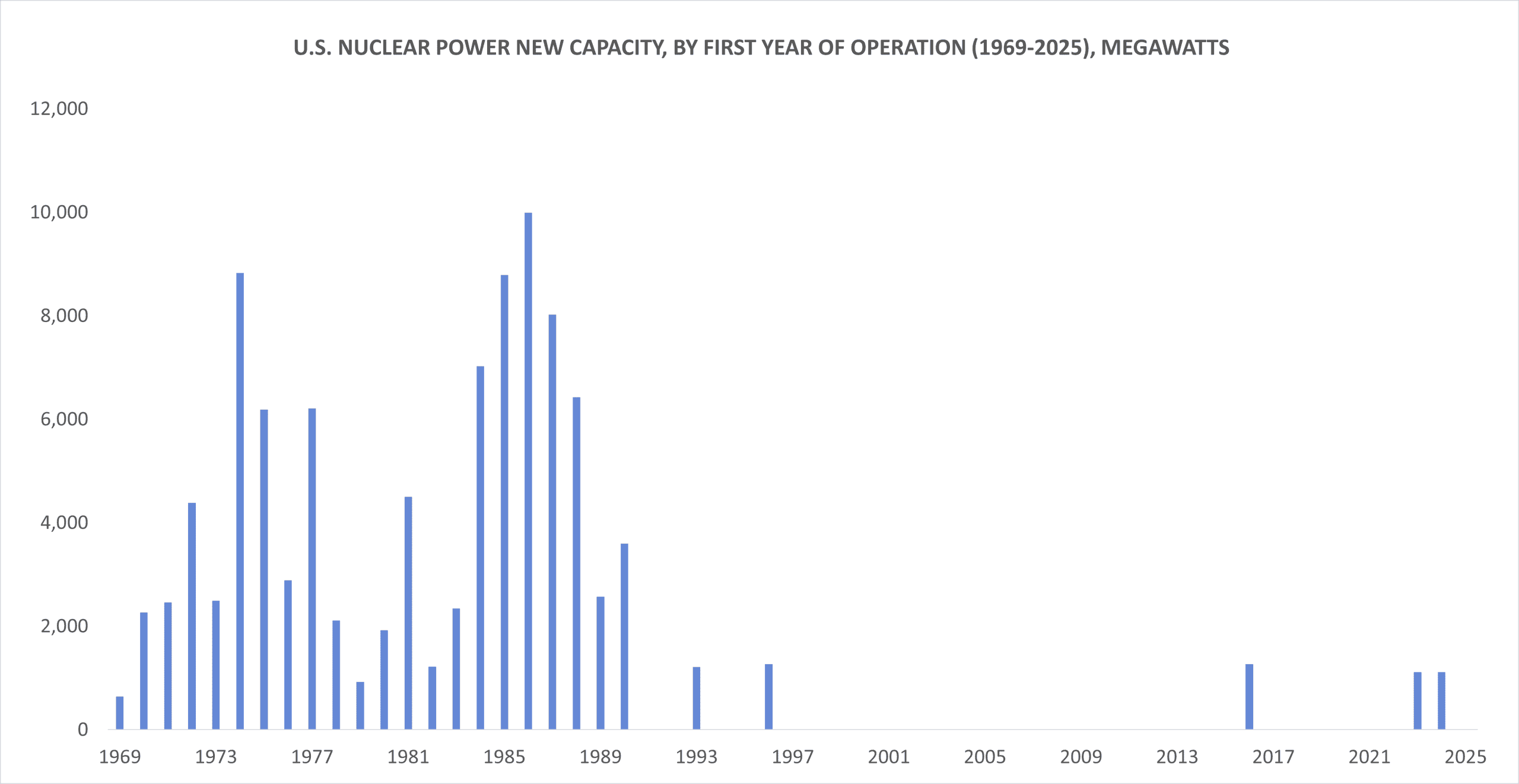
Source: U.S. Energy Information Administration Monthly Electric Generator Inventory
Notably, since the most recent NRC regulation was released in 1989, eight of 20 applications have been approved under the framework. The aforementioned Vogtle Units 3 and 4 are the only units to reach commercial operation. The other approved projects were either suspended or terminated due to cost or other factors. Other operating reactors such as the Watts Bar Unit 2 were approved under regulations that predate the 1989 framework.
Following the 2024 bipartisan nuclear legislation, the “Accelerating Deployment of Versatile, Advanced Nuclear for Clean Energy Act of 2024,” the Trump Administration has been leveraging executive action to boost U.S. nuclear energy development.
In 2025, President Trump signed four executive orders (EOs) designed to streamline regulatory reviews, boost nuclear energy exports, and reform the NRC. This AAF insight provided an in-depth analysis of the goals and implications of those EOs. These orders are part of the administration’s broad efforts to fulfill its energy independence agenda.
The NRC is expected to release several additional new rules over the next months to “revolutionize reactor licensing,” according to the agency’s press release.
Conclusion
The new NRC licensing rule is broader, more flexible, and updated to match the technological advancement in the U.S. nuclear energy industry compared to the old rule published 37 years ago. It is an encouraging development in the U.S. nuclear regulatory framework that will be helpful in accelerating the approval process for a new generation of nuclear reactors.
