









Insight
November 19, 2024
Renewed U.S. Interest in Nuclear Energy: An Update
EXECUTIVE SUMMARY
- While the construction of new nuclear reactors has been stalled for the past three decades, nuclear energy still offers a cost-effective, clean, and reliable source of power – and with rising energy costs and a demand for clean energy, nuclear is seeing renewed interest from lawmakers and industry leaders.
- There recently has been unprecedented business investment in nuclear, as large technology companies invest in nuclear reactors with improved safety and lower costs; moreover, there has been movement on the legislative front to lower the upstart costs of constructing new nuclear energy facilities.
- The successful implementation of the bipartisan Accelerating Deployment of Versatile, Advanced Nuclear for Clean Energy Act of 2024 is important for ensuring the timely development and deployment of the new generation of nuclear technologies, which are likely to be safer, more efficient, and have fewer limitations, with advancements in fuel sources, cooling methods, and reactor size.
INTRODUCTION
Nuclear energy has been playing a quiet but important role in U.S. electricity production. Although public and legislative support has been stagnant over the past few decades, in particular since the Three Mile Island partial nuclear reactor meltdown incident in 1979, nuclear energy has been producing approximately one-fifth of America’s electricity and about half of the country’s carbon-free power.
As shown in the chart below, most of the nuclear reactors in the United States were built between 1970 and 1990. The latest commercial reactors built in the United States were the Unit 3 and Unit 4 reactors at Georgia’s Vogtle nuclear power plant that came online in 2023 and 2024; prior to that was the Tennessee Valley’s Watts Bar Unit 2 reactor that started operation in 2016.
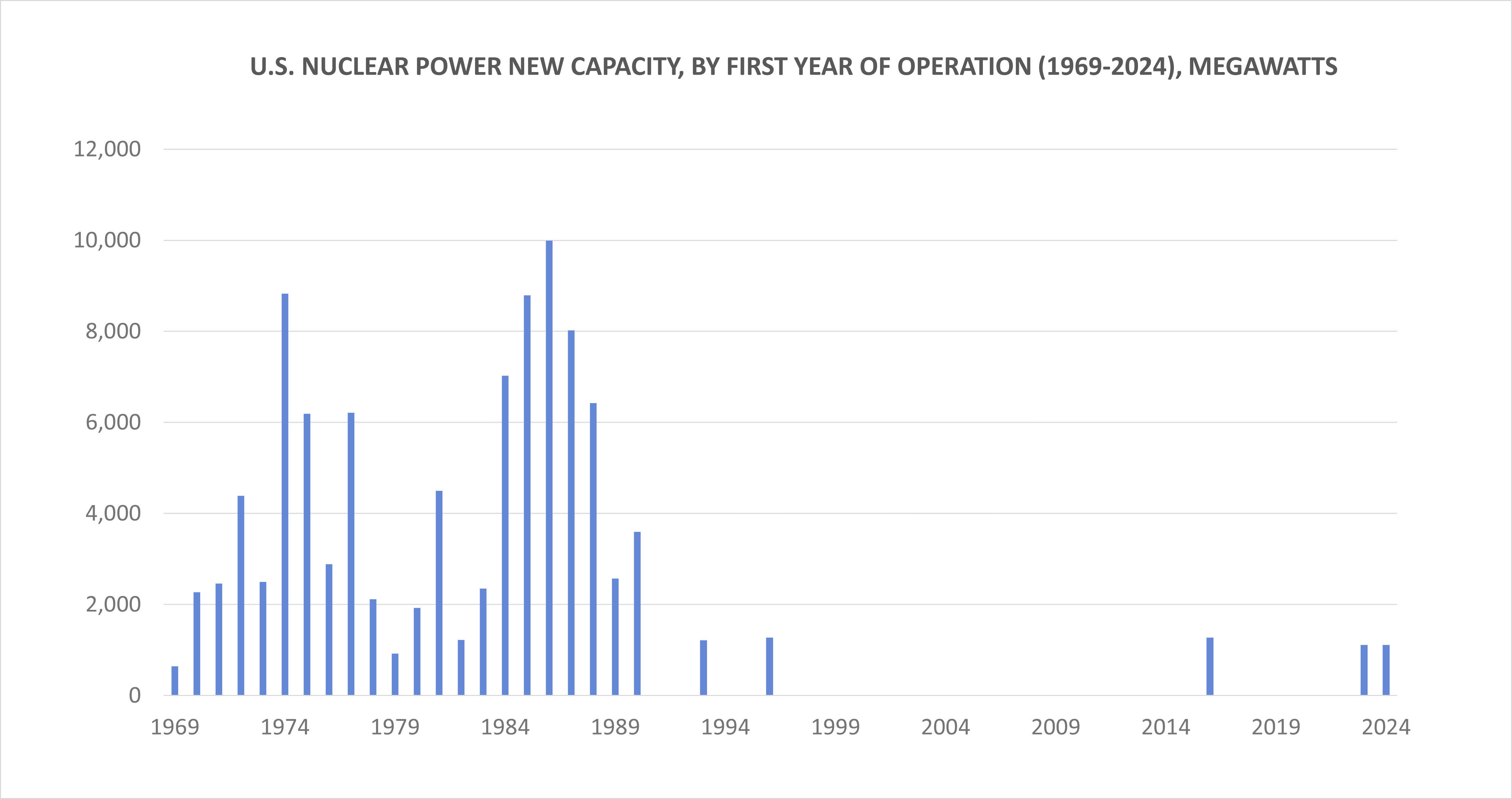
Source: U.S. Energy Information Administration Monthly Electric Generator Inventory
While safety concerns and high upfront capital costs stalled development of reactor construction between 1990 and 2020, there has been renewed interest in this clean energy recently with new private-sector investments and legislative support.
Several large tech companies have invested in the new generation of nuclear reactors by signing long-term power purchase agreements with utility companies to meet the increasing electricity demand from their data centers. Coinciding with technological developments in advanced nuclear reactors in terms of new fuel, cooling agents, and smaller reactor sizes, this year has also seen significant momentum in legislative action to spur further development of nuclear infrastructure, with the bipartisan Accelerating Deployment of Versatile, Advanced Nuclear for Clean Energy Act of 2024, or ADVANCE Act, passed earlier this year, and several other bipartisan proposals to support nuclear energy development.
This primer reviews the latest legislative developments and private-sector investments in nuclear power, the main factors driving the recent momentum toward this source of clean energy, and the key issues to watch for going forward.
OVERVIEW OF NUCLEAR ENERGY
Nuclear energy is a form of energy released from a nuclear fission reaction. In the reaction process, the core of an atom is split apart to release a large amount of energy in the form of heat and radiation.
Nuclear energy’s role in electricity production
Nuclear power plants do not generate greenhouse gas emissions during electricity production. As a carbon-free energy, nuclear power provides nearly half of America’s electricity generated by clean energy, making it the largest domestic clean energy source.
In 2023, nuclear power plants in the United States generated 775 billion kilowatt hours of electricity, accounting for nearly 20 percent of total U.S. electricity generation. Worldwide, nuclear energy generates about 9 percent of the world’s electricity from 440 nuclear reactors.
As of April 2024, there were 94 nuclear power reactors across 28 states in the United States. Currently, 12 states have restrictions on building new nuclear power facilities: California, Connecticut, Hawaii, Illinois, Maine, Massachusetts, Minnesota, New Jersey, New York, Oregon, Rhode Island, and Vermont.
Nuclear energy’s benefits and challenges
Nuclear energy has unique advantages compared to other mature clean energy sources, including solar and wind. It’s reliable, geographically independent in its newest iterations, and efficient in land use. Nuclear power plants operate 24 hours a day, seven days a week, whereas solar and wind can only provide intermittent energy when the sun is out, or the wind blows. While traditional nuclear power plants need to be built near water, as they use large amounts of water to cool the nuclear reactors, the new generation of nuclear reactors can be geographically independent, using molten salt or liquid metals to cool the reactor instead. Nuclear reactors also have a significantly smaller land use footprint at 1.3 square miles per 1,000 megawatts of electricity a plant produces, 31 times less than solar panels, and 173 times less than wind turbines.
Despite its various advantages, nuclear energy has challenges, such as large upfront capital costs and safety – a major reason why the technology has been largely restricted in some states. Nuclear reactors produce radioactive waste from uranium, a naturally occurring radioactive element that is used as the main fuel source for nuclear reactors. Radioactive waste must be handled, stored, and disposed properly, otherwise it would cause harmful or even fatal damage to humans, animals, and plants. In the United States, the Nuclear Regulatory Commission (NRC) regulates all waste generated from the commercial use of nuclear reactors.
The Three Mile Island accident was the most serious in the U.S. history of commercial nuclear power plants. On March 28, 1979, the Three Mile Island Unit 2 reactor located near Middletown, Pennsylvania melted down partially. According to the NRC, the small radioactive releases from the accident did not cause traceable effects on the health of the power plant’s workers and the public. Nevertheless, the accident led to significant changes in nuclear power plant operations and the NRC regulations, which substantially improved the safety of U.S. nuclear reactors.
Nuclear power plants also require large upfront capital investments and a long construction period. Additionally, several features of nuclear projects make them uniquely challenging for investors, including technical complexity in construction, political and regulatory barriers, and nuclear waste management.
New generations of nuclear technology
Most of the existing nuclear reactors today use fuels enriched with up to 5 percent of uranium-235 to power their fission reactions and pressurized water in a cooling system to control the reactors’ temperature.
Today, there are three areas in which a nuclear reactor can be modified using the next generation of technologies: fuel, cooling system, and the size of the reactor. The following modifications can be made to improve safety, lower project costs, or improve efficiency.
- Fuel: The most common alternative fuels are TRISO (tri-structural isotropic particle fuel) and HALEU (high-assay low-enriched uranium). TRISO fuel is designed to structurally contain fission reactions and resist corrosion and melting. HALEU is enriched with a higher percentage of uranium-235 at between 5 and 20 percent, which enables a smaller reactor to generate more power than a conventional one.
- Coolant: One major coolant alternative for water is molten salt, which is liquified salt at high temperatures. Reactors that use molten salts as a coolant are more fuel efficient and produce waste that is easier to manage. Other new coolant options include liquid metals, helium, and other gases.
- Reactor size: Small modular reactors (SMRs) are smaller reactors that are at a lower capacity than a large nuclear power plant. There are a variety of SMRs currently under development that differ in size, technology, and capability, which range from tens to hundreds of megawatts in productive capacity. SMRs have several advantages compared to conventional nuclear reactors, including a smaller land footprint, lower capital cost requirement, shorter construction timeline, greater flexibility with location, and simpler operation.
LEGISLATIVE DEVELOPMENTS IN NUCLEAR ENERGY
Nuclear energy has been gaining strong political and public support over the past two years. Lawmakers have introduced multiple bipartisan legislative proposals to support the development of nuclear energy. One of the most significant legislative milestones was the ADVANCE Act of 2024 signed into law by President Biden in July 2024.
The ADVANCE Act of 2024
The Accelerating Deployment of Versatile, Advanced Nuclear for Clean Energy Act of 2024, or ADVANCE Act, was introduced by Senators Shelley Moore Capito (R-WV) and Tom Carper (D-DE) and Representatives Cathy McMorris Rodgers (R-WA) and Frank Pallone, Jr. (D-NJ). It passed the Senate with a vote of 88-2, and 393-14 in the House.
The ADVANCE Act provides support for the nuclear energy industry through two major approaches: lowering regulatory compliance costs and removing some regulatory barriers for developers.
By law, nuclear energy developers must apply for approval from the NRC to construct reactors and pay for the costs of the agency’s regulatory review. The ADVANCE Act, to ease this burden, reduces the hourly rate of the nuclear reactor application fee from $300 to approximately $160. A Harvard Law Review article estimated that this reduced application fee could save developers tens of millions of dollars, as the average regulatory review time of an application is 90,000 hours. The ADVANCE Act also provides incentives to reimburse the application fee for companies that pioneer certain nuclear reactor technologies and are first to license such technologies. Note that these provisions are only applicable to advanced new reactors rather than traditional reactors.
The ADVANCE Act also includes provisions that direct the NRC to accelerate its regulatory review process for licensing, siting, and constructing advanced new reactors. Additionally, it requires the NRC to publish several reports and guidelines on important issues such as environmental review and reactor manufacturing.
Other notable provisions in the law include loosening the restrictions on foreign investment in reactors and expanding the NRC’s role in collaborating with international stakeholders.
Other major legislative developments
The Inflation Reduction Act of 2022 included multiple tax subsidies for nuclear power plants. Some incentives applicable to other sources of clean energy are also applicable to nuclear power, such as the production tax credit and investment tax credit. Additionally, the 45J tax credit provides targeted tax subsidies for eligible advanced nuclear power plants.
There is other pending legislation to support the development of nuclear power. The International Nuclear Energy Act of 2023, introduced by Senators Jim Risch (R-ID) and Joe Manchin (D-WV), proposed the update and expansion of U.S. cooperation with other countries on nuclear energy issues. The Milestones for Advanced Nuclear Fuel Act of 2024, introduced by Representatives Eric Sorensen (D-IL) and Brandon Williams (R-NY), proposed an evaluation methodology to provide financial support for leading nuclear technology projects. The Nuclear Waste Administration Act of 2024, introduced by Representatives Mike Levin (D-CA) and August Pfluger (R-TX), proposed establishing an independent organization to manage nuclear waste.
PRIVATE INVESTMENTS IN ADVANCED NEW REACTORS
Large U.S. technology firms are investing in advanced nuclear reactor technologies to meet their increasing demand for power and emissions-reduction goals.
For example, on September 20, 2024, Microsoft signed a 20-year power purchase agreement with Constellation, a large U.S. clean energy producer, to restart the Unit 1 reactor on Three Mile Island. The Unit 1 reactor (which was not impacted by the Unit 2 reactor accident in 1979) was shut down five years ago for economic reasons. Constellation plans to spend $1.6 billion to revive the plant by 2028.
Last month, Google signed the world’s first corporate agreement to invest in nuclear energy generated by several SMRs to be developed by Kairos Power. The project plans to put Kairos Power’s first SMR in use by 2030, with the rest of the SMRs to start operating by 2035. The SMRs to be built will use molten salts instead of pressurized water as coolants to allow the reactors to operate at low pressure with a simpler design than traditional reactors.
Amazon also made substantial investments in SMRs to meet the electricity demand from its web services business. The company invested in Energy Northwest and X-energy to build four advanced SMRs in Washington state to generate up to 960 megawatts of electricity. Additionally, Amazon invested in Dominion Energy on an SMR project in Virginia, which is expected to generate at least 300 megawatts of electricity.
DRIVING FACTORS
The recent legislative support for and private investment in nuclear energy are largely motivated by several factors: rising electricity demand, meeting emissions reduction goals, and U.S. energy security.
Electricity demand in the United States is expected to grow at a compound annual growth rate at 2.4 percent between 2022 and 2030, contrasting with the stagnant growth in the U.S. electricity market over the past decade. Goldman Sachs estimated that 0.9 percent points of this growth rate will be driven by surging electricity demand from data centers, partly driven by artificial intelligence technology. This explains why first movers that invest in advanced nuclear reactor projects are generally large U.S. tech companies that consume a substantial amount of electricity.
Nuclear power plays a critical role in meeting emissions-reduction goals, especially with its around-the-clock advantage compared to other intermittent renewable energy sources such as solar and wind. Princeton University released a net-zero modeling study with different pathways for the United States to reach net-zero emissions by 2050. Across five scenarios for reaching net-zero emissions, nuclear energy constitutes a key energy source in U.S. electricity production, except in one scenario which assumes the economy will be powered by 100 percent renewable energy (while nuclear is clean energy, it is not renewable, like solar or wind). Large tech companies’ need for 24/7 electricity to meet the needs of their data centers, in addition to meeting their corporate decarbonization targets, makes nuclear power an appealing source of energy, as well.
The heightened bipartisan emphasis on energy security also is driving the political support for the development of advanced nuclear reactors. The International Energy Agency estimated that two-thirds of new nuclear power capacity will be built in emerging and developing markets in its net-zero emissions scenario modeling by 2050. Some lawmakers view the significant development of nuclear energy technologies in countries such as Russia or China as a national security threat. For example, the world’s first commercial SMR power plant started its operation in Russia in May 2020. According to the World Nuclear Association, out of the eight new nuclear reactor projects that started construction in 2024, six of them are in China, one in Russia. As reflected in several pieces of related legislation, there is broad bipartisan consensus in Congress that the United States must retain its leadership in nuclear power technology.
WHAT’S NEXT?
There are at least three areas in nuclear power that are worth watching over the next few years:
- Capital costs: High interest rates would make financing costly for large clean energy projects, including advanced nuclear reactor developments. Whether interest rates will eventually come down in the broader economic context will be important for the deployment progress of the next generation of nuclear reactors.
- Regulatory costs and barriers: Successfully implementing the ADVANCE Act to lower the regulatory costs and remove some unnecessary regulatory barriers would help accelerate the development of nuclear energy.
- Technology deployment: Policymakers should monitor the progress of deploying advanced new reactor technologies and the potential challenges in their actual construction and application.
CONCLUSION
Nuclear energy is likely to become more useful in furthering the United States’ clean energy transition, generating around-the-clock carbon-free electricity with greater efficiency and reliability. The new generation of advanced nuclear reactors offers even more promising prospects for providing clean electricity to meet the country’s rising electricity demand. Safety management, high upfront capital costs, and regulatory compliance are important aspects that investors in nuclear power projects must still consider. The next few years will be critical for nuclear energy development as the executive branch implements the ADVANCE Act and large technology companies’ nuclear energy projects begin their rollout.
