Insight
April 15, 2025
The Cost of Tax Paperwork for Tax Day 2025
INTRODUCTION
The American Action Forum (AAF) tracks the cost of complying with Internal Revenue Service (IRS) paperwork. The tracker uses data on Information Collection Requirements (ICRs) from the Office of Information and Regulatory Affairs’ (OIRA) RegInfo.gov website. For more information on how costs are calculated, see the Methodology section, below.
For this edition of the tracker, data as of April 15, 2025, is compared to the snapshot of costs compiled annually by AAF on Tax Days going back to 2017. 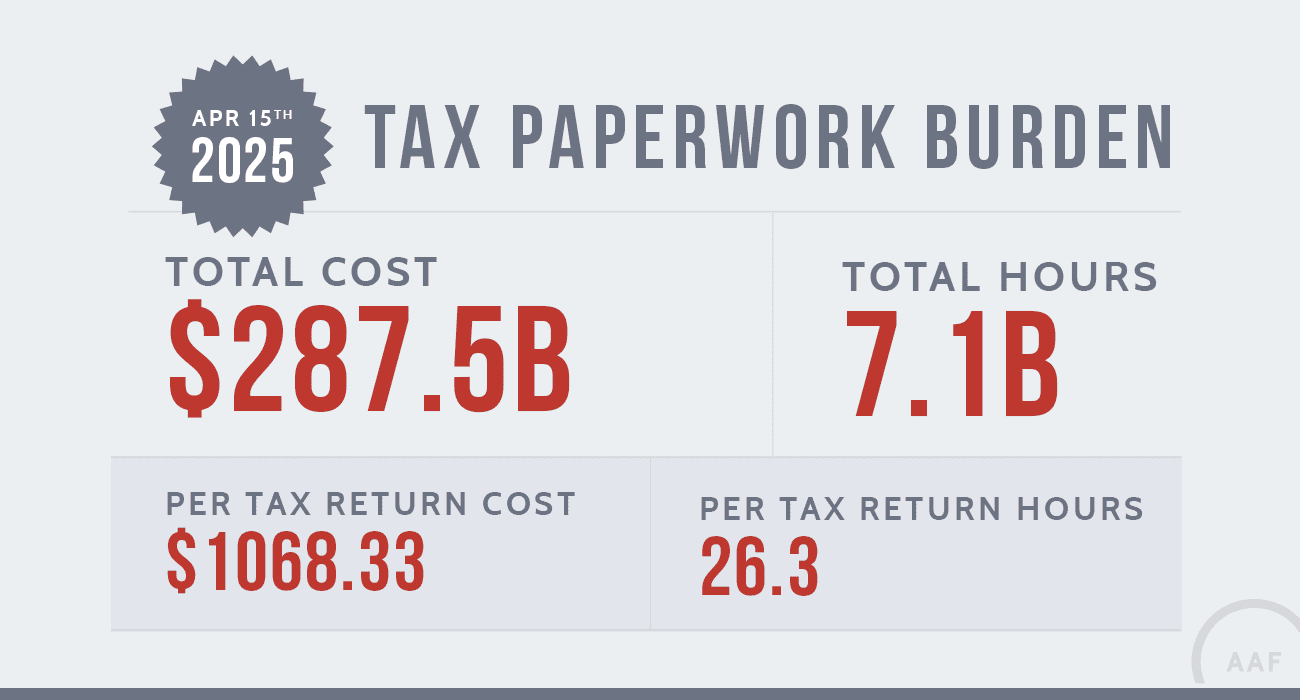
TAX DAYS: YEAR OVER YEAR
Hours
 After a four-year stretch where the total annual paperwork from the IRS steadily increased, Tax Day 2025 finds that total declining by roughly 820 million hours, or a nearly 10-percent reduction, from 2024. The most significant portion of this decrease came in the discontinuation of the ICR for “Deduction for Qualified Business Income (Form 8995 and Form 8995-A),” which represents a 336- million-hour reduction. The official notice of discontinuation (see below) essentially let the ICR in question expire at the end of February.
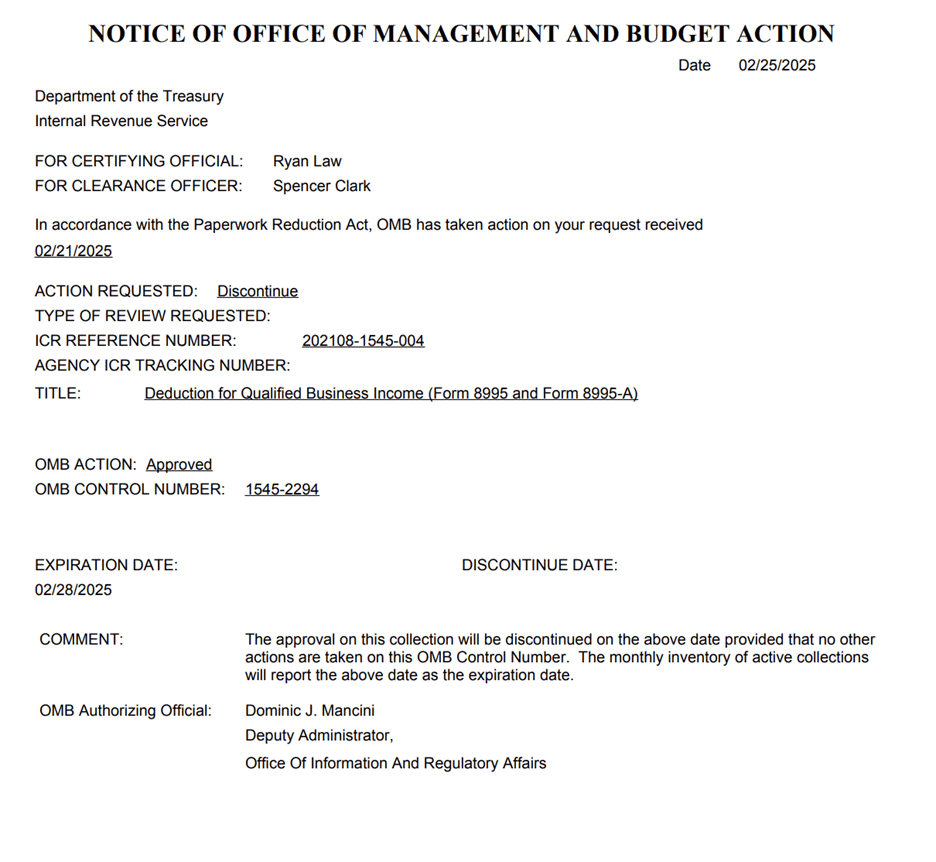 The underlying deduction in question here is one of the provisions of the Tax Cuts and Jobs Act set to expire this year. The forms previously associated with that ICR appear to now be a part of the respective ICRs for the most ubiquitous tax returns.
Collectively, those four ICRs account for a net reduction in paperwork of approximately 432 million hours. IRS cites changes in modeling and estimate assumptions as the primary reason for these shifts. These methodological shifts must be quite significant, however, since they apparently add that previously understood 336 million hours of paperwork from the Qualified Business Income returns across these other reporting requirements, and yet they all still come out to a substantial net reduction.
Costs
 Associated costs fell $7.5 billion, which represents only a 3-percent decrease from 2024. This narrower gap is partially a result of a higher wage rate used to project the per-hour cost of this paperwork (see methodology below). There were still some notable spikes in IRS’ own estimates of “out-of-pocket” costs that help explain why costs did not fall by the same rate as hours. The following ICRs had the most substantial shifts in agency-reported cost estimates:
- U.S. Business Income Tax Returns – $4.9 billion cost increase
- U.S. Individual Income Tax Return – $3.3 billion cost increase
- Employer’s Quarterly Federal Tax Return – $960 million cost increase
Much as with some of the more significant hour changes discussed above, however, these changes were primarily a function of IRS updating its underlying modeling rather than some significant policy change.
METHODOLOGY
The tax paperwork costs tracker reviews every active IRS Office of Management and Budget Control Number (collections of information or recordkeeping requirements) on RegInfo.gov, the government website that houses all federal paperwork information. That search found 432 unique ICRs, which is how OIRA segments different paperwork requests from federal agencies, all of which contained IRS estimates of expected responses and burden hours. The IRS only estimates the costs for a limited number of these ICRs, however. To project costs for those that do not include a cost estimate, AAF applies the Bureau of Labor Statistics’ most recently estimated average hourly wage for compliance officers ($40.86). The methodology is consistent with AAF’s previous Tax Day research. Per tax return calculations included in the opening graphic are based on the latest IRS official projection for expected returns filed in fiscal year 2025.
PREVIOUS TAX DAY RESEARCH
Note: Due to COVID-19, Tax Day 2021 was in May, and Tax Day 2020 was in July.