









Insight
September 2, 2026
The Jones Act Petroleum Waiver: Assessing Flows and Cost Savings
Executive Summary
- In response to global energy disruptions triggered by conflicts in the Middle East, the Trump Administration issued a waiver of the century-old Jones Act in March 2026, temporarily lifting restrictions on foreign-built and foreign-owned vessels to facilitate domestic petroleum shipments through November.
- Invoking the waiver has led to surging domestic petroleum flows via foreign vessels within the first 160 days, and to the reopening of U.S. mainland propane supply to Puerto Rico on international tankers.
- While retail gasoline prices remained elevated due to broader global market disruptions, the waiver eliminated steep domestic maritime freight penalties on petroleum products, generating an estimated $99.9–$110.1 million in cost savings across the U.S. economy over the March–November waiver period.
Introduction
In response to global energy disruptions triggered by Middle East conflicts, the Trump Administration issued an emergency waiver of the century-old Jones Act in March 2026, temporarily lifting restrictions on foreign-built and foreign-flagged vessels to facilitate domestic petroleum shipments through November.
Invoking the waiver has led to surging domestic petroleum flows via foreign vessels within the first 160 days, enabling 15.5 million barrels of petroleum to move from the Gulf Coast to the West Coast, 19.3 million barrels to the East Coast, and 6.2 million barrels to Puerto Rico—surpassing multi-decade delivery records and reopening mainland propane supply to Puerto Rico on foreign gas carriers.
While retail gasoline prices remained elevated due to broader global crude market disruptions, the waiver eliminated steep domestic maritime freight penalties on petroleum products, generating an estimated $99.9–$110.1 million in cost savings across the U.S. economy over the March–November waiver period.
A Temporary Waiver of the Jones Act
According to the U.S. Maritime Administration, the Jones Act, a statute enacted in 1920, mandates that “no vessel may transport any merchandise by water, by land and water, or via a foreign port, for any part of the transportation, between points in the United States, unless the vessel is U.S.-built, U.S.-owned, and coastwise endorsed by the U.S. Coast Guard.” As a result, intra-U.S. waterborne shipping of goods via Jones Act-compliant U.S. vessels is subject to extra costs associated with building U.S. vessels compared to international vessels, imposing a burden on the U.S. economy.
The February 28, 2026, U.S.-Israel attack on Iran, and the subsequent Iranian retaliatory strikes, triggered a de facto closure of the Strait of Hormuz—a major oil chokepoint for 20 percent of global petroleum consumption flowing from major oil producing countries in the Gulf region to the rest of the world. As of the publication date of this insight, the Middle East conflict is ongoing, the strait remains effectively closed, and the global oil and gas market continues to be impacted.
Due to the global oil disruption caused by the U.S.-Iran conflict, the Trump Administration issued a 60-day waiver for the Jones Act on March 17, which covered 619 product categories including crude oil, petroleum products, and natural gas. The waiver has been extended twice and is due to expire on November 15, with a smaller coverage of 228 product categories including petroleum products. The goal of the waiver is to “ensure our military and key industries maintain uninterrupted access to critical resources,” according to a White House spokesperson.
Significant Increase in Intra-U.S. Petroleum Waterborne Shipments
Since the Jones Act waiver took effect in March, intra-U.S. waterborne shipment of crude oil and petroleum products has increased significantly, especially from the Gulf Coast to the West Coast and Puerto Rico.
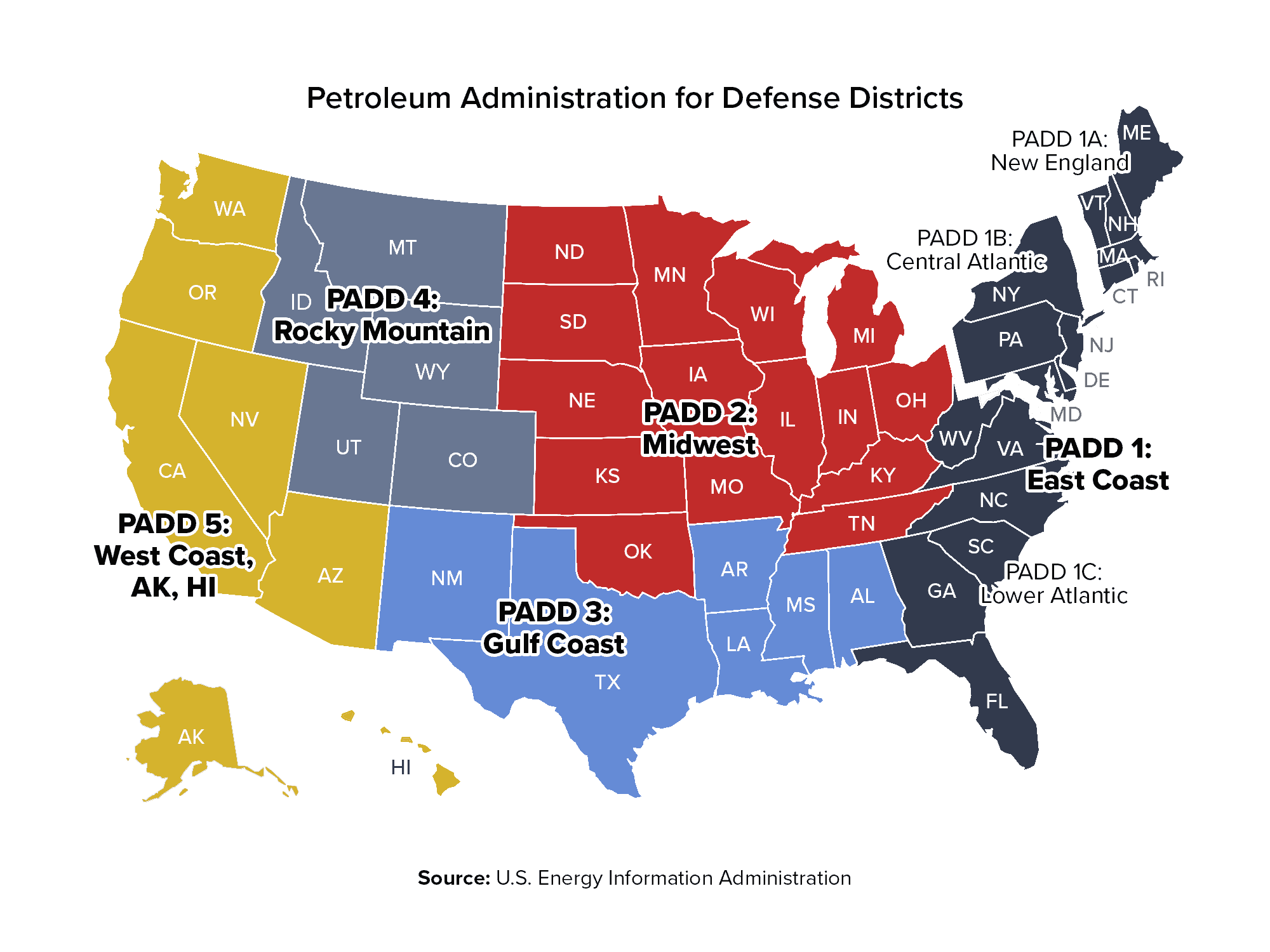
As shown in the map below, U.S. states are divided into five Petroleum Administration for Defense Districts (PADDs) for regional analysis of petroleum supply and movements. PADD 1 is the East Coast, PADD 3 is the Gulf Coast, and PADD 5 is the West Coast.
For context, most petroleum products are shipped via pipeline or rail in the United States. In 2025, Gulf Coast-to-West Coast petroleum products shipments via rail were about 219,000 barrels per day, about 6.2 times the amount shipped over water. In the same year, Gulf Coast-to-East Coast petroleum products shipments via pipeline and rail were about 2.7 million barrels per day, about 3.2 times the volume moved by water.
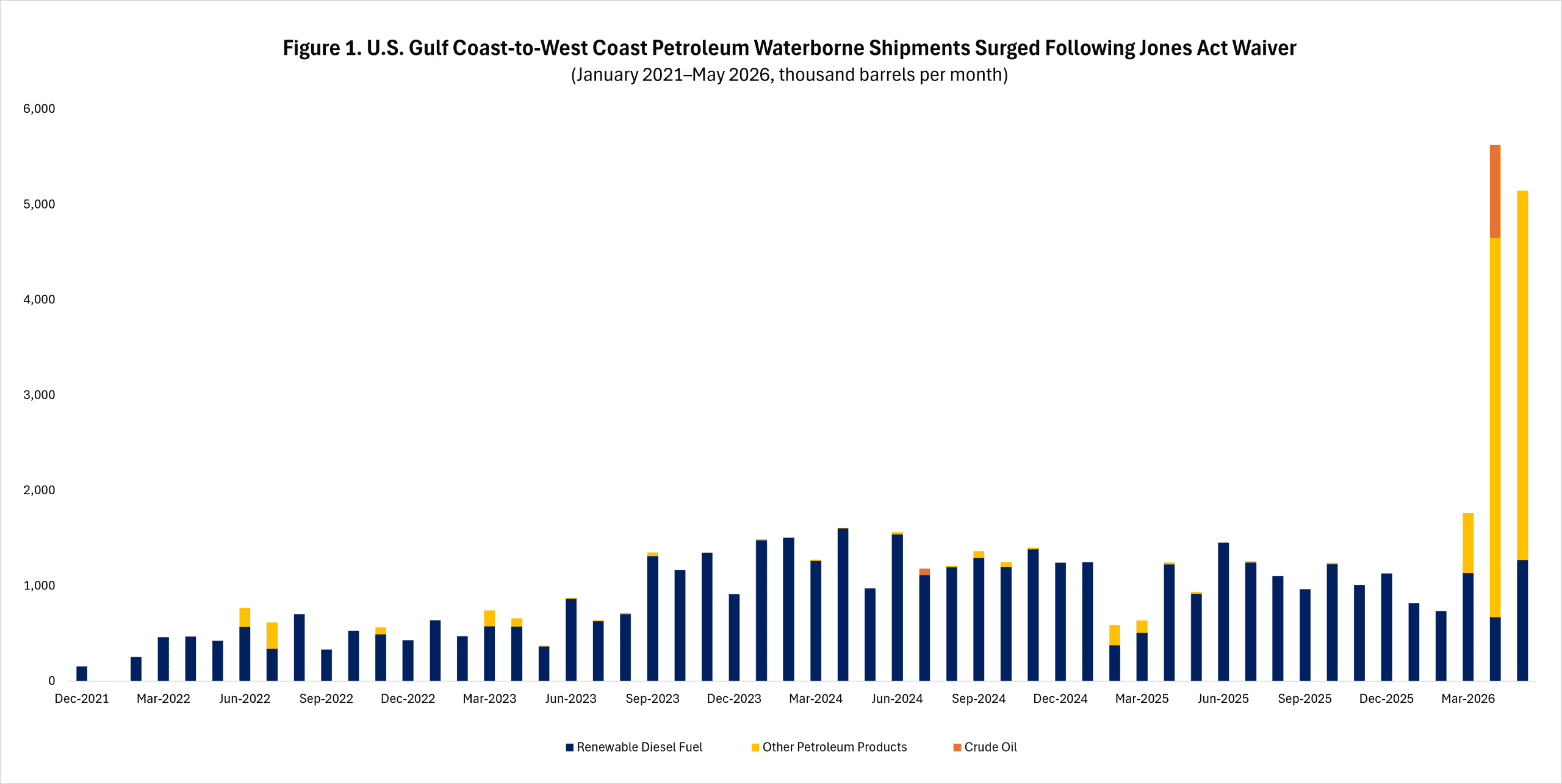
As shown in Figure 1, prior to the waiver, most waterborne petroleum shipment from the Gulf Coast to the West Coast was renewable diesel fuel. In April and May—the first two full months under the waiver—waterborne shipments of crude oil and non-renewable-diesel-fuel petroleum products (including gasoline blending components, finished motor gasoline, and jet fuel) from the Gulf Coast to the West Coast surged close to 9 million barrels, exceeding the cumulative total shipped between January 2021 and February 2026.
Source: U.S. Energy Information Administration
Note: Figures include tanker and barge shipments, other petroleum products include gasoline blending components and kerosene-type jet fuel.
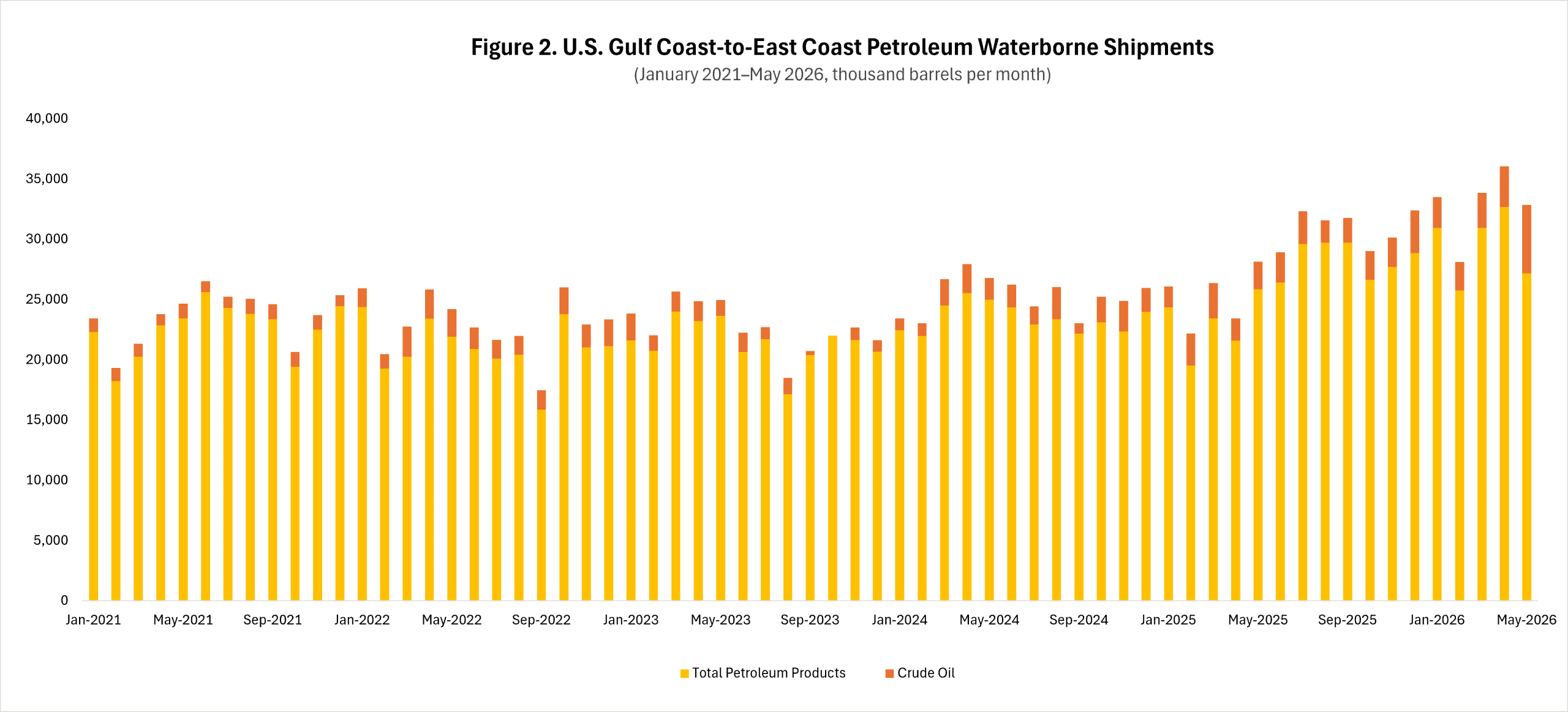
Gulf Coast-to-East-Coast waterborne shipments of crude oil and petroleum products increased slightly in April and May from prior to the waiver in 2026 (Figure 2).
Source: U.S. Energy Information Administration
Note: Figures include tanker and barge shipments, other petroleum products include gasoline blending components and kerosene-type jet fuel.
Costs Saved Under a Jones Act Waiver
As shown in Figure 3, researchers have provided estimates of the costs saved under a Jones Act waiver for petroleum products shipped from the Gulf Coast to the West Coast, East Coast, and Puerto Rico.
Argus media estimated that shipping petroleum products on an international vessel from the Gulf Coast to the West Coast saves about 6.6 cents per gallon (about $2.8 a barrel). A study by Ryan Kellogg and Richard Sweeney estimated that eliminating the Jones Act would save Gulf-Coast-to-East-Coast shipments of gasoline, jet fuel, and diesel prices by $0.63, $0.80, and $0.82 per barrel. The larger savings for West Coast-bound shipments are driven by several factors, including the much longer transit distance via the Panama Canal—which contributes to the higher shipping rates—and the lack of pipeline infrastructure connecting the Gulf Coast to the West Coast.
Puerto Rico has long been de facto cut off from U.S. supplies of propane (liquefied petroleum gas) as there are no Jones Act-compliant vessels that can transport it from the Gulf Coast. Prior to the waiver, Puerto Rico imported propane from Nigeria, Chile, Equatorial Guinea, and other countries. In the first 160 days of the waiver, however, Puerto Rico has imported 0.8 million barrels of propane from the Gulf Coast, which was 122 percent more than what was transported from the U.S. mainland over the past 20 years. The Federal Reserve Bank of New York found that in 2012, shipping a container from the U.S. mainland to Puerto Rico cost $3,063, compared to just $1,503 to the Dominican Republic, which is a comparable distance that is exempt from the Jones Act.
Within the first 160 days of the waiver, according to the Cato Institute, waterborne shipments of petroleum products from the Gulf Coast to the rest of the country via international vessels have surged: 15.5 million barrels to the West Coast, 19.3 million barrels to the East Coast, and 6.2 million barrels to Puerto Rico. (Figure 3) Notably, these shipping volumes include only shipments via foreign vessels that had to utilize the waiver.
Using the total volumes of petroleum products shipped via foreign vessels and the costs saved per barrel of products, the waiver enacted from March–November 2026 would save the U.S. economy approximately $99.9–$110.1 million. (Figure 3)
Figure 3. Estimated Costs Saved in Waterborne Shipments of Petroleum Products Under the 2026 Jones Act Waiver
| Shipping Routes | Costs Saved | Shipments on International Vessels Under the First 160 Days of the 2026 Waiver | Estimated Costs Saved (Waiver from March-November 2026) |
| Gulf Coast to West Coast | $2.8/barrel | 15.5 million barrels | $65 million |
| Gulf Coast to East Coast | $0.63–$0.82/barrel | 19.3 million barrels | $18.2 million–$23.7 million |
| Gulf Coast to Puerto Rico | $1.8–$2.3/barrel | 6.2 million barrels | $16.7 million–$21.4 million |
| Total | NA | NA | $99.9 million–$110.1 million |
Source: Author’s calculation, Cato Institute’s Jones Act Waiver Tracker, Impacts of the Jones Act on U.S. Petroleum Markets by Ryan Kellogg and Richard Sweeney, ECONOFACT, Reuters, SeaRates, Puerto Rico’s Surging Propane Imports Reveal the Jones Act’s Hidden Cost, Distances Between United States Ports.
Note: Argus Media estimated that Gulf Coast-to-West-Coast shipments of petroleum products saves about 6.6 cents per gallon, which is about $2.8/barrel; to calculate the costs saved for each barrel of petroleum products shipped from the Gulf Coast to Puerto Rico, Gulf Coast-to-East-Coast shipping rates were multiplied by the ratio of the shipping distance between Puerto Rico and Nigeria and Puerto Rico and the Gulf Coast. The cost estimate excludes the price difference between propane sourced from the U.S. mainland and foreign imports. Estimated total cost savings (Column 4) are projected across the full 8-month waiver period by scaling observed 160-day shipment volumes. These estimates assume steady monthly shipment volumes for petroleum products.
Minimal Impact on Gasoline Prices
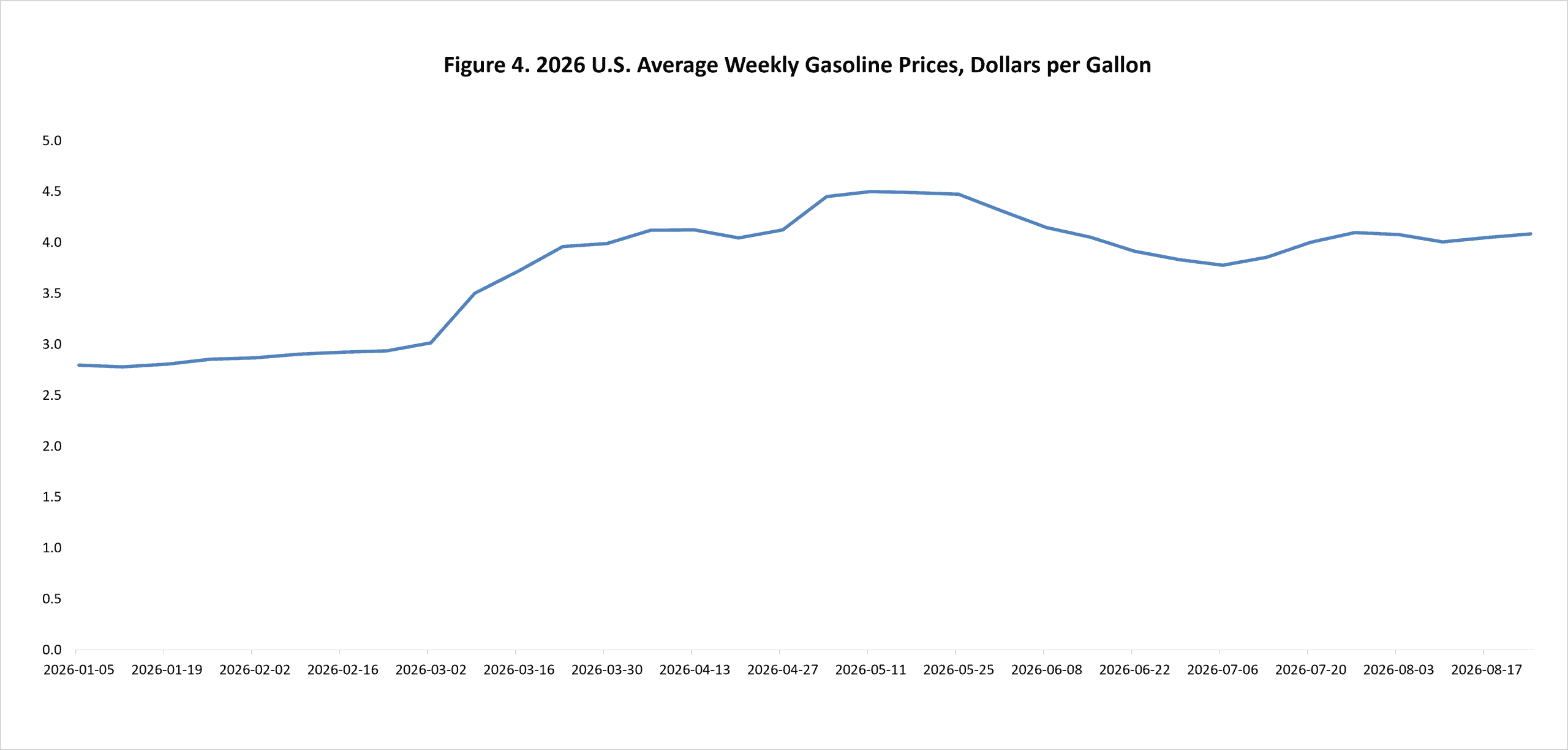
Despite the estimated savings from the Jones Act waiver, the waiver has had minimal impact on U.S. gasoline prices, as shown in Figure 4. Since the waiver took effect on March 17, U.S. gasoline prices surged past $4 per gallon by late March and remained above that threshold, dipping only briefly below $4 for a few weeks.
The Jones Act waiver’s cost savings is only a fraction of U.S. gasoline prices. The U.S. petroleum market is integrated into the global market, and gasoline prices are determined by global supply and demand. The ongoing Middle East conflicts, and most notably the effective closing of the Strait of Hormuz, have disrupted global supply of crude oil and petroleum, leading to the spikes in U.S. gasoline prices.
Source: FRED
Conclusion
It remains to be seen whether the Middle East conflicts will resolve before the Jones Act waiver expires on November 15, 2026. Despite the waiver’s minimal impact on U.S. gasoline prices, invoking the waiver allowed a significant increase in intra-U.S. petroleum flows and generated substantial cost savings for the economy. Lawmakers should consider extending the waiver or repealing the century-old legislation altogether.
