Insight
April 14, 2026
Tracker: The Cost of Tax Paperwork for Tax Day 2026
INTRODUCTION
The American Action Forum (AAF) tracks the cost of complying with Internal Revenue Service (IRS) paperwork. The tracker uses data on Information Collection Requirements (ICRs) from the Office of Information and Regulatory Affairs’ (OIRA) RegInfo.gov website. For more information on how costs are calculated, see the Methodology section, below.
For this edition of the tracker, data as of April 14, 2025, are compared to the snapshot of costs compiled annually by AAF on Tax Days going back to 2017. This year’s edition saw some marginal shifts in both the hourly burden and associated costs – with the former declining somewhat and the latter increasing. These changes are largely attributable to updates in how IRS calculated its totals for the most significant tax requirements. There was, however, some effect on the agency’s overall totals emanating from certain provisions of last year’s reconciliation bill commonly known as the “One Big Beautiful Bill Act.”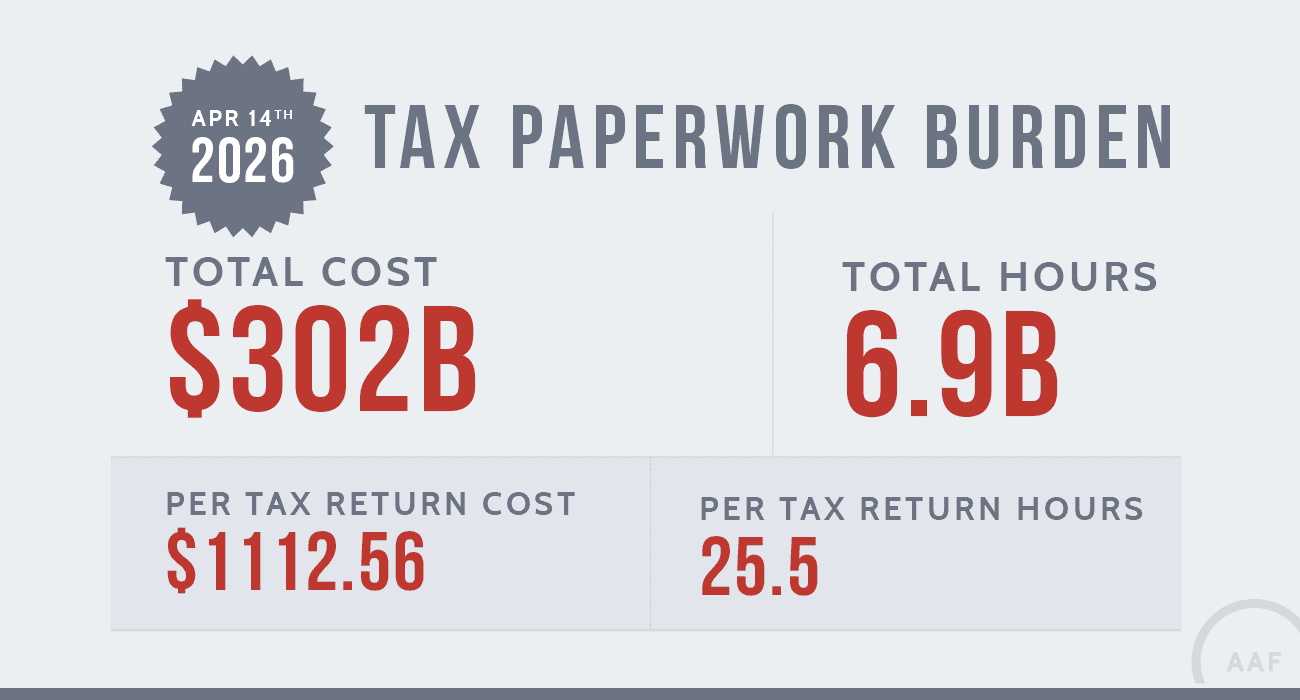
TAX DAYS: YEAR OVER YEAR
Hours
For the second year in a row, the overall hour count for IRS paperwork declined – albeit relatively slightly. Compared to the total from this time last year, IRS estimates that its paperwork requirements involve roughly 160 million fewer hours to complete. While this figure may sound daunting in absolute terms, it represents a roughly 2 percent decrease. Additionally, the IRS total still exceeds those seen on Tax Day during 2021, 2022, and 2023.
The shifts in Individual and Business Income Tax Return requirements were the main drivers of this downward trend with roughly 259 million hours in combined reductions. The most significant shares of these decreases, however, came from “Change Due to Adjustment in Estimate,” as opposed to any discernible policy shift. Same goes for the largest net increase – from the “Appllication [SIC] for Employer Identification Number” – that saw its hourly total jump by more than 66 million hours. The only significant shift in hours that came from some novel policy action was the nearly 65 million hours involved in paperwork for the new “Trump Account Election(s).”
Costs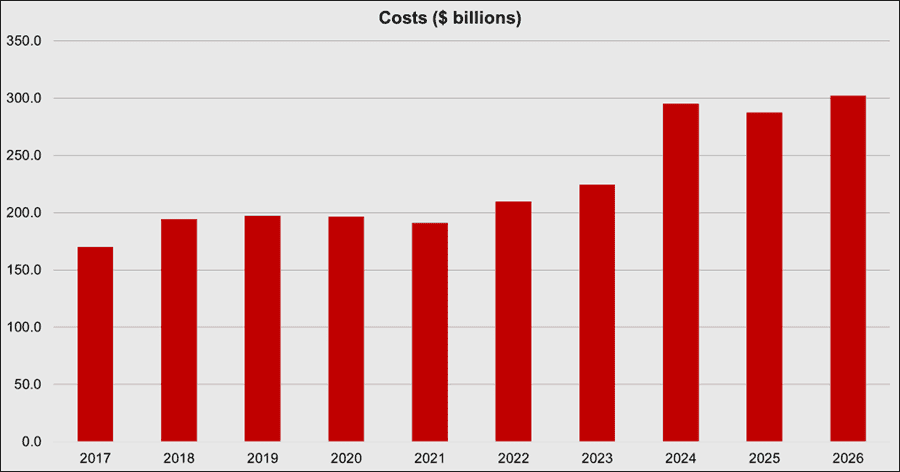
While the hours total saw a nominal decline, the cost total ticked upward a bit. Compared to Tax Day 2025, the cost total for IRS paperwork increased by $14.4 billion – a roughly 5 percent year-over-year bump. This pushes the 2026 cost total to the highest recorded by AAF since 2017. In years past, one may have been able to attribute this trend primarily to an increase in the wage rate used to fill in the estimates that did not have an attached cost estimate (see Methodology section, below). Yet as the government wage data are not set for an update until May 2026, AAF has used the same wage rate utilized for the Tax Day 2025 tracker. It is a curious result to see this cost spike despite the relatively flat per-hour rate used for many of the ICRs.
Such a dynamic suggests that some of those ICRs that did provide their own cost estimate in the “Cost Burden” section must have seen some significant increases. The culprits – as is often the case from year to year given their outsized significance in the canon of tax paperwork – are once again the Individual and Business Income Tax Return requirements that brought increases of $1.1 billion and $7.6 billion, respectively. Much of the Business Income Tax Return increase comes from “Change Due to Adjustment in Estimate” portion of its calculation. The Individual Return, however, attributes roughly 84 percent of its cost increase to “Change Due to New Statute.” While IRS does not include granular, statute-by-statute calculations here, the agency does note that such cost increases are primarily the result of “new 1099-DA reporting requirements and changes associated with Pub. L. 119-21 (One Big Beautiful Bill Act).”
METHODOLOGY
The tax paperwork costs tracker reviews every active IRS Office of Management and Budget Control Number (collections of information or recordkeeping requirements) on RegInfo.gov, the government website that houses all federal paperwork information. That search found 432 unique ICRs, which is how OIRA segments different paperwork requests from federal agencies, all of which contained IRS estimates of expected responses and burden hours. The IRS only estimates the costs for a limited number of these ICRs, however. To project costs for those that do not include a cost estimate, AAF applies the Bureau of Labor Statistics’ most recently estimated average hourly wage for compliance officers ($40.86). The methodology is consistent with AAF’s previous Tax Day research. Per tax return calculations included in the opening graphic are based on the latest IRS official projection for expected returns filed in fiscal year 2025.
PREVIOUS TAX DAY RESEARCH
Note: Due to COVID-19, Tax Day 2021 was in May, and Tax Day 2020 was in July.