Insight
April 22, 2026
U.S.-Canadian Divergence in EV Policies: A Flashpoint for the USMCA Review
Executive Summary
- As the United States-Mexico-Canada Agreement (USMCA) is scheduled to have its six-year review starting July 1, the Trump Administration will decide whether to modify the agreement to extend it for another 16 years, let it expire in 2036, or withdraw entirely.
- Upcoming negotiations will be important for the auto industry, which must navigate stringent rules-of-origin requirements mandating a certain level of inputs sourced from North America; a primary sticking point will be whether to update these rules for electric vehicles (EVs), given the global supply chain’s reliance on China.
- While the United States has overhauled its EV policies by repealing tax incentives and vehicle emissions standards, Canada continues to subsidize EV adoption and recently announced opening its market to Chinese EV imports; this divergence in EV policies will likely be a flashpoint for the upcoming USMCA review, particularly given President Trump’s consistent focus on the automotive industry and Chinese exports.
Introduction
As the United States-Mexico-Canada Agreement (USMCA), a North American trade agreement, is scheduled to have its six-year review starting July 1, the Trump Administration will decide whether to extend the agreement for another 16 years, let it expire in 2036, or withdraw entirely.
Upcoming negotiations will be important for the auto industry, which must navigate stringent North American rules of origin that define regional trade barriers. A primary sticking point will be whether to update these rules for electric vehicles (EVs), given the global supply chain’s reliance on Chinese critical minerals.
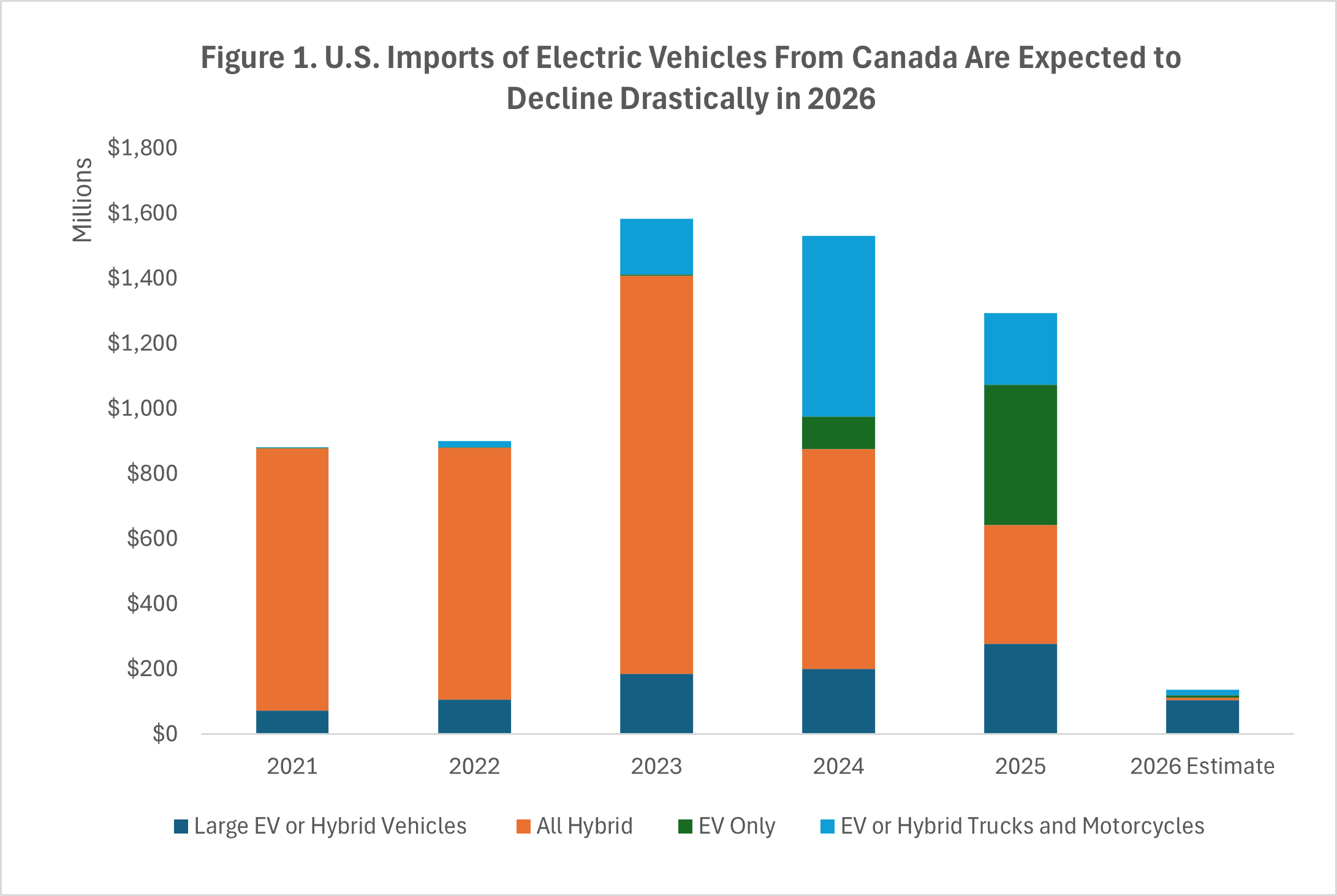
Trade tensions between the United States and Canada have begun to surface primarily in import data, as there has been a nearly 96-percent decline in U.S. imports of EVs from Canada in the first two months of 2026 compared to the same period last year.
While the United States has overhauled its EV policies by repealing tax incentives and emissions standards, Canada continues to support EV adoption by subsidizing consumers and manufacturers. It has also recently announced opening the Canadian market for Chinese EV imports. This divergence in EV policies will likely be a flashpoint for the upcoming USMCA review. While Mexico is an equal party to the trade agreement, this insight focuses on EV policies in the United States and Canada, and how their bilateral trade tensions may impact negotiations.
The EV Industry Is a Sticking Point in the Upcoming USMCA Review
The pending USMCA review
Beginning July 1, the USMCA – the North American trade agreement reached during Trump’s first term – is scheduled to have its six-year review. In this review, the Trump Administration will decide whether to extend the USMCA for another 16 years, let it expire in 2036, or withdraw entirely.
The auto industry will be particularly impacted by the results of the upcoming negotiations due to the rules-of-origin requirements currently in place for vehicles and auto parts. The USMCA requires 65–75 percent of a vehicle’s value and 70 percent of a manufacturer’s steel and aluminum purchases to originate in North America. Additionally, there is a labor value content rule that requires 40–45 percent of production by value be made by workers earning at least $16 an hour.
Auto industry stakeholders have pointed out that the current rules of origin system should be updated to account for the changing composition of the electric vehicle supply chain. The value of EVs is increasingly made up of critical minerals, batteries, and electronic devices rather than simply steel and aluminum inputs. Whether to include new requirements for these auto components would likely be a major sticking point throughout negotiations as the global supply chain is currently heavily dependent on Chinese critical minerals that are important for manufacturing EVs. China holds significant mineral reserves, mines 70 percent of all rare earths, and maintains close to 90 percent of the world’s rare-earth processing capacity.
U.S.-Canada trade tensions
The United States levied several tariffs on Canadian automotive imports under the Trump Administration’s aggressive tariffs policy. Following the “Liberation Day” announcement in April 2025, the administration enacted a 25-percent tariff on Canadian automobiles and auto parts, applicable to the value of a product’s content that does not have a U.S. origin.
Canada retaliated with counter tariffs on imported vehicles from the United States. It also provided exemptions to the retaliatory tariffs by implementing “an auto remission framework” that allows Canadian automakers to import a set quantity of vehicles from the United States without being subject to the “counter-tariff,” on the condition that the automaker maintains a certain level of production in Canada. The Canadian government recently noted that the remission framework could recognize other objectives, such as “the use of Canadian content, the creation and maintenance of high‑quality unionized jobs, and the production of electrified vehicles.” The framework is designed to align with the Canadian government’s “Buy Canadian” policy to boost investment in Canada’s auto manufacturing industry.
Notably, Canada agreed to form “a new strategic partnership” with China in January 2026 that allows imports of up to 49,000 Chinese EVs into the Canadian market annually. Chinese EVs imported under that cap would be subject to a 6.1-percent tariff rate. The goal of the partnership is to “drive considerable new Chinese joint-venture investment in Canada with trusted partners to protect and create new auto manufacturing careers for Canadian workers, and ensure a robust build-out of Canada’s EV supply chain.”
Canada opening its market for Chinese EV imports will certainly create significant tension for the upcoming USMCA review as it complicates Canada’s trade relationship with the United States.
U.S.-Canadian bilateral trade in EVs is expected to decline significantly in 2026
In the first two month of 2026, U.S. imports of EVs from Canada dropped 96 percent compared to the same period last year. This large-scale drop in imports is due not only to a shift in U.S. tariff policy but also the expiration of tax credits and lower demand within the EV market. It will take a revitalization of U.S.-Canada trade ties as well as an uptick in U.S. domestic EV demand to alter current EV import trends. If this trend continues, it is expected that 2026 will see a sharp decline in U.S. imports of EVs from Canada (Figure 1). Similarly, there has been a noticeable drop of 53 percent in U.S. EV exports to Canada in the first two month of 2026 (Figure 2). Despite the recent drop in U.S. EV exports to Canada, exports are not expected to decline substantially in 2026 based on trends for each individual EV export category.
Source: United States International Trade Commission

Source: United States International Trade Commission
U.S. and Canadian EV Policy Landscape
Global momentum for ambitious climate mandates is cooling as major economies begin to scale back their electric vehicle requirements. Both the United States and Canada have tempered their EV transition timelines and are now pursuing diverging strategies to promote adoption.
U.S. EV policies shift
Currently, the United States does not have federal policies to support EV adoption. The second Trump Administration has significantly rolled back Biden-era policies aimed at supporting the EV industry. The major overhaul was the 2025 One Big Beautiful Bill’s repeal of all the clean vehicle tax credits passed in the 2022 Inflation Reduction Act. A previous American Action Forum insight explains that rescinding the EV-related tax credits is a positive legislative development, as EV tax credits are costly, complicated, and inefficient.
Additionally, the administration has overhauled regulations designed to encourage the transition to clean vehicles. These actions include the Environmental Protection Agency’s final rule repealing the 2009 endangerment finding – which provided legal authority under the Clean Air Act for the agency to regulate greenhouse gas (GHG) emissions from cars or power plants. This rule also repealed all GHG emission standards for light-, medium-, and heavy-duty vehicles.
The Trump Administration also rescinded the waiver President Biden granted to California to set its own vehicle emissions standards in lieu of federal standards. This has created significant challenges for California’s state-wide mandate to ban sales of new combustion-engine vehicles by 2035. Following the waiver repeal, California Governor Newsom signed an executive order to reinforce the commitment to the clean vehicle mandate. The Justice Department filed a lawsuit against California to stop it from imposing the EV mandate in March 2026.
Approximately 22 percent of light-duty vehicles purchased in 2025 in the United States were hybrid, battery electric, or plug-in hybrid vehicles. This represents a slight increase from the 20-percent share in 2024, reflecting the fact that consumers were claiming the clean vehicle tax credits before they expired in September 2025.
Canadian EV policies shift
Canada substantially revised its EV policies to adopt a more realistic approach after Mark Carney became Prime Minister in March 2025. In February 2026, Canada announced repeal of the Trudeau-era Electric Vehicle Availability Standard, which mandated that by 2035, 100 percent of Canada’s new light-duty vehicles for sale be zero-emissions vehicles.
At the same time, Canada will subsidize consumers and producers through a new five-year “EV affordability program” to drive adoption. Starting in February 2026, Canadians would benefit from EV subsidies as high as CA$5,000 for a battery electric or fuel-cell electric vehicle, and CA$2,500 for a plug-in hybrid vehicle. The subsidies will decline by 2030 to less than half of their current amounts. Besides the CA$2.3 billion worth of consumer incentives, Canada is also planning to spend CA$1.5 billion on EV charging infrastructure.
Electric vehicle and battery manufacturers can also benefit from a variety of Canadian government subsidies. Currently, these manufacturers can claim a 30-percent refundable tax credit. The Canadian government has also proposed a new “tradable import credit system” to reward companies that produce and invest in car manufacturing in Canada. The system would grant import credits to manufacturers investing in Canadian production. Companies with a surplus can then sell these credits to importers to offset their tariff liabilities. The proposal is currently under review by the government.
EVs had a market share of about 15 percent in Canada in 2024. EV sales in the first quarter of 2025 declined by 23 percent compared to the same quarter in 2024 due to economic uncertainty related to President Trump’s tariffs.
Looking Forward
The diverging EV strategies of the United States and Canada, set against a shared backdrop of aggressive onshoring and foreign investment incentives, are poised to become a central friction point in the upcoming USMCA review. In particular, Canada’s decision to open its market for Chinese EV imports will complicate negotiations with the Trump Administration, which can be expected to seek tighter rules of origin for Canadian products. The negotiations will likely have a significant impact on the automotive industries including EVs, U.S.-Canadian trade relation and economic interdependence.