









Insight
June 4, 2026
Virginia Rejoining RGGI: Navigating the Electricity Market and the AI Data Center Boom
Executive Summary
- In July 2026, Virginia is set to rejoin the Regional Greenhouse Gas Initiative (RGGI), which sets a total carbon dioxide emissions cap for the electricity market; the change was made in a rushed manner, exacerbating a host of challenges and putting significant upward pressure on energy prices.
- Power plants in Virginia are already subject to strict carbon-free electricity mandates under the Virginia Clean Economy Act (VCEA) and layering RGGI on top will further increase costs for utilities; moreover, these duplicative restrictions complicate Virginia’s efforts to generate the dramatic ramp-up in electricity to power its artificial intelligence (AI) data center boom.
- An RGGI carbon price is likely the most efficient way for Virginia to reduce power-sector emissions, but its haphazard implementation threatens to force a spike in utility rates; Virginia’s re-adoption of RGGI, which produces revenue for the state, also highlights the challenges of enacting a federal power sector climate policy as states with climate policies such as RGGI may not be willing to forgo the associated revenue.
Introduction
In July 2026, Virginia is set to rejoin the Regional Greenhouse Gas Initiative (RGGI), which sets a total carbon dioxide (CO₂) emissions cap for the electricity market and allows power plants to trade emissions allowances. The change was made in a rushed manner, exacerbating a host of challenges and putting significant upward pressure on energy prices.
Notably, while Virginia withdrew from RGGI in 2023, its renewed participation assumes the state never left, leaving it subject to much tighter emissions caps that mandate a 61-percent reduction in CO₂ by 2030 and a 92-percent reduction by 2037 (both from the 2027 level).
Virginia’s pending return to RGGI will likely create allowances supply shortages in the future, as participating power plants anticipate higher demand for allowances driven by the massive emissions from power generation associated with artificial intelligence (AI) data centers. Emissions allowances are sold in RGGI quarterly auctions and also traded on secondary markets such as the Intercontinental Exchange (ICE) platform. Daily future trading prices on ICE have spiked from $25 earlier this year to a historic high of $50 recently, reflecting the size of the coming shortage.
Power plants in Virginia are already subject to strict carbon-free electricity mandates under the Virginia Clean Economy Act (VCEA). Layering RGGI on top of VCEA will further increase costs for utilities. Moreover, these duplicative restrictions complicate Virginia’s efforts to generate the dramatic ramp-up in electricity to power its AI data center boom.
An RGGI carbon price is likely the most efficient way for Virginia to reduce power-sector emissions, but its haphazard implementation threatens to force a spike in utility rates. Virginia’s re-adoption of RGGI, which produces revenue for the state, also highlights the challenges of enacting a federal power sector climate policy as states with climate policies such as RGGI may not be willing to forgo the associated revenue.
Virginia Rejoining RGGI
In February 2026, newly elected Virginia Governor Abigail Spanberger signed a budget bill that included a provision mandating the state rejoin RGGI. In April 2026, Virginia’s Department of Environmental Quality (DEQ) followed the mandate and published a revision to the state’s CO2 Budget Trading Program regulation. Under current law, Virginia is set to resume participation in RGGI starting July 1, 2026, and join the regional initiative’s auctions in September and December.
This action is the latest development in Virginia’s whiplash-inducing back and forth in its engagement with RGGI. Here’s a broad timeline of the state’s policy pendulum:
- Initial Participation in 2021: Virginia first joined RGGI in January 2021, under Democratic Governor Ralph Northam, as mandated by the state’s 2020 Clean Energy and Community Flood Preparedness Act.
- Withdrawal in 2023: Virginia officially exited RGGI in December 2023, following a 2022 executive order from Republican Governor Glenn Youngkin and a subsequent regulatory repeal by the State Air Pollution Control Board. The Circuit Court of Floyd County ruled this repeal unlawful in 2024, a decision the Youngkin Administration subsequently appealed.
- Resuming Participation in 2026: The Spanberger Administration redirected Virginia to rejoin RGGI in 2026 via legislative action and withdrew the appeal to the court.
Overview of RGGI
RGGI is a regional climate mitigation initiative that aims to reduce CO2 emissions in the power sector through cardon pricing, which includes two broad types of policies: a carbon tax and a cap-and-trade mechanism. The carbon tax directly prices per unit of emissions. The cap-and-trade mechanism sets the total level of permissible emissions for participating states and allows power plants to trade corresponding emissions allowances under that overall cap. Unlike a carbon tax alone, which would make the price per unit of emissions predictable, RGGI makes the total amount of emissions in a given year predictable. Carbon pricing policy is more efficient than command-and-control regulations because it allows utilities the flexibility to reduce emissions with the least-costly technologies.
RGGI was founded in 2005 and currently has 10 member states: Connecticut, Delaware, Maine, Maryland, Massachusetts, New Hampshire, New Jersey, New York, Rhode Island, and Vermont.
RGGI sets an annual regional CO2 emissions cap for power plants that declines each year. Power plants with a capacity of 25 megawatts or larger must comply with the regulation. Each RGGI state issues a specific number of emissions allowances annually based on its share of the regional cap. Participating power plants must purchase one allowance for each short ton of emissions.
States hold quarterly auctions to sell emissions allowances to power plants. The most recent auction was held in March 2026. RGGI has raised more than $10 billion from the sale of allowances since 2005 – a significant source of revenue for member states. Allowances can be retained by power plants or resold, which establishes a secondary market that trades continuously.
RGGI has two price-stabilizing mechanisms that essentially set an arbitrary ceiling and floor for the allowance price. The Emissions Containment Reserve (ECR) acts as a price floor by withholding allowances if prices fall below a preset trigger, ensuring steady emissions reductions. In 2026, the ECR trigger price is $8.40; it will grow by 7 percent each year.
The Cost Containment Reserve (CCR) holds a buffer of allowances above the emissions cap, releasing them only when prices hit a predetermined trigger level. The CCR sets a cap on how high the price of allowances can go – equal to 10 percent of the total regional emissions cap each year. The CCR trigger price is $18.20 in 2026; it will rise by 7 percent annually. CCR allowances were released several times over the past decade to prevent prices from rising too high.
Notably, if a power plant fails to comply with RGGI in a three-year control period by having emissions in excess of its allowances, the entity will be required to remit allowances equal to three times the excess emissions.
As shown in Figure 1, RGGI allowance prices have gone up significantly from about $2 per short ton of CO2 in early 2010s to $25 in March this year. While the CCR was first triggered in 2014 and 2015, it has been activated much more frequently over the past five years, with releases occurring in 2021, 2023, 2024, 2025, and 2026. The rising RGGI allowance prices and the more frequent triggering of the CCR were driven by a rising demand for allowances as power plants ramped up electricity generation to support fast-growing needs of AI data centers and other sectors.
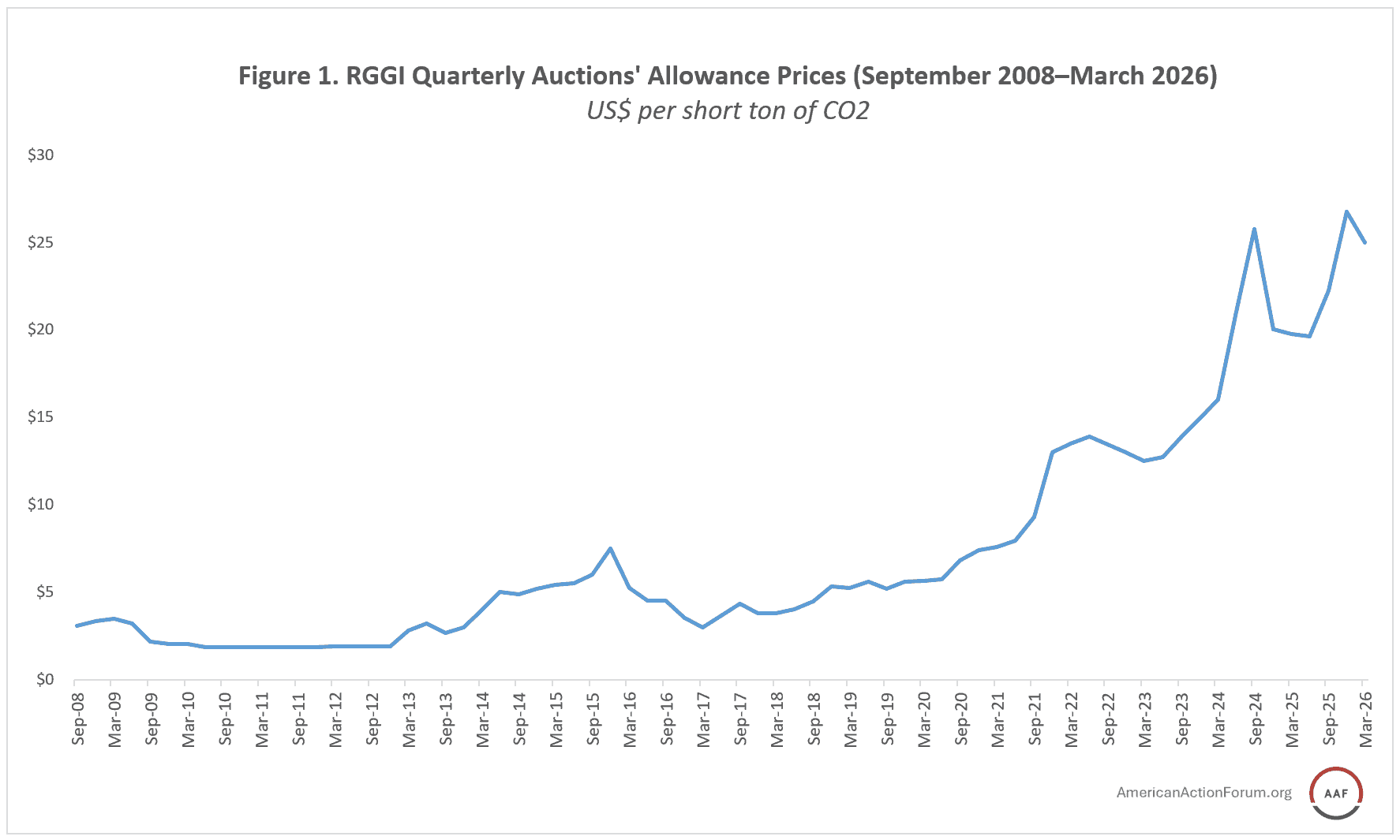
Source: RGGI
Virginia Is Set to Face Tighter Emissions Caps Amid an AI Data Center Boom
Virginia, sometimes referred to as “Data Center Alley,” is the world’s leading data center market, thanks to its strategic geographic location and robust fiber-optic infrastructure. It had the country’s highest operating capacity in data centers as of 2024 at 5,926 megawatts. In 2023, it ranked first nationally in the amount of electricity required to power all its data centers. Data centers are projected to be the key drivers for rising energy demand in Virginia over the next 15 years. A previous American Action Forum’s insight considers the implications for the electricity market of Virginia’s AI data center boom.
Figure 2 shows Virginia’s historic emissions from 2015–2025 and projected emissions caps under RGGI from 2026–2037. The state’s total emissions declined slightly from 33.6 million tons in 2015 to 32.8 million tons in 2020 despite some intermediate spikes. From 2021–2023, when Virginia was participating in RGGI, its emissions dropped faster – from 28.5 million tons in 2021 to 25.6 in 2023. After Virginia withdrew from RGGI in December 2023, its emissions bounced back quickly to 30.8 million tons in 2024 and 33.4 million in 2025.
Since Virginia is rejoining RGGI in July 2026, it will be subject to a half-year emissions cap of 11.4 million tons (half of the full year’s 23-million-ton cap). The 2026 emissions cap of 23 million tons is nearly identical to what Virginia’s cap would have been had the state not withdrawn from RGGI in 2023, based on the author’s analysis of the initial emissions cap trajectory. It will be equivalent to a 31-percent reduction in CO2 emissions from 2025–2026, assuming the full-year cap is met.
Each RGGI member state uses a model rule to develop its own annual emissions cap. RGGI member states updated the model rule in July 2025, which will change the magnitude and pace at which the emissions cap declines.
Starting in 2027, allowances will decline by 10.5 percent of the 2025 budget each year through 2033. From 2033–2037, allowances will decline by 3 percent of the 2025 budget annually.
As shown in Figure 2, the new model rule subjects Virginia to a stricter emissions cap that declines much faster from 2027–2037. Specifically, Virginia’s cap will decline by about 2.4 million short tons annually from 2026 (23 million short tons) to 2030 (13 million short tons), equaling a 61-percent mandated reduction in CO2 emissions over the four-year window. The emissions cap will further decrease by 92 percent to 2.6 million short tons in 2037. Meanwhile, Dominion projects that Virginia’s electricity demand will grow by 5 percent annually starting in 2025 and double by 2045 – mostly driven by data center demand. This means that most of the new energy sources in Virginia will need to be clean, emissions-free energy, and some existing fossil fuels energy sources would also need to be replaced to meet the aggressive emissions reduction target.

Source: Virginia DEQ, RGGI, author’s analysis.
Note: The estimate of 2026 emissions cap is based on Virginia’s renewed participation in RGGI at 23 million short tons. Emissions cap projections do not include CCR/ECR adjustments. The old RGGI emissions cap only covered until 2030 with future years’ emissions declines to be updated in the following new model rule.
Challenges of Virginia Rejoining RGGI
Soaring daily future prices
RGGI-regulated entities trade emissions allowances on secondary platforms like the Intercontinental Exchange. In addition to physical emissions allowances and financial derivatives such as futures contracts, allowing utilities to lock in allowance prices for a specific future date. This secondary market provides crucial price signals that help companies make long-term compliance and investment decisions. RGGI futures prices have historically followed similar trends to allowances traded in the auction market.
As shown in Figure 3, futures prices on ICE started to elevate after Governor Spanberger mandated the state rejoin RGGI in February 2026. Futures prices jumped significantly – to as high as $52.50 on May 4 after Virginia officially announced its return to RGGI on April 29. This was a substantial increase from the prices earlier this year at around $25.
The soaring futures prices indicate that power plants and utility companies expect it will be more costly to emit carbon emissions in the future, which drives a higher demand for allowances at present. Notably, the auction in March 2026 already exhausted all CCR allowances (7.9 million short tons of CO2) set aside for 2026. The anticipation of allowance supply shortages after Virginia rejoins RGGI will keep futures prices at an elevated level.
While Virginia plans to inject 1.1 million tons into its own CCR to stabilize costs in 2026, this mechanism will offer limited relief. This is because the broader regional CCR threshold was triggered and entirely exhausted before Virginia even rejoined the program; the state is entering an already tight market. Higher allowance prices will lead to higher electricity prices, which has become a political flashpoint at federal and state levels.
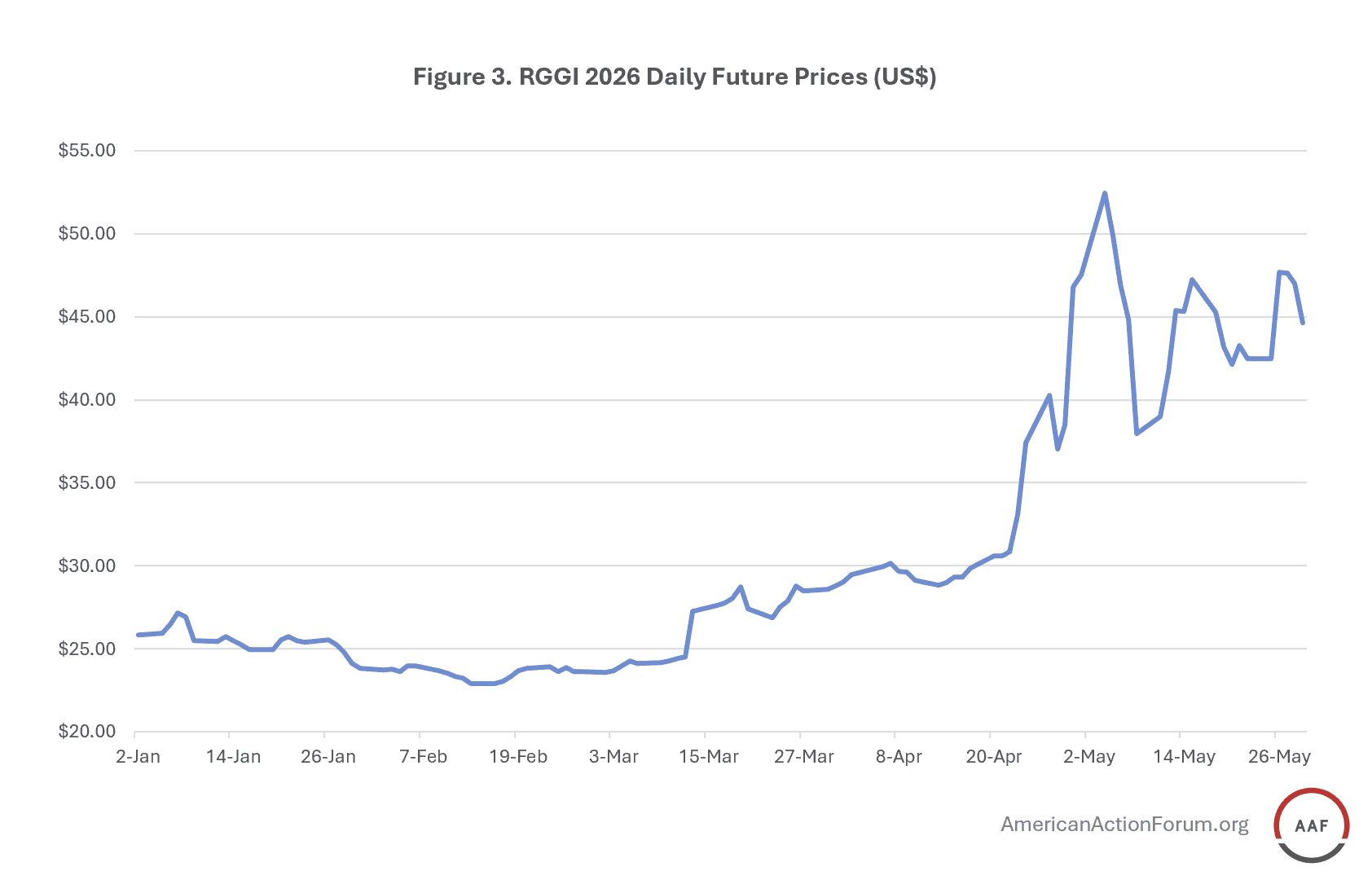
Source: ICE.com
Virginia’s patchwork of emissions regulations on the power sector
Virginia currently has several regulations requiring emissions reductions by the power sector. The Virginia Clean Economy Act mandates the state’s primary utility, Dominion Energy, deliver 100-percent carbon-free electricity by 2045. Additionally, the law layers annual renewable portfolio standards alongside standards for energy storage capacity and efficiency metrics.
AAF’s previous analysis explains why this mandate faces severe feasibility challenges due to an unprecedented surge in power demand driven by AI data centers. Notably, Dominion concluded in its 2025 annual report that fully retiring fossil fuels before 2045 would be prohibitively costly and impact grid reliability. A state-commissioned study confirms that fossil fuels will remain a critical component of Virginia’s power mix.
Piling the RGGI carbon pricing policy on top of Virginia’s existing command-and-control mandates is both redundant and inefficient. Layering a carbon price over rigid emissions regulations does not yield additional decarbonization benefits. Instead, it creates significant policy friction that drives up administrative and compliance burdens. Ultimately, these unnecessary costs are passed directly to consumers through higher utility bills.
Upward pressure on electricity prices
Rejoining RGGI will put additional upward pressure on Virginia’s electricity rates. Dominion projected that the state’s summer peak load will increase by 70 percent from 2022–2045, mostly driven by skyrocketing demand from AI data centers. Fueled by data center expansion, Virginia’s energy demand is projected to surge by 183 percent by 2040 – a massive contrast to the modest 15-percent growth expected in the absence of a data center boom.
Starting in January 2027, AI data centers and other large-scale power users in Virginia will face new minimum electricity rates. Approved by Virginia’s State Corporation Commission (SCC), the policy mandates that these customers pay for at least 85 percent of their contracted distribution and transmission capacity, and 60 percent of their generation capacity.
Dominion has already indicated that it is planning to submit a rate increase request to SCC due to the additional costs of complying with RGGI. It is expected to detail the anticipated new ratepayer costs in an upcoming June filing. Under Virginia’s previous participation in RGGI, it was estimated that ratepayers on average were paying $2-$4 per month more than otherwise.
Virginia raised about $827 million from its previous participation in RGGI. Revenue raised from rejoining RGGI will be used for upgrading energy efficiency for existing and new residential buildings in Virginia. Advocates for the specific revenue uses argue that this will help lower utility bills for low-income households. But this would take a long time and does not prevent short-term electricity rate spikes.
Looking Forward
To maximize economic efficiency, policymakers should eliminate overlapping state regulations such as the VCEA and allow the RGGI to serve as the primary, market-based mechanism to incentivize emissions reduction. Adopting multiple redundant and stringent emissions reduction policies unnecessarily increases costs for utilities without yielding additional environmental benefits. Using RGGI’s carbon price as the central climate policy tool allows the market to identify the least costly decarbonization methods and reduce the significant regulatory burden on energy producers.
To prevent a sudden spike in consumer utility rates, policymakers should consider delaying Virginia’s RGGI compliance obligations until at least 2027, rather than mandating an immediate return under a retroactive 2026 emissions cap that assumes the state never left. Since this year’s CCR allowances were already exhausted in March, utilities face a severely constrained market with little ramp-up time to adjust to the carbon price. Without a smoothed compliance trajectory, utilities will have to rush infrastructure replacements or purchase expensive carbon allowances, driving up electricity bills. Additionally, RGGI’s penalty mechanism will put non-compliant utilities further behind. Delaying participation will give the energy grid the necessary time to adapt, preventing rapid rate hikes for consumers, while preserving long-term grid reliability and decarbonization goals.
Virginia’s regulatory whiplash offers critical lessons for both state and federal climate policy. For other states looking to curb emissions in the power sector, Virginia’s experience demonstrates that it is important to rely on a market-based policy rather than piling on several overlapping mandates, which would inevitably increase costs for utilities and consumers.
Virginia’s experience also underscores challenges of enacting a federal climate policy. If more states join RGGI in the future, it may be increasingly difficult to enact a federal climate policy, as states may not be willing to forgo revenue from state climate policies such as RGGI.
