







The Shipment
October 29, 2026
A Spooky Surprise Section 338 Adjustment
(Not So) Fun Fact: U.S. consumers are expected to spend roughly $13.5 billion on Halloween this year, a 3-percent increase from last year and a 69-percent increase from 2020; this is driven by a combination of greater demand and higher prices, with the price of a bag of candy (100 pieces) up around 3.5 percent since last year and 85 percent since 2020.
Section 338 Tariffs on Canada: A Last-ditch Gambit
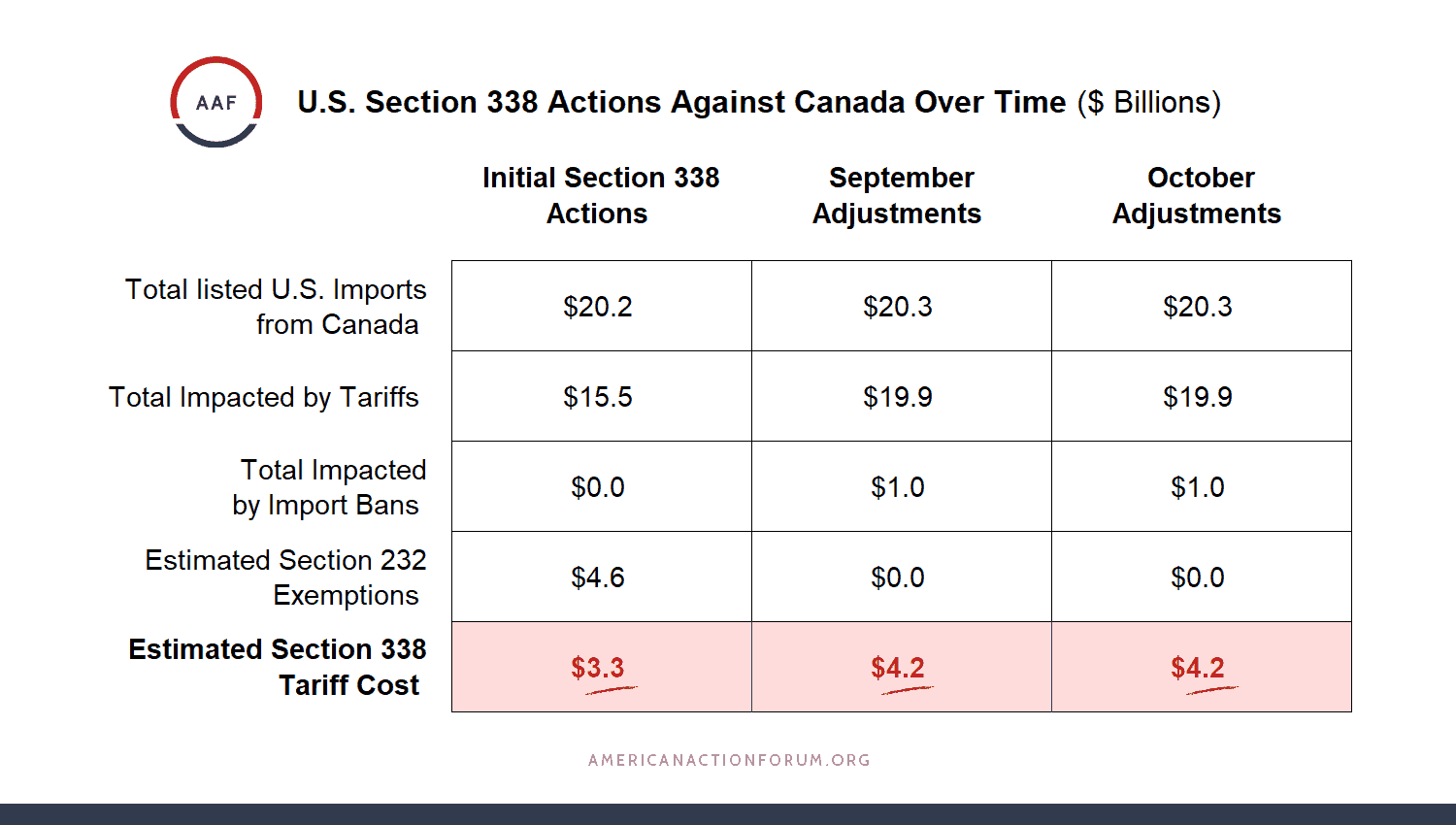
What’s Happening: Last Friday, President Trump issued a proclamation modifying the 50-percent Section 338 tariffs imposed on Canada. Specifically, the proclamation removes tariffs on imports such as certain packaging materials, packaging machinery, plywood, and refrigeration equipment. This tariff relief was aimed at helping heavily impacted industries and consumers in Maine and Michigan, both of which have close midterm Senate races that will be decided next week. While the tariff relief and its potential electoral implications have been highly advertised, less discussed are the additions to the 50-percent tariff list. These include Canadian imports such as cocoa powder, surgical instruments, shampoo, canoes, paints, and dozens of other items, virtually eliminating the impact of the targeted tariff reductions. This latest adjustment is scheduled to take effect October 30, on the eve of Halloween.
Recall that these tariffs were initially imposed August 22 on approximately $20 billion worth of Canadian goods in response to claims by the administration of discrimination against U.S. autos, alcohol, and other products. Canadian retaliatory tariffs took effect soon after. The administration further adjusted the Section 338 action on September 15, adding an estimated $1.8 billion worth of imports to the 50-percent tariff list and removing $1.7 billion. Additionally, the adjustment authorized Section 232 tariffs to stack on top of Section 338 tariffs and previous exemptions for imports compliant under the United States-Mexico-Canada Agreement (USMCA) were eliminated. The trade war further escalated on September 29 when the United States fully banned close to $1 billion worth of imports from Canada.
Why It Matters: According to the Shipment’s analysis, the new Section 338 modifications will remove roughly $2.6 billion worth of imports from the 50-percent tariff list, while adding another $2.6 billion (based on 2025 import data). The modifications actually result in a slight increase of $45 million worth of imports subject to tariffs. The imports removed from the tariff list primarily comprise sacks and bags used for packaging, packaging machinery, and refrigeration equipment. In exchange, the newly added imports consist largely of medical equipment (used to treat skin cancer) as well as lab-test chemicals (reagents used to test for various illnesses). In total, 22 import categories (HTS-8 level) were removed while 100 were added – for reasons that have yet to be fully explained. The likely rationale is simply to maintain pressure in the U.S.-Canada trade war since roughly $20 billion in imports are still subject to tariffs. These modifications instead distribute the tariff cost impact more broadly among U.S. consumers, businesses, and states rather than concentrating them on a handful of imports used heavily in a particular region. Take, for example, packaging equipment being removed from the tariff list while shampoo was added. As Senator Susan Collins (R-ME) notes, packaging equipment from Canada is particularly important for Maine’s blueberry, potato, apple, and seaweed producers; thus, the packing-tariff costs are concentrated among those producers in Maine. Shampoo, on the other hand, is not specific to a particular industry or U.S. state, meaning shampoo tariffs – while burdensome and costly – are dissipated to a greater extent.
While the recent modifications to the Section 338 tariffs do not meaningfully change the overall economic impact, it does mark another instance of the Trump Administration attempting to minimize or shift tariff costs. In this proclamation, it justified the modification as “consistent with the public interests and the interests of the United States.” But again, these tariff shifts primarily benefit states that border Canada – and have highly competitive upcoming elections. In any case, it is important to point out that this is the first time the Trump Administration has altered these tariffs on Canada since Section 338 was challenged in court. One of the lawsuit’s contentions is that even if Section 338 is constitutional, the administration is improperly utilizing the tariff authority because it is not following a 30-day waiting period before applying tariffs to new products. Whether the executive branch would have to wait 30 days for modifications to a Section 338 tariff or whether the 30-day wait only applies to the initial imposition of a Section 338 tariffs will be for the courts to decide.
Looking Ahead: With respect to the upcoming midterm elections, the Section 338 tariff adjustments are unlikely to have much of an impact. First, the economic impact remains virtually unchanged on a macro-level. Second, while these adjustments kick in tomorrow, it will take time before U.S. consumers and businesses see any direct impact. Third, the U.S.-Canada trade war has been active for months and Section 338 tariff costs have already been incurred for weeks. Reports suggest there has been some recent progress in U.S.-Canada trade negotiations, with both President Trump and Prime Minister Carney softening their trade war tones this past week. This could point to a major “trade deal” announcement in the final days before the midterms, but that is simply speculation. In the meantime, the trade war continues to rage on with all of the costs and uncertainty that entails.
In Other News
The Administration’s Softer Section 232 Tariff Touch: On October 28, President Trump signed a proclamation regarding the Section 232 national security investigation into robotics and industrial machinery first initiated on September 2, 2025. Rather than imposing a Section 232 tariff on related imports, the president directed the Secretary of Commerce and the U.S. Trade Representative to negotiate trade agreements to address purported national security concerns. Similarly, on October 22 the president issued a proclamation on the Section 232 investigation into wind turbines – launched on August 13, 2025 – authorizing negotiations with other countries (read more here). In both cases, officials are expected to provide progress updates or reach agreements with trade partners within 180 days. Notably, each proclamation leaves open the possibility that President Trump imposes tariffs or institutes other import restrictions in the future.
These two Section 232 announcements are significant because they mark a major shift in how the White House uses this national security tariff authority. Instead of imposing tariffs first and asking questions later, the administration has flipped the script by starting off with discussions. Readers might recall that past tariff adventures usually involved tariffs up to 50 percent being announced and imposed before any sort of trade deal was struck. For instance, there have been Section 232 tariffs put on steel, aluminum, automobiles, auto parts, trucks, copper, lumber, furniture, semiconductors, and pharmaceuticals. In many of these cases, the tariffs were imposed without negotiating with countries beforehand. The few exceptions include tariff caps for trade partners such as the European Union, South Korea, or Japan which negotiated trade deals after being slapped with tariffs imposed under a separate authority. This important change to the administration’s handling of tariff policies indicates that it may seek to mitigate unnecessary economic impacts and uncertainty. It could indicate that the Trump Administration no longer needs to impose tariffs for leverage before trade talks because other countries now realize protectionism is clearly on the table for the United States. For U.S. consumers and businesses, this is welcome news after numerous instances of on-again off-again tariffs, constantly shifting tariff rates, and an overall sporadic tariff regime that has plagued trade policy for well over a year.