








The Shipment
November 12, 2026
China Commitments and Congressional Agendas
(Not So) Fun Fact: Based on current trends, the Shipment estimates that China will fall about $10 billion short of its $17-billion agricultural purchase commitments for 2026.
China Commits To Fulfill Commitments if the U.S. Commits
What’s Happening: Last week, the principals of the U.S.-China Board of Trade – United States Trade Representative Greer, Treasury Secretary Bessent, and Chinese Vice Premier He Lifeng – spoke regarding the status of the U.S.-China trade deal. The U.S. team emphasized the desire for China to “fully and immediately” implement its commitments as outlined in past summits, including agricultural purchases and continued exports of rare earths to the United States. He Lifeng expressed “serious concern over recent U.S. economic and trade restrictions against China” and stated that tariff concessions are essential to the discussion. In the view of Chinese officials, purchase commitments rely firmly on the Board of Trade’s “30-for-30” framework coming to fruition, which includes tariff reductions on $30 billion of each nation’s imports from the other. While negotiations continue in the background, President Trump is expected to meet with Leader Xi of China next week during the Asia-Pacific Economic Cooperation forum and again during the Group of 20 summit in mid-December. All eyes will be on the results of these upcoming meetings as the U.S.-China trade truce is set to expire on January 10.
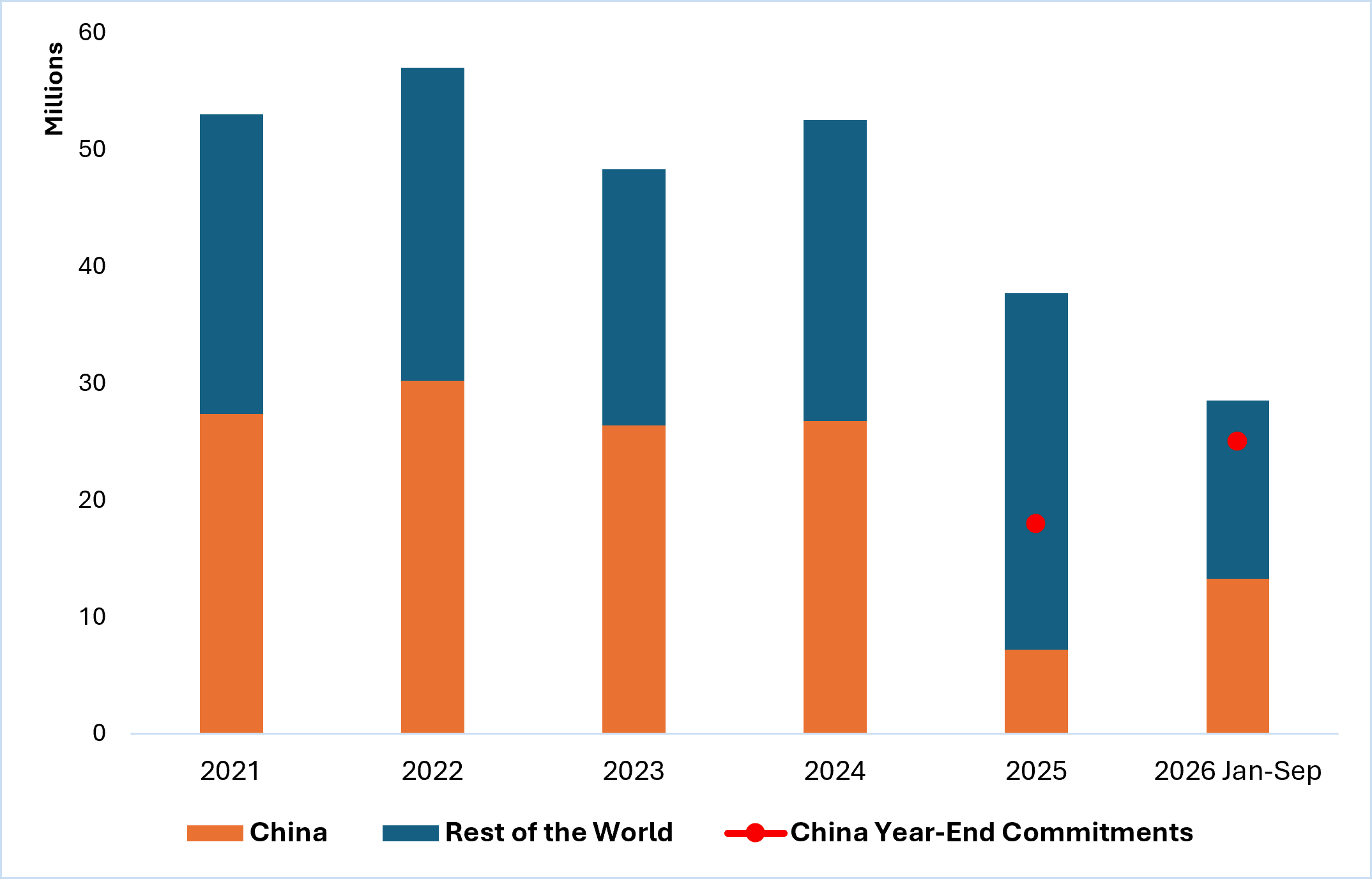
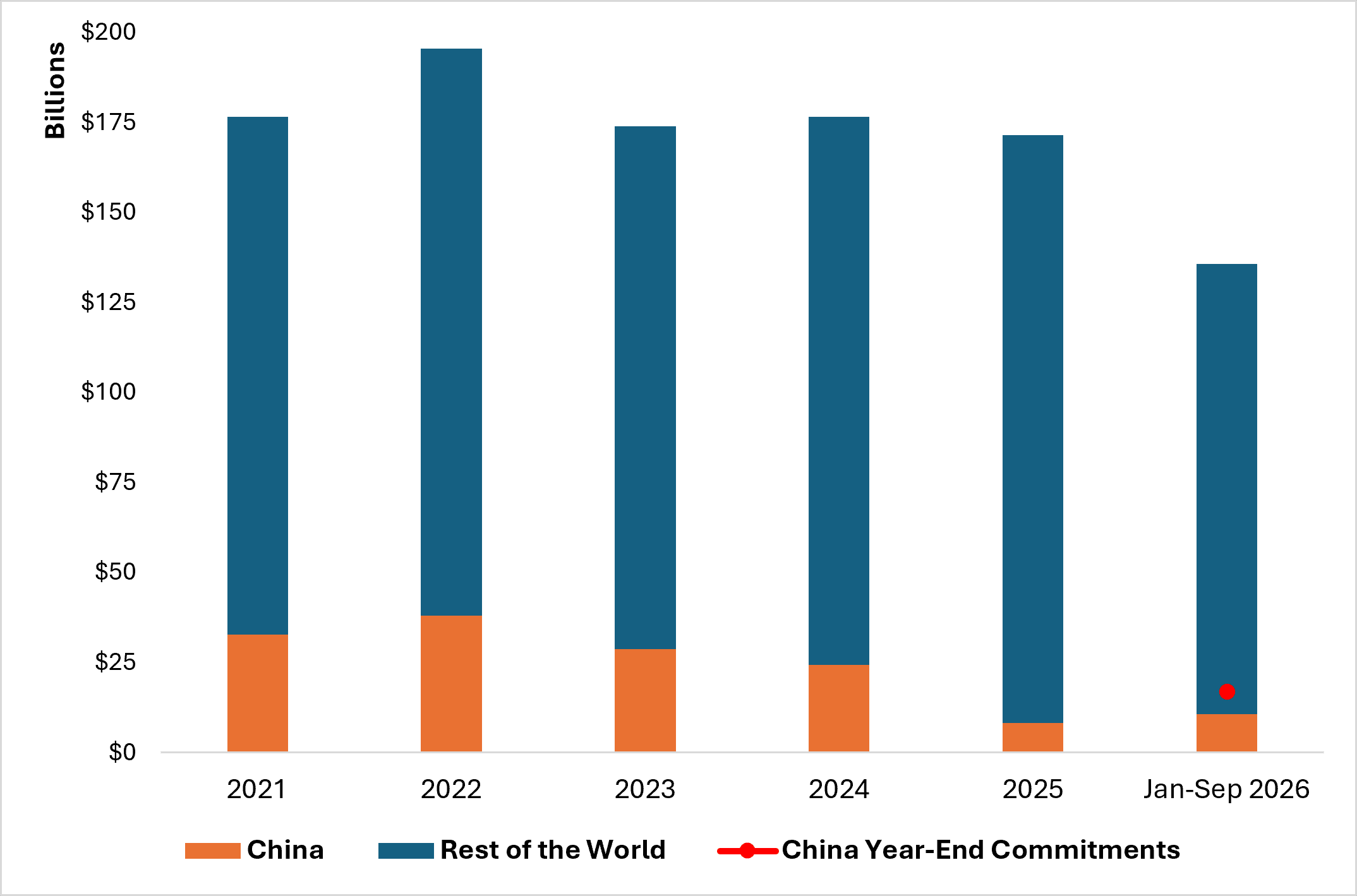
Why It Matters: The current state of the U.S.-China trade deal leaves much to be desired, so let’s review what is on the table. First, China committed to purchase $17 billion of U.S. agricultural products in addition to 25 million tons of soybeans annually through 2028. As covered by the Shipment in September, China failed to meet its 2025 commitments for soybean purchases. While China has ramped up its purchases in 2026, U.S. soybean exports to China have only reached 13.3 million metric tons as of September. This is just slightly over half of the 25-million-ton target and well below historic levels, which means it is highly unlikely China will live up to this commitment. Similarly, U.S. agricultural exports to China sit at roughly $10.8 billion as of September, and excluding soybean sales, this figure drops to just $4.7 billion. Based on current trends, the Shipment estimates that China will fall about $10 billion short of its agricultural purchase commitments for 2026. Second, China committed to purchase 200 Boeing planes (although President Trump has touted even larger numbers). This has not materialized, and some sources speculate the deal could be reduced to 150 planes. Third, China agreed to restore critical mineral exports to the United States. China has extended export-control waivers for critical minerals and at least on paper, continues to suspend restrictions otherwise blocking sales to U.S. companies. That said, U.S. imports of gallium and graphite have remained relatively low and a September report states that rare earth magnets are still being restricted. Finally, the following have been put on hold until the January deadline: Chinese tariff hikes, the U.S. Section 301 tariff targeting China’s shipbuilding dominance, port fees impacting each nation’s vessels, and additions to the U.S. Entity List.
Looking Ahead: For now, there has been limited progress in fully realizing much of the U.S.-China trade deal other than preventing further escalation. It is possible that upcoming meetings between President Trump and Leader Xi result in a formal announcement of the “30-for-30” framework’s tariff reductions or an extension of the January 10 truce deadline. It does not appear as if any substantive changes to the trade relationship can be made until one side acts, meaning China either has to ramp up its purchases of U.S. agricultural products or the U.S. trade team has to give the green light for tariff reductions.
Figure 1: U.S. Exports of Soybeans (Millions of Metric Tons)
Source: United States Department of Agriculture
Figure 2: U.S. Exports of Agricultural Products ($ Billions)
Source: United States Department of Agriculture
In Other News
The Congressional Tariff Agenda: As attention shifts from midterm results to actual policymaking, voters’ concerns regarding the cost of living will make reducing trade barriers a priority. Ending the trade war with Canada may be the opening congressional shot against President Trump’s tariff agenda. Senator Wyden (D-OR) – the likely next chair of the Senate Finance Committee – has stated there is significant support for removing the Section 338 tariffs on Canada. Similarly in the House, both Democrats and some Republicans are on board to prioritize ending the 50-percent tariffs on many Canadian goods as well as stopping a future hike on Canadian automobiles. Prime Minister Carney of Canada has made clear he will welcome any restoration of the free trade agreement between the two countries. In addition to removing Section 338 tariffs, there will also likely be legislation to restrict the president’s tariff authorities altogether. Senator Wyden has been a leading proponent of eliminating tariff authorities such as Section 122 and Section 338 and putting further limits on the use of Section 232, 301, and 201. While legislation to eliminate Section 338 and 122 is likely to gain traction in the House and Senate, it is less probable that tangible restrictions on other trade authorities are as popular. Despite the apparent support for reining in the executive’s trade authority, any legislative effort to control tariffs faces substantial roadblocks. Most notable of these is the Senate’s filibuster, which would require 60 votes to overcome, and of course the presidential veto, which requires 67 votes in the Senate and 290 votes in the House to override. If Democrats are unable to gain substantial Republican support, any attempt by Congress to restore its trade authorities is essentially dead on arrival.
The Jones Act Waiver May Be Sent to the Depths: On November 15, the current 60-day waiver for the Jones Act is set to expire. (The act is a 1920 statute that generally requires cargo between U.S. ports to be shipped on U.S.-built, owned, flagged, and crewed ships.) The president first waived the law on March 17 to help alleviate cost pressures associated with the closure of the Strait of Hormuz; he has extended it twice since its initial implementation. The results speak for themselves. As AAF’s Shuting Pomerleau covered in September, the waiver has contributed to a substantial increase in intra-U.S. petroleum waterborne shipments while also generating roughly $100 million in cost savings across the U.S. economy. According to the Cato Institute’s Jones Act Waiver Tracker, there have been at least 330 voyages as a result of the waiver, carrying cargo across 16 categories, primarily energy and fertilizer products. Over 25 million barrels of gasoline, nearly 25 million barrels of crude oil, and close to 3.8 million barrels of diesel have been transported due to the Jones Act waiver that would not have otherwise occurred. Additionally, the waiver has particularly benefited Puerto Rico, which under normal circumstances never receives propane due to the lack of liquified petroleum gas tankers in the Jones Act fleet. It will be important to watch whether the waiver is extended further as it has been an economic boon for U.S. domestic commerce and mitigated some of the pressures from the global energy market. If the president allows the waiver to expire, it will restore a misguided driver of higher consumer prices – an odd move in the wake of an election where affordability was a key issue.
Uh, What’s Happening With Nvidia?: Today, the CEO of Nvidia, Jensen Huang, resigned from the company. The U.S. government believes Jensen had a romantic relationship with Alice Huang – an alleged Chinese spy. To make matters worse, Alice is an executive at Singapore-based Megaspeed, which was allegedly used to smuggle advanced Nvidia chips into China, violating U.S. export controls. One estimate puts the total value of Nvidia chips smuggled to China at a minimum of $7.5 billion since 2023. Other than the consequences for the firm’s reputation and share price, this scandal provides another talking point for lawmakers who support greater restrictions on chip sales to China. Such export controls are expected to be attached to the annual defense package and newly emboldened Democrats appear to be in favor of cracking down further on the chip trade to China. Recall that last year the Trump Administration struck a deal with Nvidia and Advanced Micro Devices to allow the semiconductor companies to sell their chips to China in exchange for paying the U.S. government 15 percent of the revenue from those sales. This deal only applied to lesser performing chips and not the most advanced varieties, but with increased scrutiny due to the Huang situation it is possible more lower-end chips will be cut off from the Chinese market.