The Shipment
February 12, 2026
More Beef, Fewer Tariffs = Lower Prices?
(Not So) Fun Fact: The Chinese automobile manufacturer BYD has filed a lawsuit to receive refunds in the event the Supreme Court strikes down the International Emergency Economic Powers Act (IEEPA) tariffs; because auto-specific tariffs have been imposed under Section 232 rather than IEEPA, this lawsuit is unlikely to affect them significantly.
Increasing Argentina’s Beef Quota
What’s Happening: On February 6, President Trump signed an executive order titled “Ensuring Affordable Beef for the American Consumer” that increases the tariff-rate quota (TRQ) for certain beef products from Argentina. This follows the recent signing of the U.S.-Argentina trade deal, first announced last November, which reduces some U.S. tariffs and is intended to expand U.S. market access. The beef executive order temporarily increases the TRQ by 80,000 metric tons of beef, a sharp increase from the current quota’s 20,000 to 100,000 by the end of 2026. The TRQ will increase on a quarterly basis, with the first tranche beginning February 13 and the last tranche being October 1 through December 31. The National Cattlemen’s Beef Association came out against the Trump Administration’s move that is aimed at lowering record high beef prices, stating that President Trump should “let the cattle markets work.” The president last used this same authority on December 31 to increase the TRQ for beef from the United Kingdom by 13,000 tons and decrease it by the same amount for other countries.
Why It Matters: On paper, this executive order represents a 400-percent increase in tariff-free beef imports from Argentina. According to the Argentine Ministry of Foreign Affairs, this is equivalent to $800 million in additional exports to the United States, which would be over $650 million more than 2025. It is estimated that in 2025, U.S. imports from Argentina of the beef in question totaled just 17.5 metric tons, well below the new quota adjustment. Based on historical trends, the growth in imports from Argentina would be about 6 percent from 2025 (Figure 1), implying that it is highly unlikely that imports will reach 100,000 by year’s end. Assuming imports remain steady from other key trade partners such as Australia, New Zealand, and Canada, the administration’s move should ease inflationary pressure on beef products – albeit to a small degree. Other global trade policy changes such as Mexico’s new beef quota and China’s protectionist beef measures will have more of an impact as suppliers shift exports to the United States. Most important for the price of beef will be the status of domestic herds which have declined in recent years due to droughts and increasing input costs.
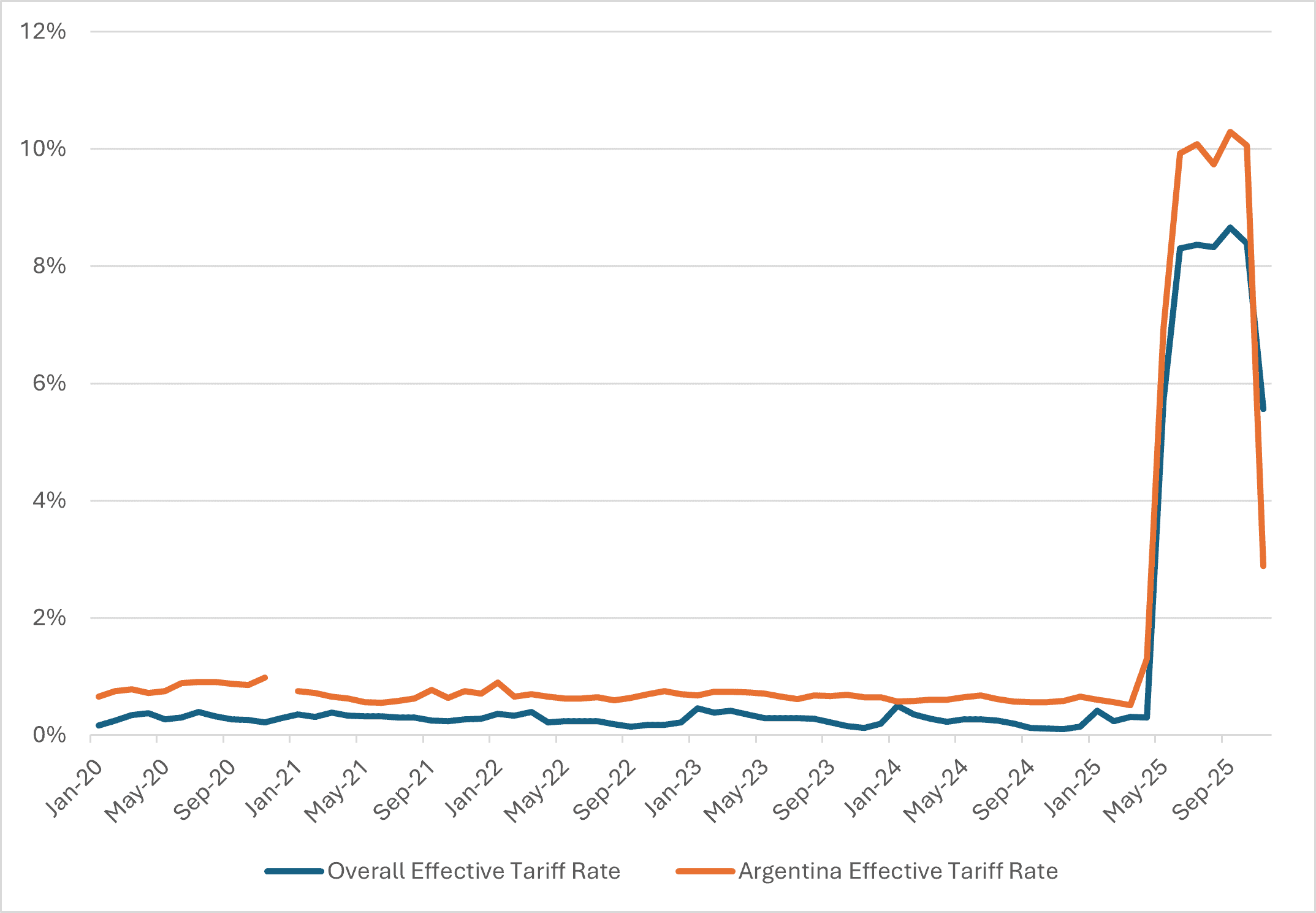
Whether it is feasible for Argentine exporters to meet the quota increase remains to be seen. This policy shift, however, provides yet another valuable lesson in economics: Increasing the supply of a good will reduce the price if demand remains constant. President Trump and his trade team appear to be quietly admitting that lowering tariffs and increasing beef imports will lower prices for cost-conscious consumers. The Shipment seems to be experiencing a case of déjà vu as this exact scenario occurred last year when the Trump Administration gave the green light to import hundreds of millions of additional eggs from Turkey to reduce rising egg prices. The hard truth for the administration is that the president’s tariff policies have raised prices for U.S. businesses and consumers, a fact that is well understood in polling data. In 2025, tariffs on the same beef products cost an estimated $270 million or about 15 cents per pound of imported beef. The Shipment estimates that approximately 85 percent of these costs are directly attributable to new tariffs put in place in 2025. So once again, the administration is reversing course on a high-profile piece of its tariff agenda because U.S. consumers are particularly sensitive to rising food prices.
Looking Ahead: If the administration is willing to acknowledge that reducing protectionist policies on beef imports helps to reduce domestic prices, it begs the question of why it is maintaining such high barriers on thousands of other products. As the 2026 midterms approach with “affordability” and other economic concerns top of mind for many U.S. voters, further tariff carveouts will be something to monitor. It is not out of the question that the Trump Administration will further backtrack on its tariff excesses as it did in November 2025 with the substantial tariff exemptions on agricultural imports. A future milestone for the administration would be exemptions that go beyond food and agriculture to other everyday consumer goods. There have been specific carveouts and reductions for certain trade agreements and semiconductors, but large-scale exemptions for, say, children’s toys or shoes remain to be seen. The recently signed trade deal with Bangladesh may signal future exemptions as certain clothing and textiles will be allowed to enter the United States tariff-free.
In Other News
Looks Like Iran Tariffs Are Back on the Menu: On February 6, President Trump signed an executive order that “imposes a system that allows the United States to impose additional tariffs” on countries that do business with Iran. This makes official the January proposal of imposing a 25-percent tariff on Iran’s trade partners, which according to the Shipment would cost between $100–$350 billion depending on implementation. Although this order is active, it still lacks any specifics on tariff rates, impacted countries, or whether it applies to all types of imports.
Trump Meets Xi: President Trump is scheduled to meet with leader Xi in China during the first week of April, coinciding with the anniversary of “Liberation Day.” This has the potential to be one of the most important trade events since Trump took office as the relationship between the world’s two largest economies has major implications for the global economy. Tariffs on China are by far the most costly for U.S. businesses and consumers, which face a tariff rate of about 45 percent on most Chinese goods. The immediate leadup to this meeting will be important to watch as the president has often levied tariff threats before such events to presumably increase negotiating leverage.
Congress Does Something on Trade: The House voted on Tuesday to reject a rule to prevent members from proposing resolutions to challenge the Trump Administration’s tariffs until July 31. Speaker Johnson stated that the rule was intended to allow the Supreme Court to announce a final decision regarding the legality of IEEPA tariffs. Three Republicans joined Democrats to advance a measure allowing the House to vote on the IEEPA tariffs imposed on Canada due to the flow of fentanyl across the border. The House on Wednesday passed by a vote of 219 to 211 a resolution to end the national emergency used to impose these tariffs. Although this is a small win for Congress taking back its authority over taxes and trade, this resolution will likely be vetoed by President Trump.
U.S.-Bangladesh Trade Deal: On February 9, the Office of the United States Trade Representative (USTR) announced the signing of a trade deal with Bangladesh that reduces the U.S. tariff from 20 to 19 percent. Unlike many of last year’s trade deals, this deal includes a 32-page, formal document that lays out what the two countries have agreed to. Bangladesh has committed to providing preferential market access for certain U.S. industrial and agricultural products, and to accepting U.S. motor vehicle standards and U.S. Food and Drug Administration certificates. The United States will consider supporting investment financing in critical mineral sectors in Bangladesh while also providing tariff-free treatment for certain textile and apparel products. Bangladesh will also purchase approximately $3.5 billion in U.S. agricultural products over an unknown period, $15 billion in U.S. energy over 15 years, and an unknown amount of U.S. aircraft.
Argentina, El Salvador, and Guatemala Trade Deals: After being announced via White House factsheets in November of last year, USTR has signed trade deals with Argentina, El Salvador, and Guatemala that are 37, 159, and 167 pages, respectively. Each of these agreements once again flies in the face of many of the one-page, handshake deals announced in 2025. The United States will reduce many of its tariffs on these countries, particularly mineral and agricultural products. In exchange, each of these countries has agreed to reduce non-tariff barriers by accepting various U.S. standards and eliminating certain licensing requirements (see more here). This trend of more in-depth and formalized agreements bodes well for many of the major deals struck with the European Union, South Korea, and Japan.
Figure 1: U.S. Beef Imports Over Time
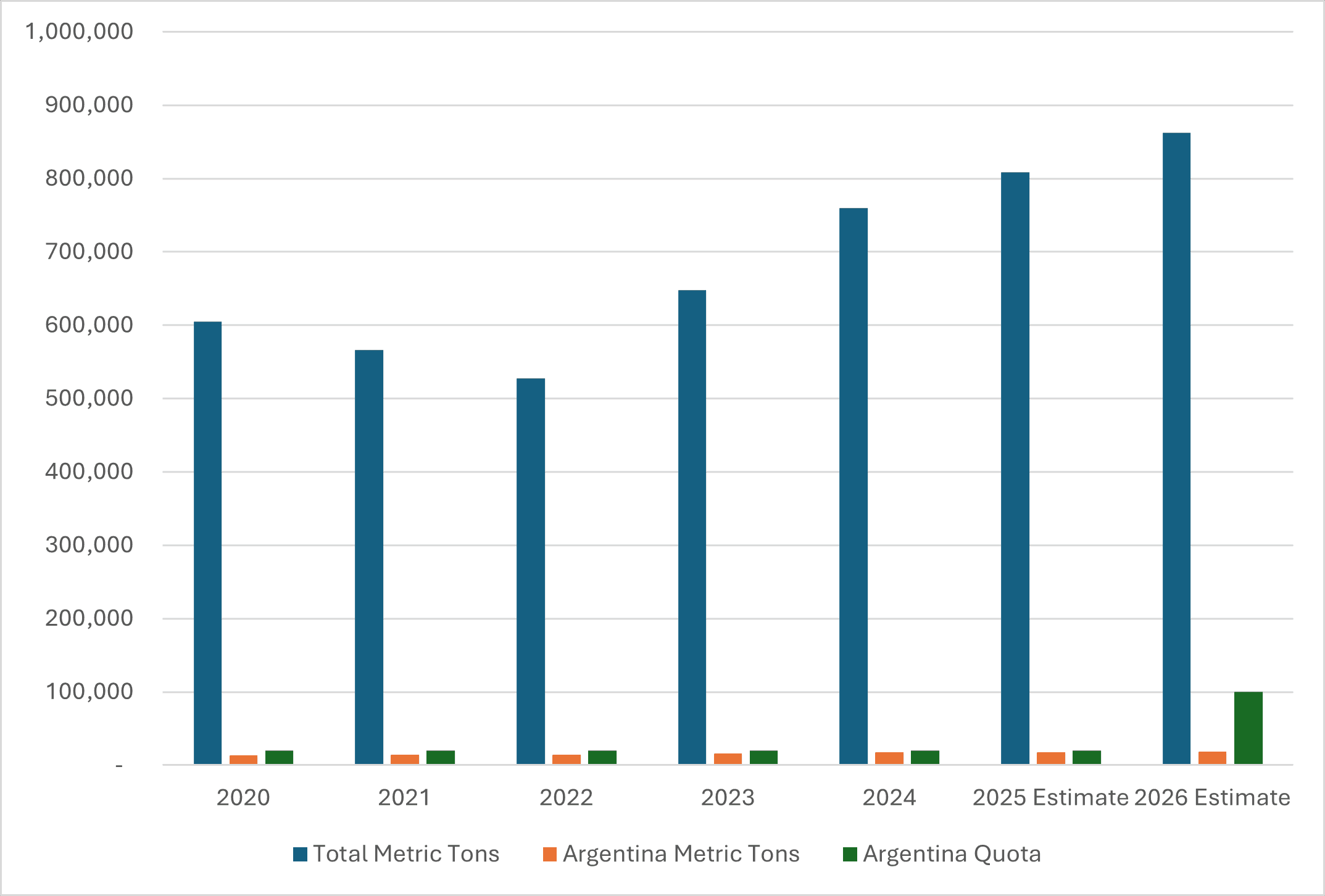
Source: United States International Trade Commission
Figure 2: Monthly Effective Tariff Rate on U.S. Beef Imports (2020 to 2025)