The Shipment
March 26, 2026
Fertilizer Fears Flare
(Not So) Fun Fact: The global average price of jet fuel has nearly doubled since the conflict with Iran began; U.S. airline passengers should expect higher ticket prices as fuel represents 15–23 percent of operating costs.
The Strait of Hormuz and Fertilizer
What’s Happening: It has been nearly one month since the conflict with Iran began. The global energy shock and major trade flow disruptions have impacted shipping costs, trade in key fertilizers, and the price of oil. The United States has reportedly offered Iran a 15-point peace plan that could bring the conflict to an end in the near future and President Trump told reporters that the administration has been in communication with Iranian officials. Meanwhile, Iranian state television has declined ceasefire talks and military officials deny that discussions with the Trump Administration are taking place at all. While hope for a deal has temporarily calmed global markets and eased oil prices slightly, there has been no resurgence of traffic in the Strait of Hormuz.
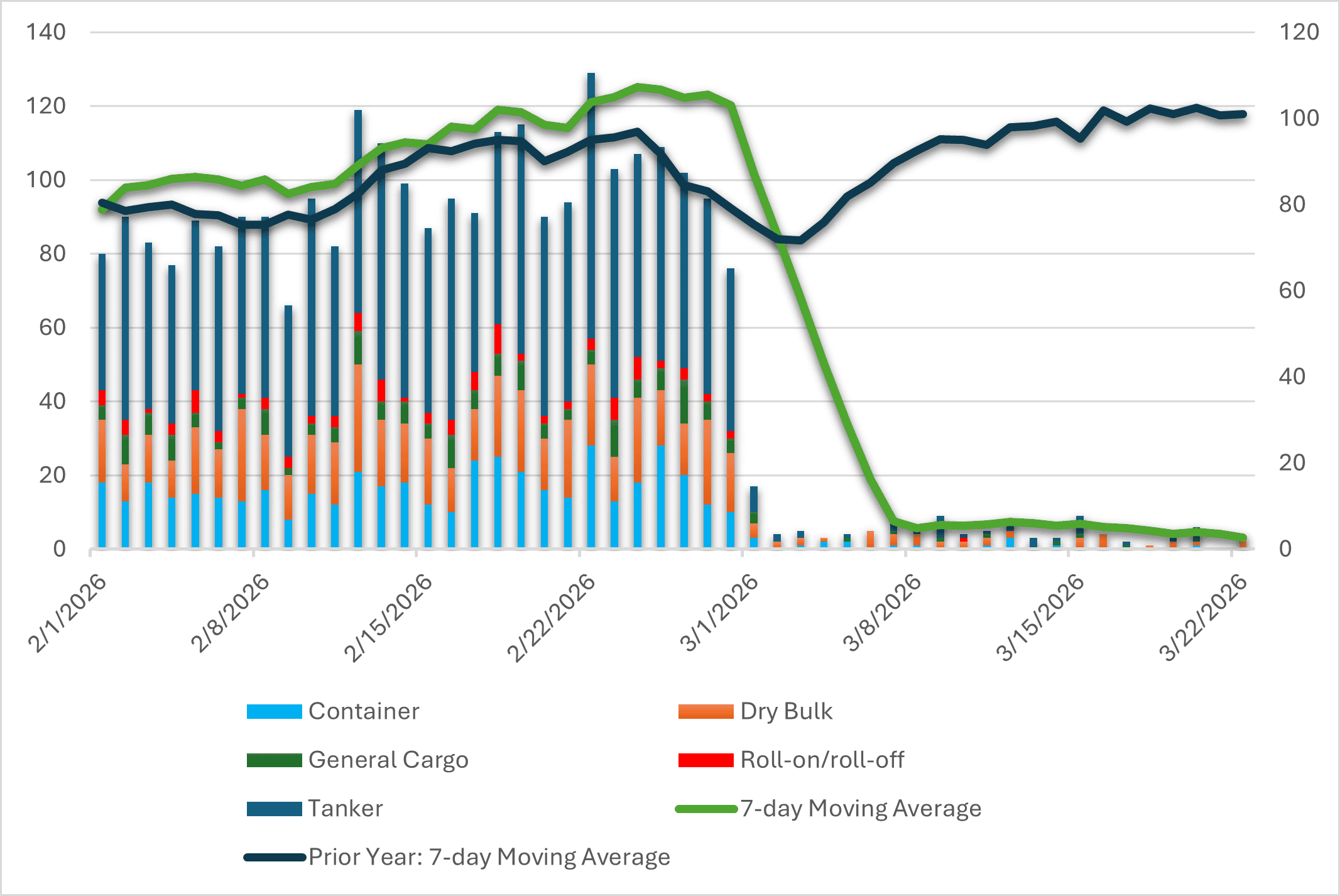
Why It Matters: The standstill in the Strait of Hormuz has effectively closed one of the world’s vital trade routes, which normally supplies 20 percent of the world’s oil and gas as well as close to 30 percent of its fertilizers. As long as Iran threatens trade routes, higher insurance costs, shipping premiums, and uncertainty undermine the viability of the strait. Reported transits sit at 4 percent of normal levels, severely restricting outgoing shipments. This has become increasingly worrisome to farmers that rely on urea, ammonia, and other fertilizers critical to global agricultural production. Adding to concerns is the fact China has responded to Middle East supply constraints by restricting its own fertilizer exports by between 50–75 percent. As China is one of the largest exporters of fertilizer, this is a significant move that may reduce global supply of some fertilizer varieties by up to 8 percent according to the Shipment’s estimates.
Since the Iran conflict began, fertilizer prices have soared between 30–40 percent at the same time U.S. farmers purchase the product ahead of the spring planting season. The blockage of fertilizer exports will lead to both shortages that reduce output and higher input costs that work their way through the supply chain, eventually hitting U.S. consumers. Fertilizer represents between 15–25 percent of a farmer’s production costs, depending on the type of crop and system used. It is worth noting that even if most U.S. farmers are safeguarded from the fertilizer supply shock, U.S. trade partners may be heavily impacted – which could reduce U.S. exports and raise the price of certain agricultural imports. The combination of higher transportation, input, and tariff costs – along with labor shortages – may culminate in serious price hikes later this year.
Looking Ahead: As has been the case since the beginning of the Iran conflict, a long-term closure of the Strait of Hormuz is not in the best interest of the United States or the global economy. Despite the speculation that a deal may soon be reached, it is still far from clear how the United States plans to open the strait to normal commerce. Recent deployments of U.S. marine and air forces may provide some indication that military options are still on the table. If the Trump Administration wants to mitigate long-term economic consequences to global agriculture and energy markets, time is of the essence.
Figure 1: Strait of Hormuz Transit Calls by Number of Ships
Source: International Monetary Fund, University of Oxford
In Other News
The European Union Trade Deal: Today, the European Parliament voted to adopt legislation that implements an EU tariff reduction on U.S. industrial products while increasing market access for the United States. Included in the legislation are certain safeguards that could suspend the agreement if additional U.S. tariffs are imposed or if the U.S. tariff rate exceeds the agreed-upon 15 percent. The legislation now must be approved by the EU’s member states before becoming law, with a vote expected as early as mid-April or as late as May. Worth noting is this legislation does not solidify many of the points from the Trump Administration’s handshake agreement such as investment pledges, energy purchases, or certain non-tariff barriers and is set to expire on March 31, 2028.
The Global Energy Reaction Intensifies: As the Shipment mentioned last week, many Asian countries have already begun to introduce energy rationing measures amid the Strait of Hormuz oil and gas shock. The Philippines has declared a national emergency to control fuel prices and import energy from countries such as Russia more quickly. South Korea has announced an energy saving campaign, as has Thailand, Vietnam, Sri Lanka, and India. Australia is experiencing major fuel shortages across hundreds of stations, causing prices to skyrocket at the same time many of its farmers rely on diesel for harvesting crops. Finally, Slovenia recently became the first EU country to introduce fuel rationing, a trend likely to continue across Europe if the Iran conflict continues into April.