The Shipment
March 6, 2025
Trade War 2.0
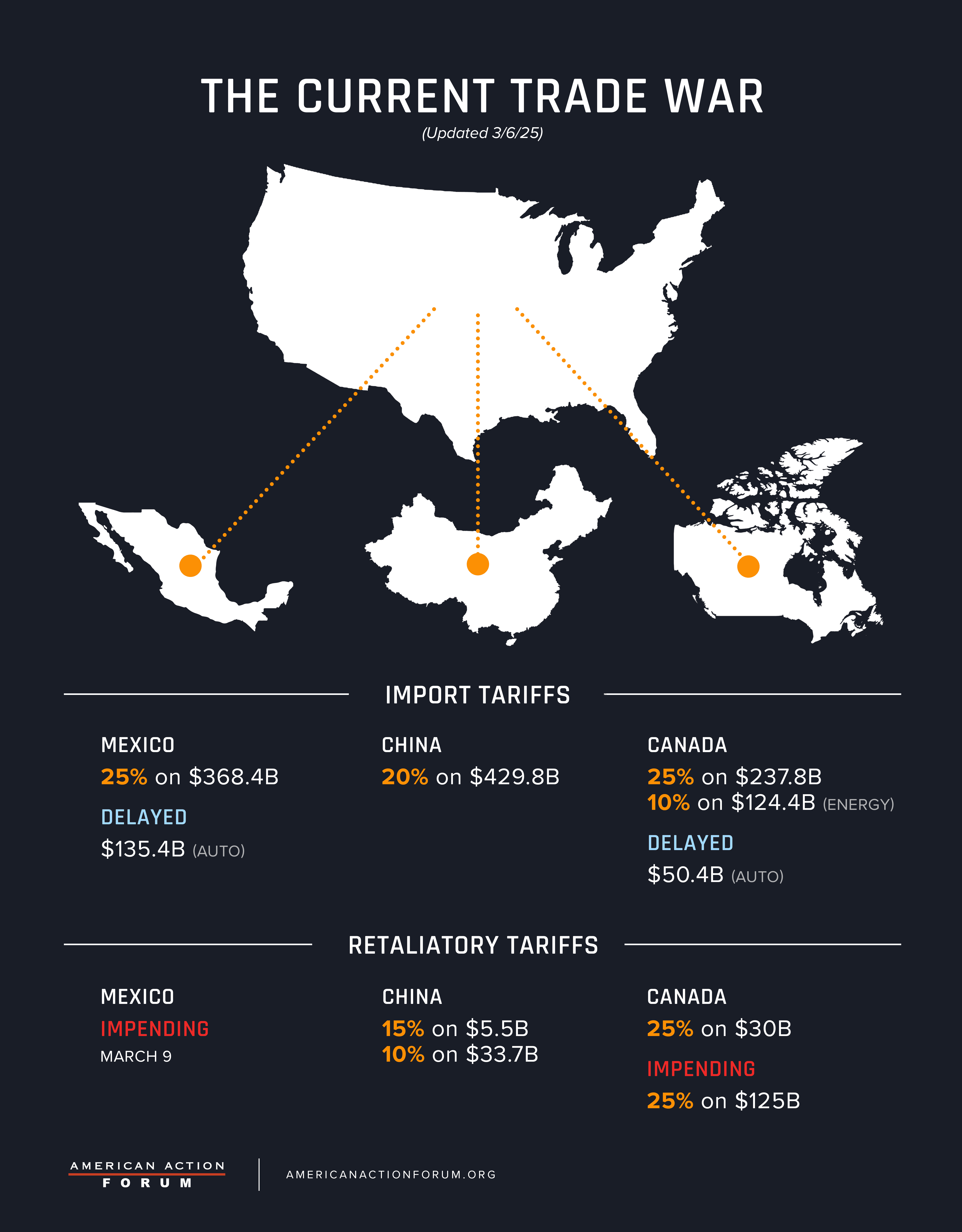
See graphic, below, that lists the tariff actions the United States, China, Canada, and Mexico have taken thus far, as well as the value of impacted goods.
The Tariff Tantrum Toll
What’s Happening: On Tuesday, March 4, President Trump imposed 25-percent tariffs on most imports from Mexico and Canada, as well as an additional 10-percent tariff on all imports from China, sparking a global trade war. Canadian energy will face a 10-percent tariff, and in response the premier of Ontario has threatened to halt all energy exports to the United States or impose a 25-percent export tariff, raising the cost of energy that Canada sends to Minnesota, Michigan, and New York. Canada has already put into effect retaliatory tariffs on $30 billion worth of U.S. goods, with an additional $125 billion scheduled to hit in three weeks. China announced additional tariffs on U.S. agricultural products of 10–15 percent beginning March 10, and has directly targeted U.S. companies with export controls. As of Thursday afternoon, Mexico was able to obtain exemptions on nearly all of its exports to the United States after a discussion with Trump delayed tariffs until April 2. It is unclear what the Trump Administration is looking to gain specifically from each of these countries or whether negotiations are ongoing. Department of Commerce Secretary Howard Lutnick, however, stated on CNBC this morning that the number of fentanyl deaths in the United States may be used as a metric for determining when tariffs are removed.
Why It Matters: Last year, Mexico, Canada, and China made up over 40 percent of both U.S. imports and exports, with nearly $41 billion worth of imports coming entirely from these trade partners. On March 5, the White House confirmed that tariffs on auto imports from Canada and Mexico would be delayed one month, lowering the total amount of imports subject to tariffs. If tariffs were to hit each of these countries while factoring in auto exemptions, the total annual cost to U.S. consumers and business may be between $125 billion and $240 billion, representing one of the largest tax hikes in U.S. history. If tariffs end up applying to auto imports, annual costs will increase to between $150 billion and $300 billion, according to the Shipment’s calculations. The economic damage does not stop there. Businesses and workers reliant on exports, specifically agricultural goods, will also feel the heat as both China and Canada have announced retaliatory tariffs. As mentioned earlier, Canada has targeted $30 billion worth of U.S. poultry, dairy, grains, and hundreds of other goods with 25-percent tariffs. Meanwhile, China has placed tariffs of 15 percent on close to $3 billion in chicken, wheat, corn, and cotton, as well as 10 percent tariffs on about $19 billion in soybeans, pork, beef, and other agricultural products. China’s reaction also includes the addition of 10 U.S. companies to its unreliable entity list and 15 U.S. companies to its export control list. All told, China has instituted tariffs against close to $40 billion in U.S. exports, which is far less than the trade war during Trump’s first term but more targeted in scope.
Looking Ahead: Prime Minister Trudeau spoke with President Trump this week to discuss the progress along Canada’s border – one Trump demand is for Canada to reduce the amount of fentanyl that flows from Canada to the United States, although the true number is frankly miniscule – with the president concluding that the Canadians’ efforts were “not good enough.” There have been no reported discussions between China and the United States on this front. The exclusion of most Mexican imports from tariffs will provide some relief to U.S. businesses and consumers and it means that any retaliation is also on pause. This game of tariff chicken appears to have resulted in a head-on collision, jeopardizing the health of the global economy the longer tariffs and uncertainty remain.
Tariffs Implemented:
February 4: 10-percent tariff on all imports from China.
March 4: 25-percent tariffs on all imports from Mexico and Canada alongside an additional 10-percent tariff on all imports from China.
March 5: Auto imports from Mexico and Canada are excluded from 25-percent tariffs for one month.
Upcoming Tariffs:
March 12: 25-percent tariffs on steel and aluminum may take effect.
April 1: Target date for USTR trade policy review and recommendations.
April 2: Reciprocal tariffs on many or all countries may take effect.
April 2–4: Auto imports from Mexico and Canada may be subject to 25-percent tariffs.
Unspecified Date: Various tariffs on pharmaceuticals, semiconductors, automobiles, copper, and the EU and BRICS countries.
Graphic Explanation
These charts display the value of U.S. imports from and exports to Mexico and Canada by how reliant the United States is on those countries. For example, 92 different U.S. imports valued at $9.5 billion are sourced 100 percent from Mexico. Additionally, 190 U.S. imports worth nearly $38.5 billion are sourced between 90—99 percent from Mexico. Furthermore, 75 U.S. exports valued at $900 million are 100 percent exported to Mexico. This analysis used 2023 Dataweb import and export data with 10-digit HTS codes.